
Evidence reviewed: 7 August 2026
Author: ExtolX Editorial Team
This is an educational overview of published research, not medical advice.
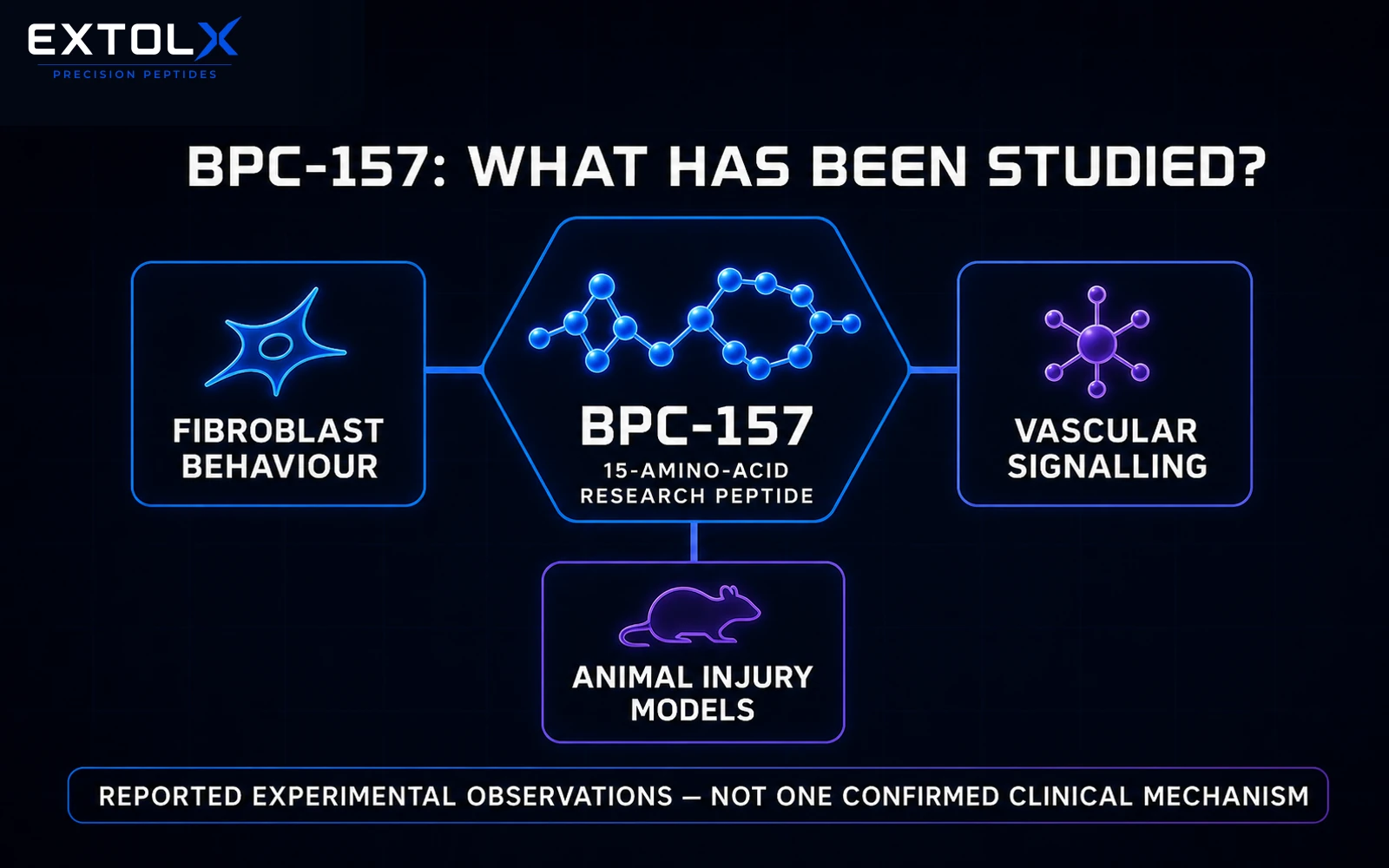
BPC-157 is a synthetic 15-amino-acid research peptide. Most evidence comes from cells, tissues and animal injury models, while published human research remains small, exploratory and unable to establish a medical benefit.
The short version
- BPC-157 is a laboratory-made peptide containing 15 amino acids.
- Studies have examined how it affects cell movement, blood-vessel signals and responses to deliberately created injuries in animals.
- These experiments suggest several possible biological pathways, but they do not establish one confirmed explanation for the wide range of claims made online.
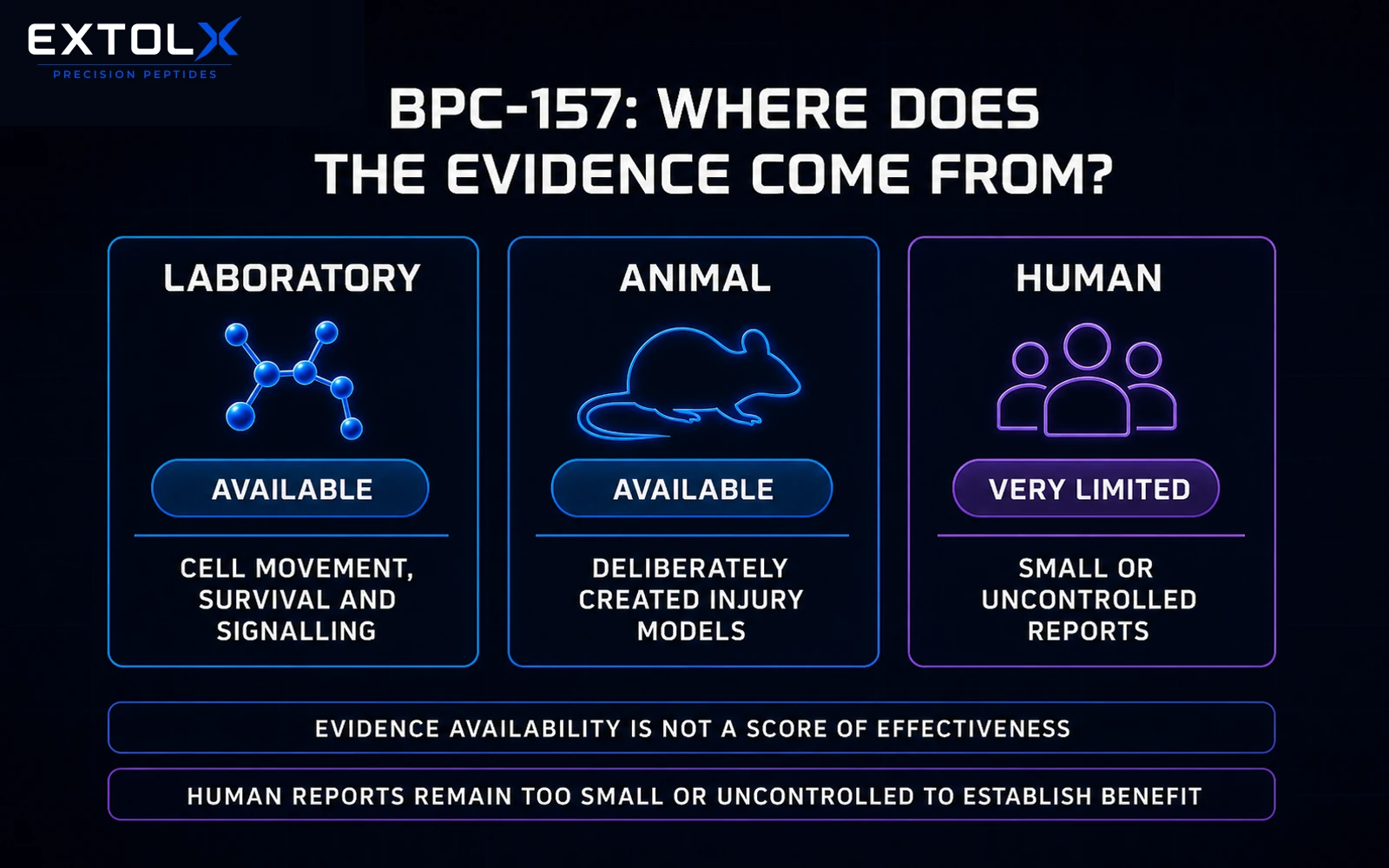
- Human evidence is very limited and consists of small or uncontrolled reports and a two-person safety pilot.
- BPC-157 is not an approved medicine, and the 2026 WADA Prohibited List bans it in sport.
What is BPC-157?
BPC-157 is a chain of 15 amino acids with the sequence GEPPPGKPADDAGLV. Scientific papers describe it as part of a sequence associated with a gastric “body protection compound”. However, the original material and its early development history are not documented publicly as clearly as they would be for an approved medicine.
The important point is that BPC-157 itself is a synthetic research peptide. Calling it “natural” or saying that the human body produces the finished 15-amino-acid peptide can give a misleading impression of what has actually been demonstrated.
Why are researchers interested?
Interest grew from animal experiments that reported changes after deliberately created injuries. Studies have covered tendons, muscles, nerves, blood vessels and the digestive system.
That breadth creates a problem. Results from very different experiments are often grouped together as if they proved one broad “healing” effect. They do not.
Researchers have proposed several possible pathways, including:
- Survival and movement of cells that help organise connective tissue
- Signals involved in how cells attach to and move across a surface
- Nitric-oxide-related effects on blood vessels
- Signals involved in forming new blood vessels
- Cell responses to chemical or inflammatory stress
These are experimental observations, not a settled clinical mechanism. The pathway reported in one cell type may not explain a result in another tissue or animal model.
What has research found so far?
Laboratory and tissue research
A frequently cited study used pieces of rat tendon kept alive outside the body and tendon cells grown in the laboratory. BPC-157 was linked with more cells moving out from the tissue, better cell survival under chemical stress and increased cell movement. It did not directly increase cell multiplication in that experiment.
This difference is useful. Cell movement, cell survival and cell multiplication are not the same measurement. A study reporting one should not be rewritten as proof of all three.
Animal research
Most of the BPC-157 literature uses rodents. Experiments have reported outcomes in tendon, ligament, muscle, nerve, bone, vascular and gastrointestinal models. Animal studies can help researchers choose possible mechanisms and endpoints for later work.
They also have major limits. Experimental injuries are deliberately created and treated under controlled conditions. Species, anatomy, timing and outcome measures may differ greatly from a real human condition. Positive findings therefore need independent replication and properly designed clinical trials.
Human evidence
Published human evidence remains very small. It includes retrospective or pilot reports without the controls needed to determine whether BPC-157 caused an outcome. A 2025 intravenous safety paper included only two participants who had both previously received the peptide.
A 2026 review identified fewer than 30 participants across three published human studies. This is far below the evidence normally needed to establish whether a treatment works. It is also too little to show how responses change with exposure, how long the substance remains in the body or whether it causes uncommon risks.
Why the evidence gap matters
A substance can produce an interesting result in a cell dish and still fail as a medicine. Researchers must learn how it enters, moves through and leaves the body. They also need to know how much reaches the target tissue, whether impurities or clumps trigger immune reactions and whether any intended effect outweighs unwanted effects.
In its July 2026 review of BPC-157-related bulk substances for pharmacy compounding, the US FDA highlighted short studies, small sample sizes, exploratory doses and gaps in product characterisation. The agency also discussed possible immunogenicity and peptide-related impurity risks. This review concerned US compounding policy, but the scientific gaps it describes are relevant when assessing the evidence more broadly.
In plain English, the available studies were too small and short, and there was not enough certainty about the tested products or their possible effects on the immune system.
What remains unknown?
- How does BPC-157 enter, move through and leave the human body?
- Which results from cell and animal studies can independent groups repeat?
- Does changing the amount tested produce a consistent change in any defined outcome?
- What are the risks of repeated or long-term exposure?
- How do free-base, acetate and differently formulated materials compare?
- Can any proposed clinical use succeed in a randomised controlled trial?
Regulatory and anti-doping context
BPC-157 is not an approved medicine. In the United States, FDA reviews have raised unresolved characterisation and safety concerns for compounded preparations. In sport, WADA lists BPC-157 under its class of non-approved substances, prohibited at all times.
A “research use only” label does not create evidence of safety or effectiveness and must not be treated as permission for personal use.
What could better research look like?
The normal development path would begin with consistently manufactured material whose identity, purity and stability have been confirmed. Researchers would also need reliable ways to measure it in biological samples. Formal laboratory safety and behaviour studies would come before human studies large enough to produce dependable results.
Only then could randomised trials test one defined use with an outcome chosen in advance, a suitable comparison group and transparent safety reporting. This step-by-step approach is slower than collecting many animal findings. It is also how researchers learn whether an experimental result becomes dependable human evidence.
Plain-English glossary
- Fibroblast: A cell involved in producing and organising connective-tissue material.
- Preclinical: Research performed before adequate human clinical testing, usually in cells or animals.
- Pharmacokinetics: How a substance moves into, through and out of the body.
- Immunogenicity: The ability of a substance to trigger an immune response.
- Randomised controlled trial: A study that assigns participants to comparison groups by chance.
Explore BPC-157 research material
The ExtolX BPC-157 10MG research material is listed with a stated purity of at least 99%. A supplier-issued Certificate of Analysis is available to request from the product page.
Published studies use their own defined experimental materials. Independently supplied laboratory material is not established as equivalent to the material used in any animal experiment, pilot report or development programme.
References and further reading
- Tendon-explant and fibroblast study — PubMed
- Review of preclinical musculoskeletal research — PubMed
- Two-participant intravenous safety pilot — PubMed
- 2026 review of translational and formulation barriers — PubMed
- FDA 2026 advisory-committee evidence review
- 2026 WADA Prohibited List
Research-use notice: ExtolX materials are supplied for laboratory research only and are not for human or veterinary use.