
Evidence reviewed: 25 August 2026
Author: ExtolX Editorial Team
This is an educational guide for laboratory research audiences. It does not provide medical advice, dosage or administration guidance.
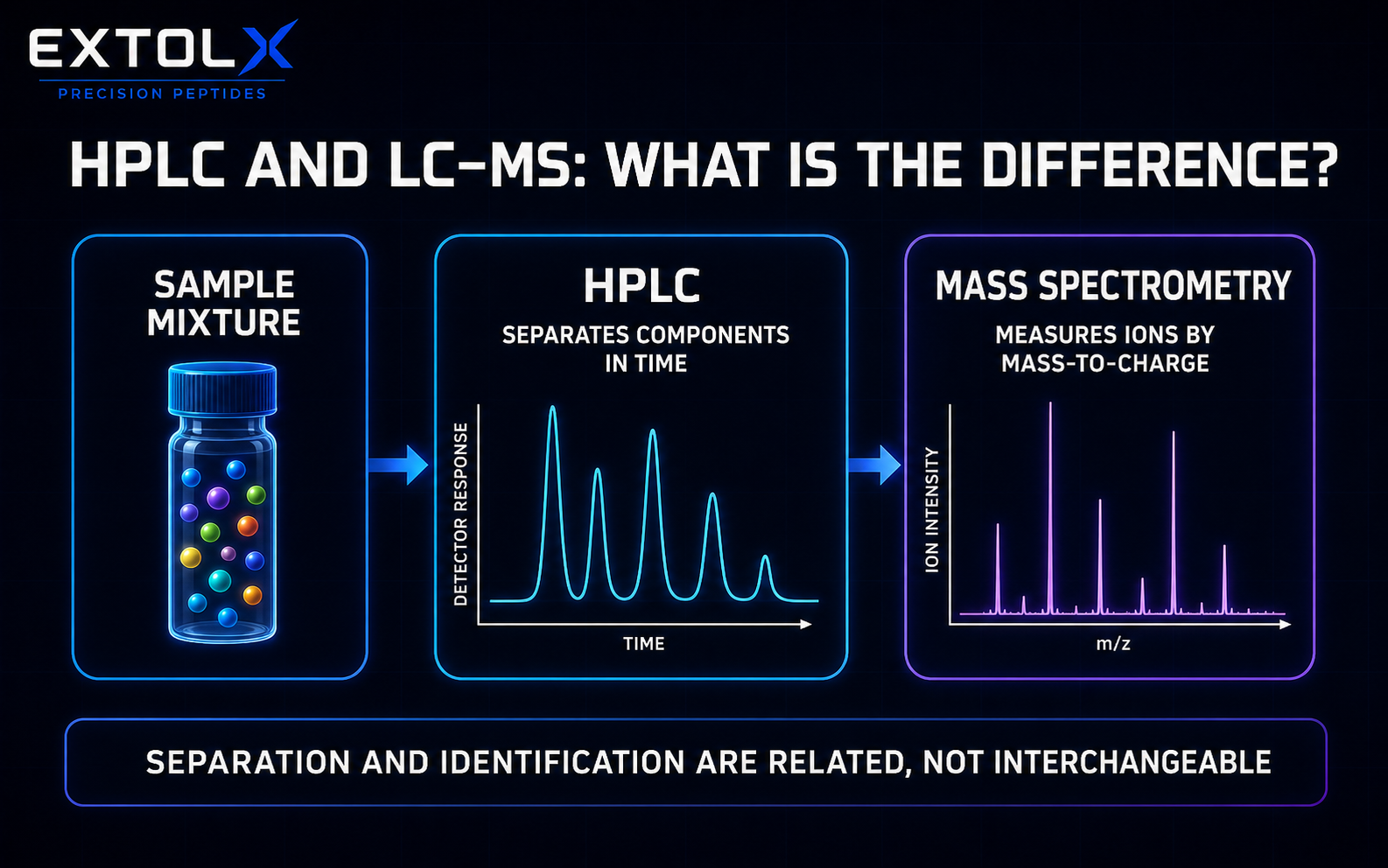
HPLC and LC–MS are often presented as competing tests. That is misleading. HPLC is a way of separating a mixture, while LC–MS connects liquid chromatography to a mass spectrometer so separated components can be examined by their mass-to-charge signals.
The practical question is not “Which acronym is better?” It is “What did this exact method measure, and is that enough to support the claim being made?”
The short version
- HPLC separates components because they move through a column at different rates.
- A detector records the separated components as peaks over time.
- HPLC with ultraviolet detection can estimate chromatographic purity under the stated method, but peak area is not automatically total mass or peptide content.
- LC–MS adds mass-spectrometry data by measuring ions according to mass-to-charge ratio.
- An expected mass can support identity, but mass alone may not distinguish every closely related structure or sequence.
- Retention time, accurate mass and fragmentation data are stronger when supported by suitable references and other methods.
- Neither HPLC nor LC–MS establishes sterility, endotoxin status, biological activity, clinical effectiveness or pharmaceutical equivalence.
- The result is only as reliable as the sampling, method development, validation and technical review behind it.
On This Page
- The short version
- What does HPLC actually do?
- What does an ultraviolet detector measure?
- What does mass spectrometry add?
- Why are HPLC and LC–MS not true opposites?
- Can retention time prove identity?
- Can an expected mass prove the complete peptide sequence?
- What can interfere with LC–MS results?
- What does a “99% HPLC” result not prove?
- What should an analytical report include?
- Does analytical testing establish animal or human outcomes?
- Where do interpretation mistakes happen?
- What would stronger peptide testing look like?
- Plain-English glossary
- How this applies to ExtolX research materials
- References and further reading
What does HPLC actually do?
HPLC stands for high-performance liquid chromatography. In plain English, it pushes a liquid sample through a packed column under pressure. Different components interact with the liquid and the column in different ways, so they leave the column at different times.
The time taken for a component to reach the detector is called its retention time. The detector response is plotted as a chromatogram, where each peak represents a signal recorded during the run.
HPLC is the separation stage, not one single test format. Columns, mobile phases, gradients, temperatures and detectors can all differ. A method should therefore be described rather than reduced to the word “HPLC”.
What does an ultraviolet detector measure?
Many peptide HPLC methods use an ultraviolet, or UV, detector. It measures how strongly material leaving the column absorbs light at a chosen wavelength.
The area under a peak reflects detector response, not a direct count of molecules. Different substances may absorb differently, and some components may produce little or no signal at the selected wavelength.
This is why a main-peak area percentage is method-specific. It can be useful for comparing detected peaks under controlled conditions, but it should not be described automatically as total vial content or absolute mass purity.
What does mass spectrometry add?
Mass spectrometry turns molecules into charged particles called ions and measures them by their mass-to-charge ratio, written as m/z.
For a peptide, the pattern of charged forms can be used to calculate a molecular mass and compare it with the expected material. High-resolution instruments can make that comparison more precise.
In tandem mass spectrometry, written as MS/MS, selected ions are broken into fragments. The fragment pattern can provide additional structural or sequence information. This is often more informative than one intact-mass value.
Why are HPLC and LC–MS not true opposites?
LC–MS means liquid chromatography–mass spectrometry. The sample is first separated by liquid chromatography and then analysed by a mass spectrometer.
In other words, LC–MS uses chromatography too. The comparison usually intended is HPLC with a conventional detector, such as UV, versus liquid chromatography coupled to mass detection.
The techniques answer related questions. Chromatography asks whether components can be separated under the method. Mass spectrometry asks what mass-to-charge signals are associated with the detected ions. Combining them can connect a chromatographic peak with mass information.
Can retention time prove identity?
Retention time can support identity when the sample is compared with a suitable reference under controlled conditions. It is rarely enough on its own for a confident peptide identification.
Closely related peptides, impurities or breakdown products may have similar retention behaviour. ICH Q2(R2) therefore emphasises specificity: the method should distinguish the target from components that could reasonably be present.
Where one technique cannot provide enough distinction, independent analytical approaches can be combined. These are often called orthogonal methods.
Can an expected mass prove the complete peptide sequence?
Not always. A matching intact mass is useful evidence, but different sequences or modifications can sometimes produce the same or very similar overall mass.
Fragmentation data, sequence analysis, reference comparison and other structural methods may be needed to distinguish alternatives. The amount of evidence required depends on the risk of confusion and the claim being made.
What can interfere with LC–MS results?
A mass spectrometer only detects material that reaches the instrument and forms measurable ions. Salts, solvents, other sample components and the way the source is operated can change ion formation.
Ion suppression occurs when other components reduce the signal from the target. Adducts can create additional ion forms, while in-source fragmentation can create signals that need careful interpretation. Method controls and suitable references are therefore essential.
What does a “99% HPLC” result not prove?
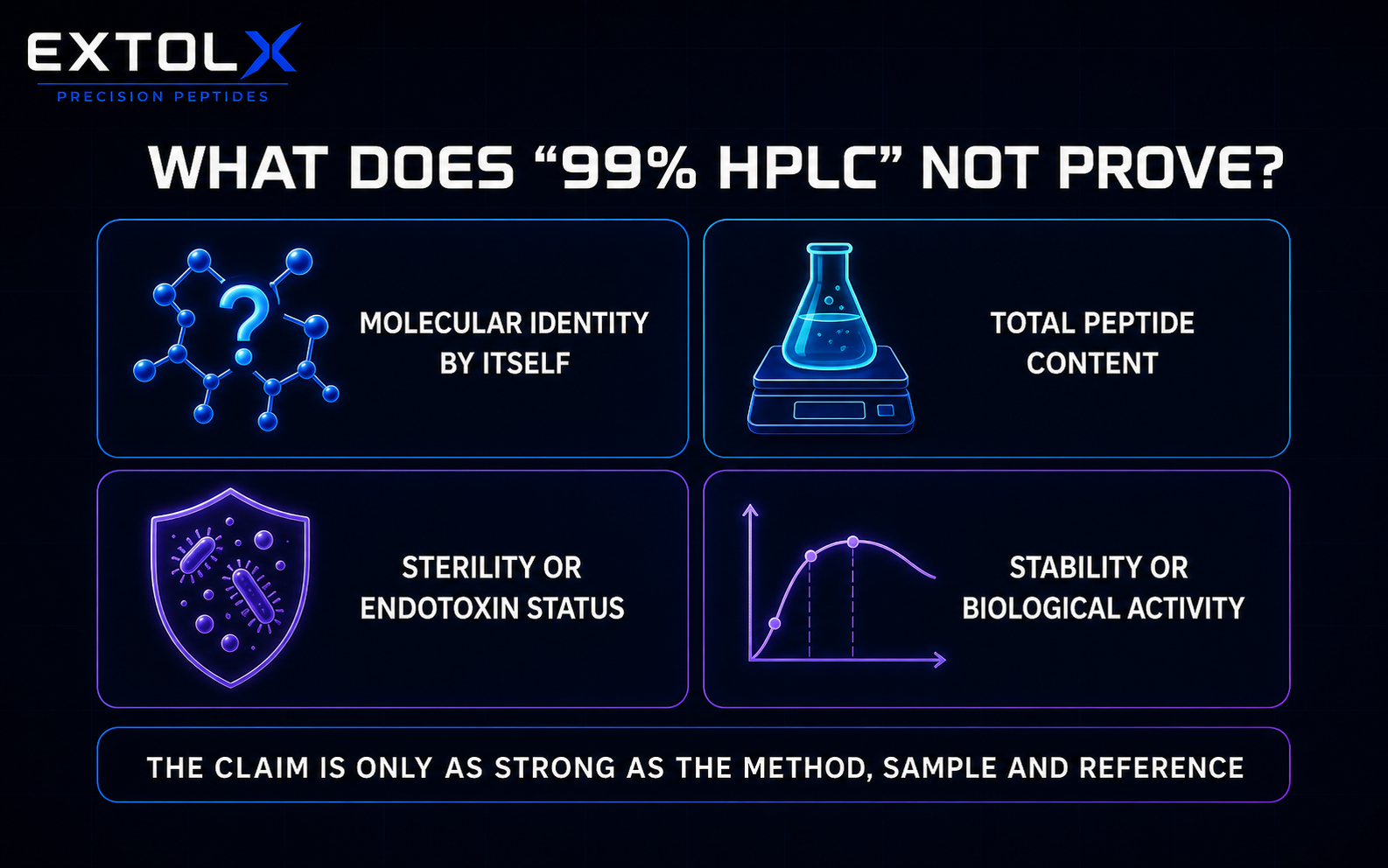
- Molecular identity by itself: a main peak needs suitable identity evidence.
- Total peptide content: area percentage is not automatically the amount of peptide in the vial.
- A complete impurity profile: undetected, co-eluting or poorly responding components may be missed.
- Sterility: chemical separation is not a sterility test.
- Endotoxin status: bacterial endotoxin requires a separate suitable method.
- Stability: one result does not show how the sample changes across time or storage conditions.
- Biological activity: analytical similarity does not establish a functional response.
- Clinical equivalence: matching a name, retention time or mass does not reproduce a regulated product’s complete evidence package.
What should an analytical report include?
The practical point is that the result should be reviewable. A headline percentage without method context leaves important questions unanswered.
- Material name, sample identifier and batch or lot number.
- Sample preparation and the quantity or concentration tested.
- Column, mobile phases, gradient, flow, temperature and run time.
- Detector type and wavelength for HPLC–UV.
- Mass analyser, ionisation mode, mass range and relevant MS/MS settings for LC–MS.
- Reference materials and calibration approach.
- System-suitability criteria showing that the method performed as expected.
- Chromatograms, spectra, integration approach and actual numerical results.
- Method validation or fit-for-purpose evidence relevant to the claim.
Does analytical testing establish animal or human outcomes?
No. HPLC and LC–MS are laboratory tools. They can provide evidence about separation, identity, quantity or impurities when suitable methods are used. They do not establish what a material does in an animal or a person.
Biological activity requires a suitable functional assay. Safety and effectiveness require their own evidence. Results from one level should not be presented as proof at another.
Where do interpretation mistakes happen?
- HPLC to one universal method: different columns, gradients and detectors can produce different results.
- Peak to molecule: a detector peak is a signal, not an identity label.
- Area percentage to mass percentage: detector response and unmeasured material break that shortcut.
- Expected mass to full structure: closely related structures may need fragmentation or other evidence.
- LC–MS signal to absence: a weak or missing ion can reflect ionisation and matrix effects, not only absence of material.
- One batch to ongoing quality: a single test does not establish future consistency or stability.
- Analytical result to clinical claim: chemical measurements do not establish a health outcome.
What would stronger peptide testing look like?
- Define the analytical question before choosing the technology.
- Use a separation method capable of resolving relevant impurities and variants.
- Support identity with accurate mass, suitable fragmentation or another structurally informative method.
- Use qualified reference material where appropriate.
- Validate specificity, accuracy, precision, range and robustness for the intended purpose.
- Use a separate quantitative assay when total content matters.
- Investigate co-eluting peaks, unexpected masses and inconsistent results.
- Include stability-indicating work when storage or degradation claims are made.
Plain-English glossary
- Chromatography: a way of separating components in a mixture.
- Retention time: the time a component takes to pass through the chromatography system and reach the detector.
- Chromatogram: the plot of detector response against time.
- Peak area: the integrated detector signal recorded for a chromatographic peak.
- Mass-to-charge ratio: the measured mass of an ion divided by its electrical charge, written m/z.
- Ionisation: the process of giving molecules an electrical charge so a mass spectrometer can measure them.
- MS/MS: tandem mass spectrometry, where selected ions are fragmented to obtain more structural information.
- Orthogonal methods: different techniques used together because they provide independent evidence.
- System suitability: checks showing that the analytical system is performing adequately before results are accepted.
How this applies to ExtolX research materials
When an ExtolX product page links to analytical documentation, readers should match the report to the relevant batch and interpret HPLC, mass or other results within the stated method.
Analytical documentation supports research-material evaluation. It does not establish clinical equivalence, personal-use suitability or a human outcome.
References and further reading
- Liquid Chromatography: Introduction and Instrumentation — NIST
- Mass Spectrometry Instrument Laboratory and LC–MS overview — NIST
- Validation of Analytical Procedures Q2(R2) — ICH
- Analytical Procedure Development Q14 — ICH
- 2026 update on peptide product-specific guidances and analytical expectations — FDA
- Liquid chromatography–high-resolution mass spectrometry for peptide drug quality control — FDA staff publication record
- ExtolX Research Use Policy
Research-use notice: ExtolX materials are supplied strictly for legitimate laboratory research. They are not intended for human or veterinary use, consumption, diagnosis, treatment or prevention of disease.