
Evidence reviewed: 7 August 2026
Author: ExtolX Editorial Team
This is an educational overview of published research, not medical advice.
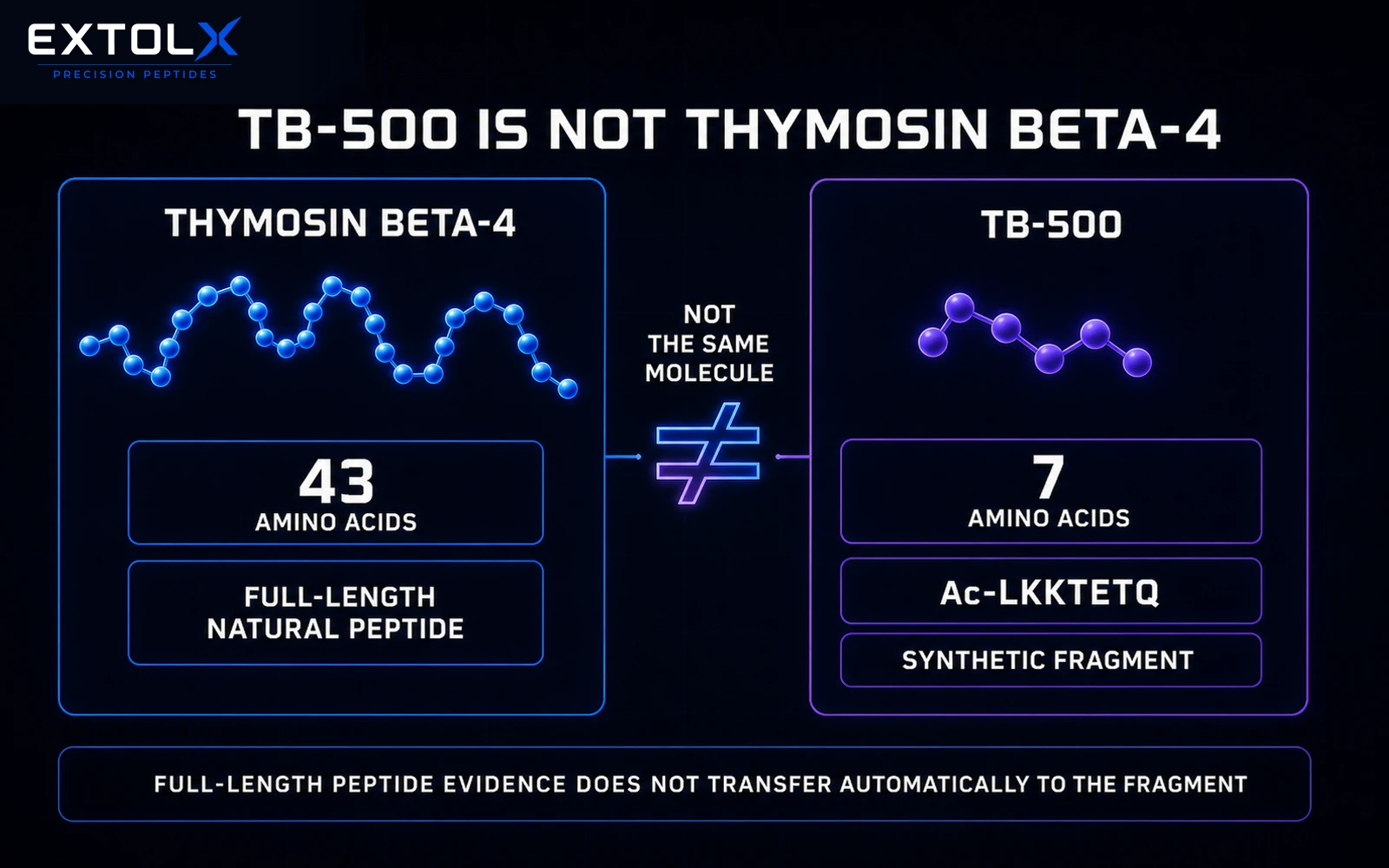
TB-500 and thymosin beta-4 are related names, but they do not describe the same molecule. Full-length thymosin beta-4 contains 43 amino acids; material characterised as TB-500 is a synthetic seven-amino-acid fragment. Evidence must be matched to the exact sequence studied.
The short version
- Thymosin beta-4, or Tβ4, is a naturally occurring peptide made from 43 amino acids.
- Analytical research identified TB-500 as a seven-amino-acid fragment called Ac-LKKTETQ, with a small chemical addition at one end.
- The fragment matches amino acids 17–23 within full-length Tβ4.
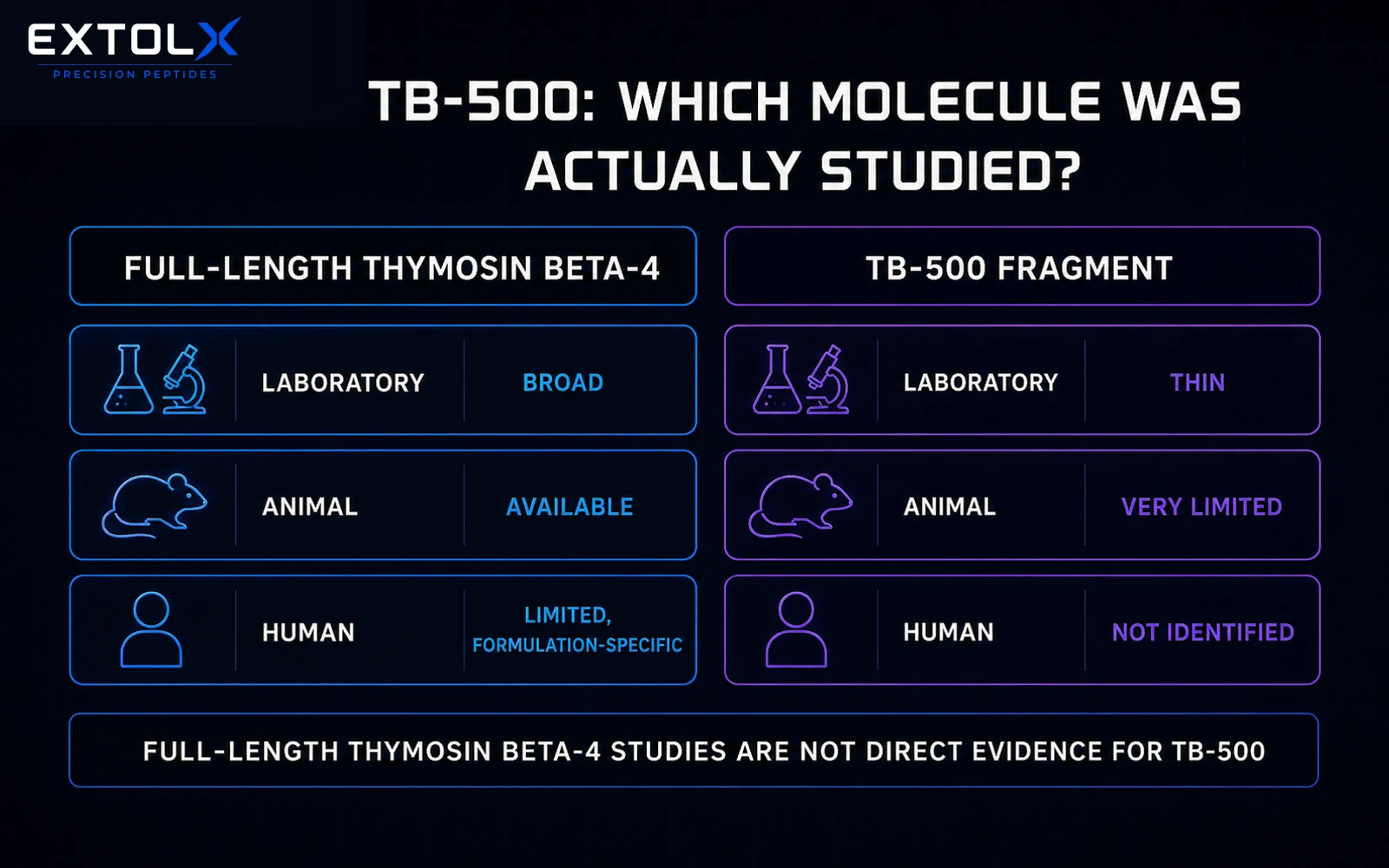
- Tβ4 has a broad laboratory and animal literature, plus limited human research on specific formulations.
- Direct evidence for the TB-500 fragment is much thinner, and FDA’s 2026 review identified no human exposure data for the fragment.
What is thymosin beta-4?
Thymosin beta-4 is a small natural peptide found in many cell types. It contains 43 amino acids and interacts with actin, a protein that works like part of a cell’s internal framework. Actin helps cells keep their shape and move.
Cells build actin into longer fibres when needed and break those fibres back into individual units. Full-length Tβ4 can bind some of the individual units and help control how many remain available for new fibres. Because this system affects cell shape and movement, researchers have studied Tβ4 in laboratory models of cell migration and tissue organisation.
What is TB-500?
TB-500 is a commercial and anti-doping name used for a shorter synthetic peptide. Laboratory analysis identified it as the sequence Ac-LKKTETQ. It matches amino acids 17–23 of thymosin beta-4 and has an acetyl group added at one end.
That makes TB-500 related to Tβ4, but not interchangeable with it. A seven-amino-acid fragment has a different size, shape, stability and set of possible interactions from the full 43-amino-acid peptide.
The LKKTETQ sequence forms part of the area that helps full-length Tβ4 interact with actin. That does not mean the short fragment can reproduce everything the complete peptide does. The surrounding parts of a molecule can change its shape, stability and interactions.
Why the distinction matters
Much online discussion starts with a Tβ4 study and ends with a claim about TB-500. That moves evidence from one molecule to a different one without direct testing. Before using a paper to support a statement about TB-500, researchers should ask:
- Was the tested material full-length Tβ4 or a shorter fragment?
- What was the exact amino-acid sequence?
- Was an acetyl group added at one end?
- Was the material a free base, salt or finished formulation?
- Was the experiment performed in cells, animals or people?
If a paper does not test the same molecule, it can provide background biology but not direct evidence for TB-500.
What has research found so far?
Full-length thymosin beta-4
Laboratory research shows that full-length Tβ4 interacts with actin and helps regulate the balance between individual actin units and longer fibres. Cell studies have also examined movement, attachment to surrounding surfaces and enzymes involved in reorganising the material around cells.
Animal research includes models involving the eye surface, skin, heart and blood vessels, and other tissue responses. These studies test the complete peptide or a named pharmaceutical preparation under defined conditions.
Limited human work has investigated particular full-length Tβ4 preparations. One small report described nine people who received sterile Tβ4 eye drops for long-lasting damage to the surface of the eye. That report is evidence about the specific eye-drop preparation—not about the seven-amino-acid TB-500 fragment.
The TB-500 fragment
Direct research on the TB-500 fragment is much smaller. Early papers focused on identifying its sequence in seized or commercial material and developing anti-doping detection methods. Some biological research on the fragment exists, but it is far less developed than the literature on full-length Tβ4.
In a 2026 evidence review, the US FDA reported that it had not identified human exposure data for drug products containing the Tβ4 fragment known as TB-500. It also highlighted gaps in characterisation and possible risks from aggregation, impurities and immune responses for proposed compounded preparations.
In plain English, the agency found no human exposure evidence for the fragment and raised questions about product identity, clumping, impurities and immune reactions.
Common mistakes when reading the evidence
- Calling TB-500 full-length Tβ4: the identified fragment is seven amino acids, not 43.
- Using a Tβ4 clinical study as TB-500 evidence: the molecule and formulation are different.
- Assuming one actin-binding section guarantees the same activity: biological behaviour depends on the whole molecule and the experimental conditions.
- Treating a product name as proof of identity: laboratory testing must confirm the sequence, chemical changes, purity and salt form.
- Combining all “healing” measurements: cell movement, inflammation, tissue closure and clinical recovery are different outcomes.
What remains unknown?
- Which biological activities are retained by the isolated Ac-LKKTETQ fragment?
- How stable is the fragment in different experimental formulations?
- How does it enter, move through and leave a biological system, and what does it break down into?
- Can independent groups reproduce effects linked specifically to the fragment?
- What are the short- and long-term safety findings for material whose identity and purity have been confirmed?
- Can any proposed use be supported by controlled human research?
Regulatory and anti-doping context
TB-500 is not an approved medicine. The FDA’s July 2026 briefing recommended against adding the reviewed TB-500 free-base and acetate substances to the US 503A pharmacy-compounding bulk list, although advisory and policy processes can continue to evolve.
For athletes, the position is clear: the 2026 WADA Prohibited List bans thymosin beta-4 and its derivatives, including TB-500, at all times.
What could better research look like?
Useful studies should compare the full 43-amino-acid peptide, the Ac-LKKTETQ fragment and suitable controls in the same system. Laboratory analysis should confirm the identity of each material, with purity, salt form, concentration and stability reported.
Early work could test binding, cell movement and clearly defined biological signals. Animal experiments should follow only if independent studies can repeat effects linked specifically to the fragment and suitable safety evidence is available. Human research would require a consistently manufactured product, formal safety testing, an understanding of how it moves through the body and regulatory oversight.
Plain-English glossary
- Actin: A protein that helps cells keep their shape and move.
- Fragment: A shorter piece of a larger peptide or protein sequence.
- Acetylated: Chemically modified with an acetyl group at one end of the peptide.
- Sequence: The exact order of amino acids in a peptide.
- Evidence transfer: Applying results from one molecule, model or formulation to a different one without direct testing.
Explore TB-500 research material
The ExtolX TB-500 10MG research material is listed with a stated purity of at least 99%. A supplier-issued Certificate of Analysis is available to request from the product page.
Researchers should verify the stated sequence and analytical documentation. Evidence concerning full-length Tβ4 or another formulation does not establish equivalence with independently supplied TB-500 material.
References and further reading
- Synthesis and characterisation of the TB-500 fragment — PubMed
- Anti-doping analysis of TB-500 — PubMed
- Structure and actin binding of full-length thymosin beta-4 — PubMed
- Full-length Tβ4 and endothelial-cell migration — PubMed
- Small human report using full-length Tβ4 eye drops — PubMed
- FDA 2026 TB-500 evidence review and meeting materials
- 2026 WADA Prohibited List
Research-use notice: ExtolX materials are supplied for laboratory research only and are not for human or veterinary use.