
Evidence reviewed: 7 August 2026
Author: ExtolX Editorial Team
This is an educational overview of published research, not medical advice.
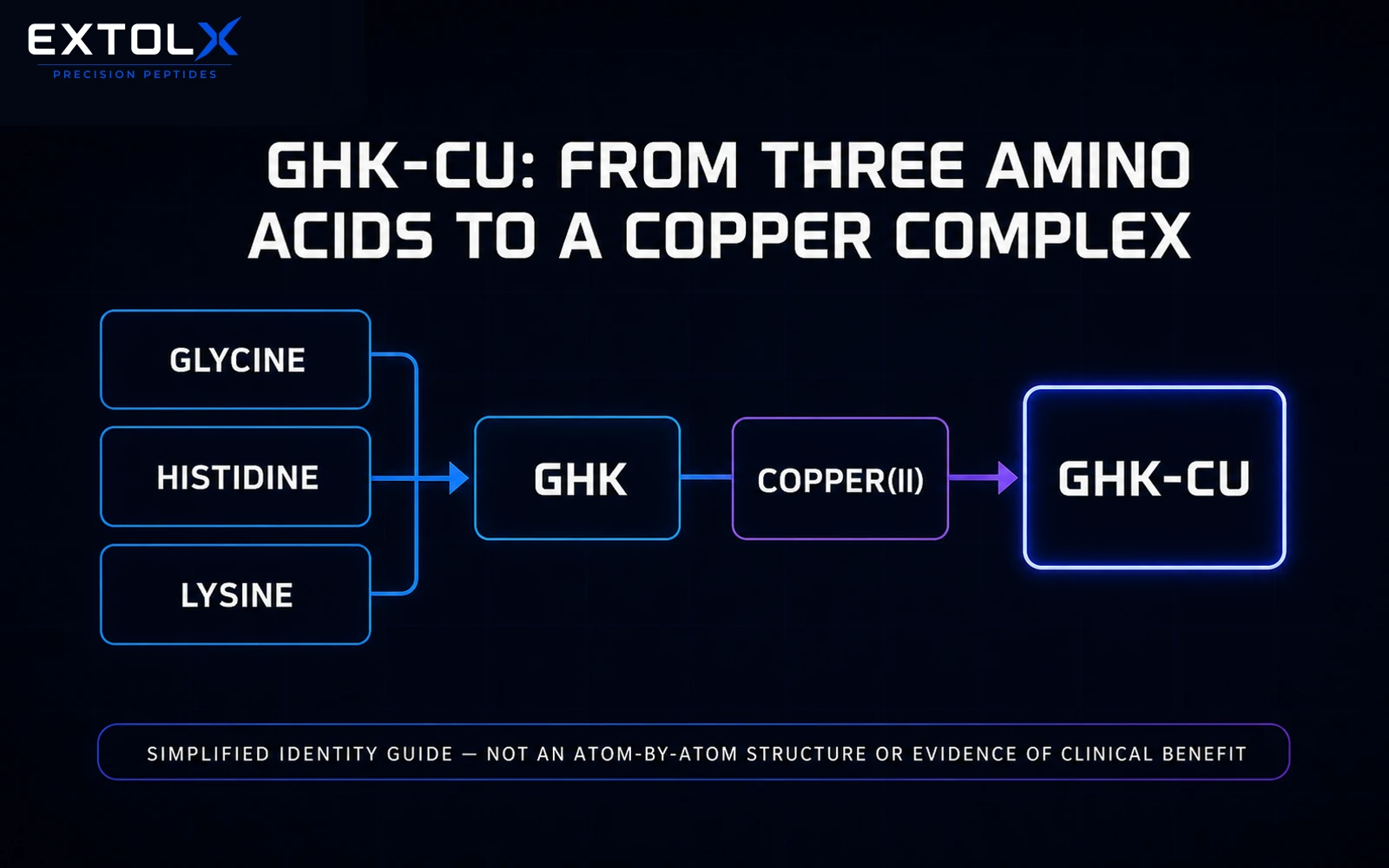
GHK-Cu is a small peptide joined to copper. Researchers have mainly studied it in cells and tissues, particularly in relation to collagen and the supporting material around cells. Human evidence is limited and applies only to the specific formulations tested.
The short version
- GHK is a peptide made from three amino acids: glycine, histidine and lysine.
- When it binds copper(II), it forms the blue complex commonly called GHK-Cu or copper tripeptide-1.
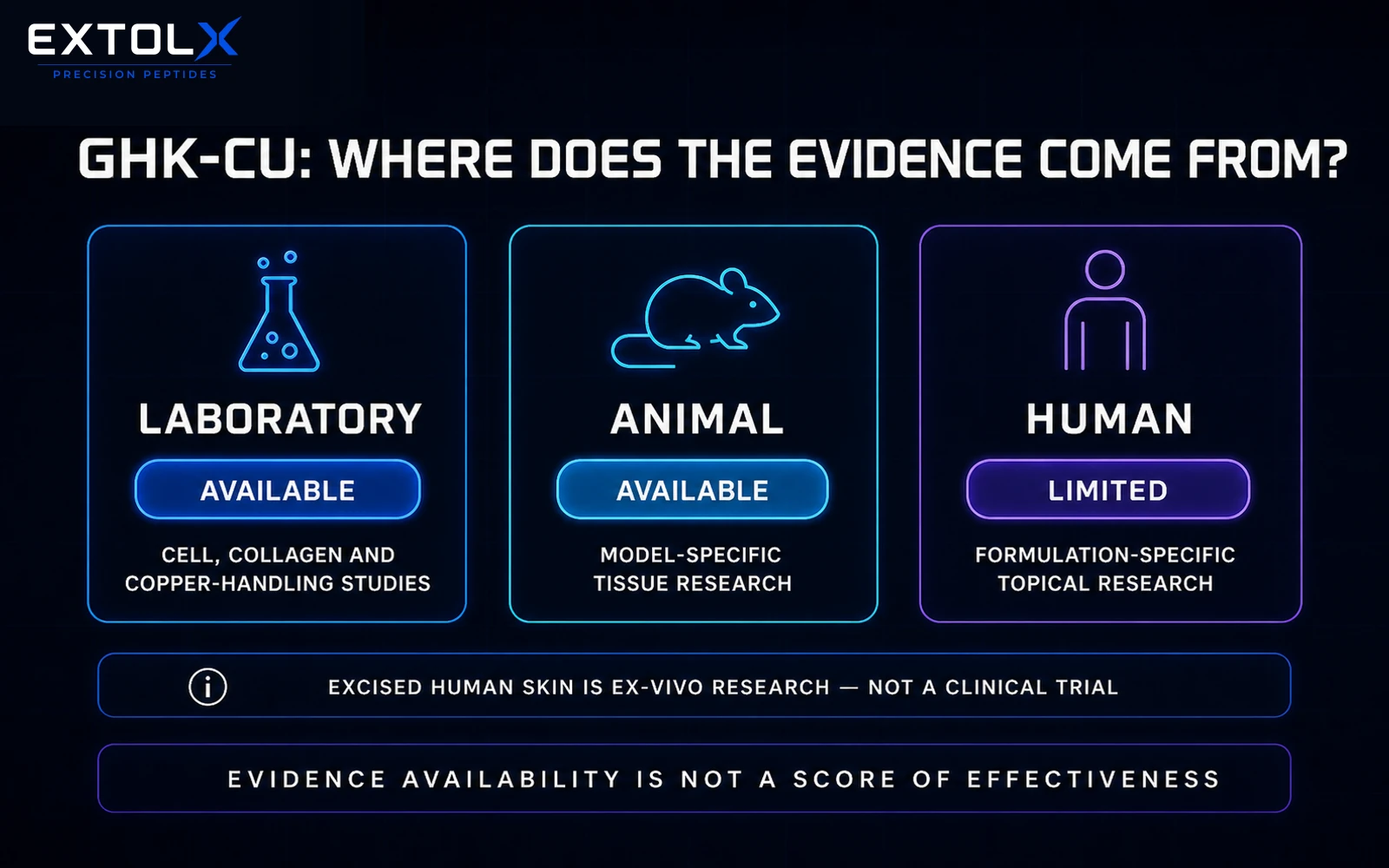
- Laboratory studies have examined collagen, copper handling and the way cells respond to stress.
- Animal evidence exists, but results remain specific to the model, concentration and formulation used.
- Human evidence is limited and mainly concerns particular topical formulations or experiments using removed human skin.
What is GHK-Cu?
A peptide is a short chain of amino acids. GHK contains only three: glycine, histidine and lysine. The histidine part of the peptide can help hold a copper ion, producing the complex known as GHK-Cu.
GHK was first identified in human plasma. It has also been reported in other body fluids, but the amount present naturally is not evidence that an independently manufactured preparation will behave in the same way.
Copper is an essential element used by many enzymes. Joining it to a peptide can change how the metal is carried, how it interacts with other molecules and how researchers measure it. Its behaviour can also change with acidity, concentration, salts and the rest of the formulation. The name “GHK-Cu” therefore does not guarantee identical behaviour in every experiment.
Why are researchers interested?
Much of the interest centres on the material that supports cells. Scientists call this the extracellular matrix. It includes collagen, elastin and other substances that cells continually build, break down and reorganise.
Cell studies have examined whether GHK-Cu changes collagen production and the enzymes that help break down or reorganise the material around cells. Other experiments have looked at responses to cell stress, changes in gene activity and the movement of copper.
These findings do not add up to one confirmed explanation of how GHK-Cu works. A response seen in connective-tissue cells grown in a dish may depend on the cell type, copper source, concentration, exposure time and other parts of the experiment.
What has research found so far?
Laboratory and tissue research
Older experiments using connective-tissue cells reported changes in collagen production after exposure to GHK-Cu. Later work examined MMP-2, an enzyme involved in reorganising the material around cells, together with proteins that control it. These results show that GHK-Cu can affect related signals under controlled laboratory conditions. They do not establish a clinical effect.
Skin-delivery experiments add an important caution. GHK-Cu mixes readily with water, while the outer skin barrier contains a great deal of fat. Studies using model membranes or removed human skin show that penetration depends on the formulation and delivery method. Research on removed tissue is called ex vivo research; it is not a clinical trial in living participants.
Animal research
GHK-Cu has been tested in several animal models involving wounds and tissue organisation. These studies can help researchers explore timing, dose and biological pathways in a whole organism. They cannot establish that the same response will occur in people.
Human evidence
Reviews discuss small studies of specific topical copper-peptide formulations. However, the published human evidence is much thinner than the laboratory literature and is not interchangeable across creams, delivery systems or other preparations.
This distinction matters. Evidence about a finished topical cosmetic cannot establish the safety or effects of an injectable, lyophilised or otherwise different material. Formulation, route, purity and stability are all part of the evidence.
Why formulation changes the answer
The way GHK-Cu is prepared can change the answer. Peptides may break down, stick to surfaces or take different chemical forms depending on their surroundings. One early formulation study found that GHK-Cu mixed readily with water and became less stable under certain alkaline or oxygen-related test conditions. Researchers have therefore studied carrier systems, including tiny fat-based containers called liposomes, as ways to change delivery.
This means two products with the same ingredient name may not be scientifically equivalent. A fair comparison requires the exact peptide sequence, copper content, associated salts, purity, concentration, acidity, storage history and testing method.
What remains unknown?
- Which laboratory findings can be repeated independently across different cell and tissue models?
- Which concentrations are biologically relevant rather than simply active in a dish?
- How do the chemical form of the copper, acidity and formulation change the measured response?
- Which topical findings can be confirmed in larger, well-controlled human studies?
- What safety conclusions, if any, apply beyond the exact formulation and route studied?
What could better research look like?
Useful future work would start with material whose identity and purity have been properly confirmed, with the complete formulation reported. Laboratory studies should include GHK alone, copper alone, GHK-Cu and an untreated control. This would show which part of the system is linked to an observed change.
For human research, larger randomised studies would need to test one defined formulation against a suitable comparison, measure outcomes chosen in advance and report unwanted effects. Results should then be described as evidence for that formulation—not for every material sold under the GHK-Cu name.
Plain-English glossary
- Tripeptide: A peptide made from three amino acids.
- Extracellular matrix: The supporting network around cells.
- Fibroblast: A cell that helps produce and organise connective-tissue material.
- Ex vivo: Research performed on tissue removed from an organism.
- Formulation: The complete way a substance is prepared, including its other ingredients and physical form.
Explore GHK-Cu research material
The ExtolX GHK-Cu 50MG research material is listed with a stated purity of at least 99%. A supplier-issued Certificate of Analysis is available to request from the product page.
Published findings apply only to the material and formulation actually tested. Independently supplied laboratory material should not be treated as equivalent to a cosmetic formulation or experimental product used in a published study.
References and further reading
- GHK-Cu and collagen synthesis in fibroblasts — PubMed
- GHK-Cu and extracellular-matrix remodelling signals — PubMed
- Copper-tripeptide penetration through excised human skin — PubMed
- GHK-Cu physicochemical characterisation and stability — PubMed
- Review of regenerative and protective GHK-Cu research — PubMed
- FDA information on safety concerns for certain compounded peptide substances
Research-use notice: ExtolX materials are supplied for laboratory research only and are not for human or veterinary use.