
Evidence reviewed: 1 November 2026
Author: ExtolX Editorial Team
This is an educational overview of published research, not medical advice.
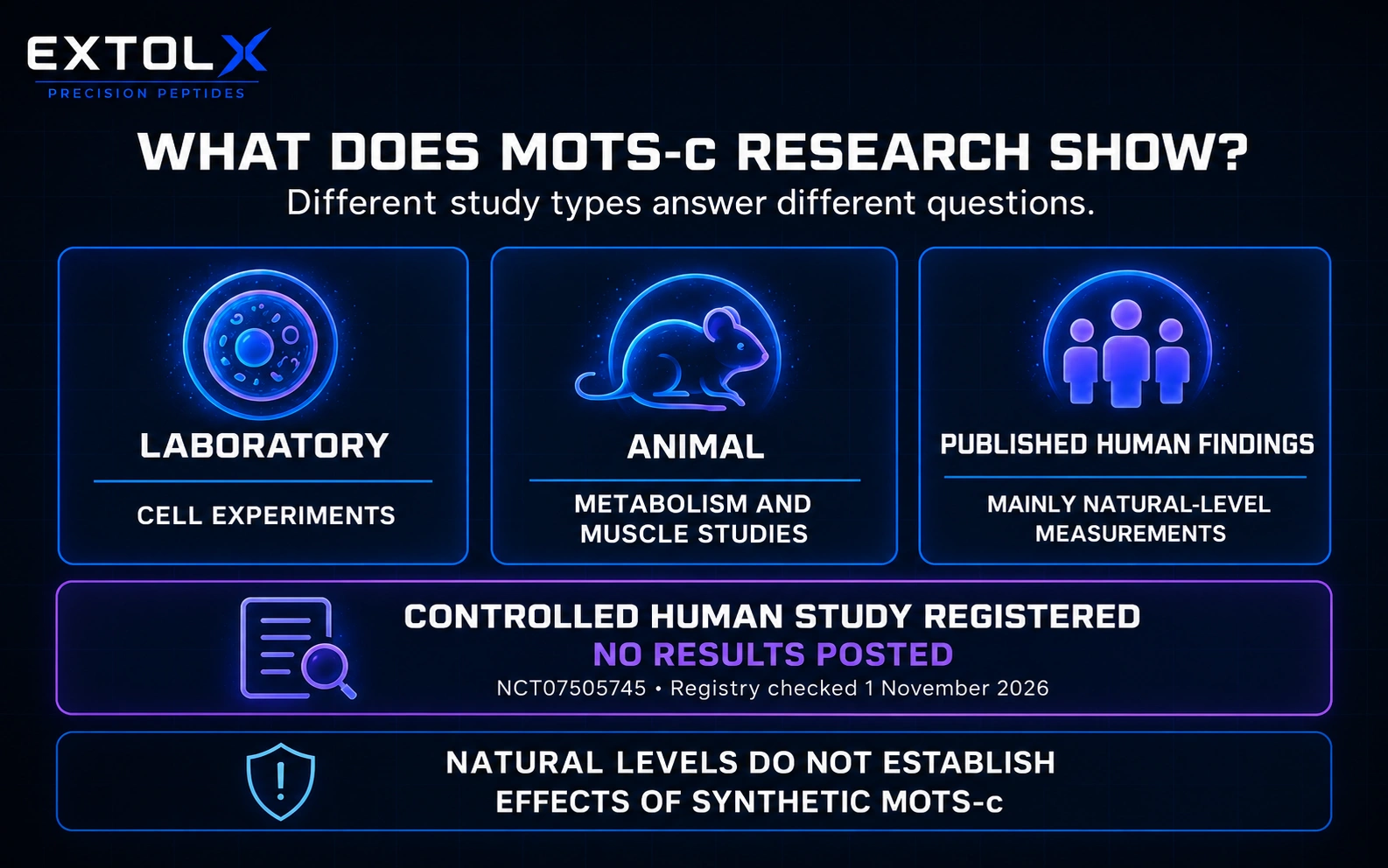
MOTS-c is a short peptide linked to mitochondrial genetic material. Cell and animal studies explore how it affects energy use and responses to stress. Published human findings mainly measure the body’s own MOTS-c; a controlled study of externally supplied MOTS-c is registered, but its record has no posted results. Natural MOTS-c measurements in people do not show what externally supplied synthetic MOTS-c would do.
The short version
- MOTS-c is described as a 16-amino-acid mitochondrial-derived peptide.
- Laboratory and mouse studies explore metabolic adaptation and skeletal-muscle biology.
- Human studies mainly measure naturally occurring MOTS-c rather than test synthetic MOTS-c as an intervention.
- Differences in measurement methods and sample handling can make studies hard to compare.
- A controlled human study is registered as NCT07505745. No results were posted in its record when checked on 1 November 2026.
- An association between natural MOTS-c levels and health does not establish cause, benefit or the effect of synthetic exposure.
On This Page
What is MOTS-c?
MOTS-c is a short chain of 16 amino acids, the building blocks of peptides. Its reported genetic instructions sit within a region of mitochondrial DNA known as the 12S ribosomal RNA region.
Mitochondria help cells manage energy and contain a small amount of their own genetic material. MOTS-c is studied as one of the small signalling peptides linked to that material.
Measuring a peptide already present in the body and testing a laboratory-made version are different tasks. Reliable tests must establish what is being detected and whether results can be compared across laboratories.
How might MOTS-c work?
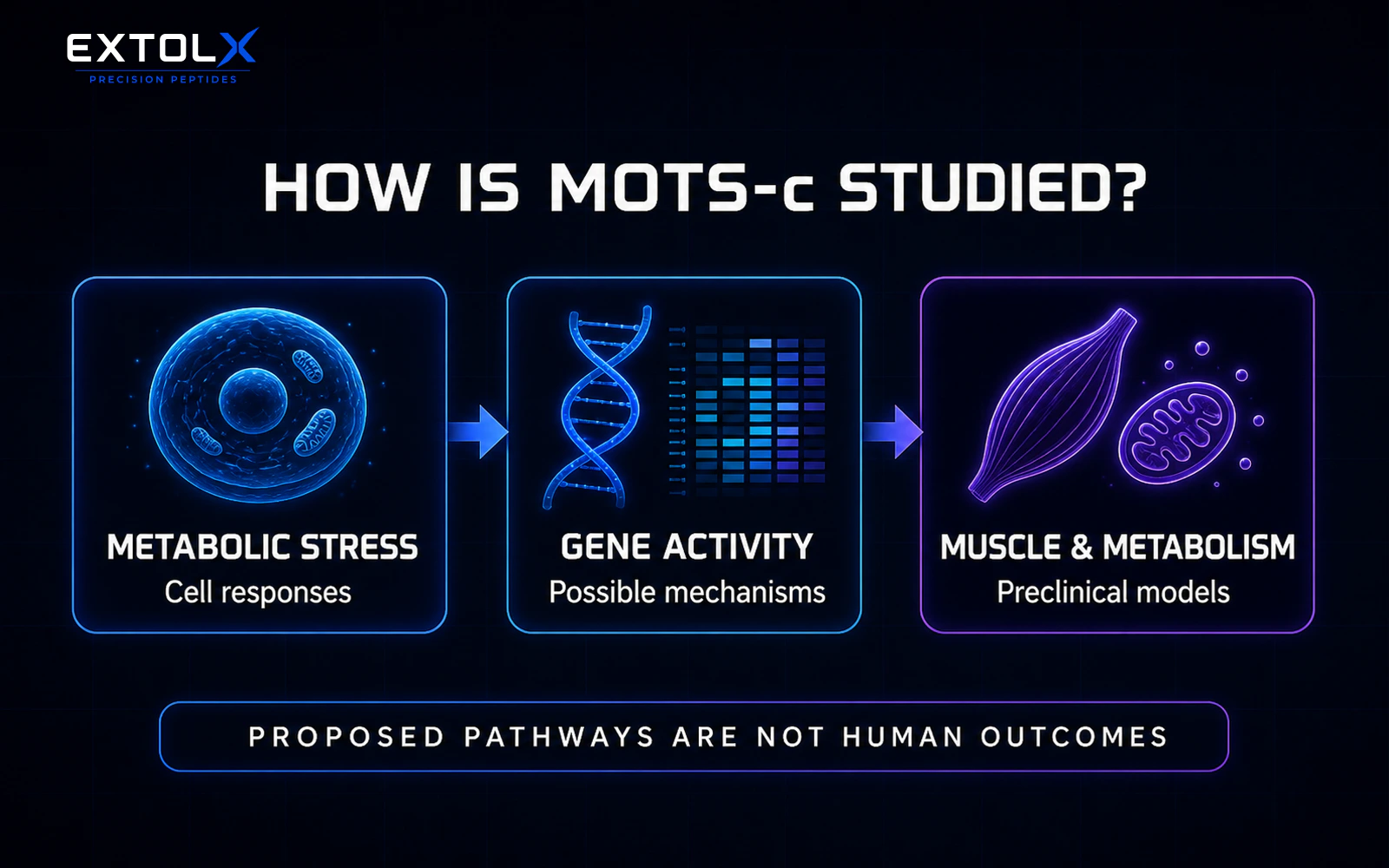
Laboratory and animal work links MOTS-c with how cells respond when their energy supply changes. One proposed pathway involves the processing of folate, a B vitamin, and AICAR, a small molecule that can help activate AMPK. AMPK acts as a cellular energy sensor.
Some studies also report that MOTS-c can affect gene activity in the cell nucleus. These findings provide testable mechanisms, but they do not establish what synthetic MOTS-c does in people.
What does the evidence show?
Laboratory research
Cell studies examine metabolic signalling, stress adaptation and changes in gene activity. These controlled systems help researchers test whether a proposed pathway responds to MOTS-c.
The results depend on the cell type, concentration and experimental conditions. They do not show a clinical outcome or define a safe human exposure.
A 23 October 2026 paper also examined kidney cells and diabetic mice. The cell experiments explored how MOTS-c affected the removal of fat droplets and signs of cellular ageing. This adds a possible mechanism, not evidence that MOTS-c treats kidney disease in people.
Animal research
Mouse studies have explored energy use, responses to insulin, physical activity and how muscle maintains its normal condition. The October 2026 kidney paper also reported changes in kidney-injury measures in diabetic mice. Those are animal findings, not human treatment results.
Animal models can reveal a biological response and help choose measurements for human research. They cannot establish effectiveness or safety in people, and findings may depend on the specific model.
Human research
Small exercise studies measured naturally occurring MOTS-c rather than giving participants synthetic MOTS-c. One 2021 study reported increases in muscle and blood measurements after exercise; another reported only a trend towards higher blood levels after endurance exercise. These are measurements of the body’s response to exercise.
A 2024 systematic review and meta-analysis combined studies of circulating MOTS-c in obesity and diabetes. The relationships differed between groups. Such comparisons cannot establish whether MOTS-c caused the differences or what externally supplied material would do.
NCT07505745 (MOTS-MET) is a registered randomised, placebo-controlled study of externally supplied MOTS-c in adults with prediabetes and overweight or obesity. The record lists planned enrolment of 120 and a recruiting status, last updated on 1 April 2026. It had no posted results when checked on 1 November 2026.
Registration describes a study plan, not a finding. The listed recruitment status is sponsor-reported, and the planned participant number is not a completed-study count. The record does not yet establish effectiveness or safety, and it is not a medicine approval.
| Evidence level | What is available | Main limit |
|---|---|---|
| Laboratory | Metabolic and gene-signalling studies | Controlled systems do not establish human outcomes |
| Animal | Several mouse metabolism and muscle studies | Model findings may not transfer to people |
| Published human findings | Exercise-related and observational measurements of natural MOTS-c | These do not establish the effects of synthetic exposure |
| Registered human intervention study | MOTS-MET: a planned controlled comparison | No results posted in the registry at the review date |
Where are evidence-transfer mistakes made?
- From natural level to intervention: measuring the body’s own MOTS-c does not show what synthetic MOTS-c would do.
- From association to cause: a relationship with a health marker does not prove MOTS-c created that difference.
- From mouse metabolism to human benefit: a response in a specific model is not a clinical outcome.
- From registration to proof: a listed study is not a published result or evidence of approval.
- From one assay to certainty: different tests and sample-handling methods may produce results that are not directly comparable.
What remains unknown?
- Whether different tests reliably identify and quantify the same material.
- Which laboratory method provides reliable and comparable human measurements.
- Whether circulating MOTS-c is a cause, consequence or marker of metabolic change.
- What the registered controlled study will report about externally supplied MOTS-c.
- The human safety profile, meaningful outcomes and longer-term effects of synthetic exposure.
Regulatory context
MOTS-c remains investigational; no MHRA-authorised MOTS-c medicine was identified in this review. A research-use label does not override the way a product is presented, promoted or used. Safety information from one formulation or jurisdiction cannot be transferred automatically to another.
There is a recent US policy development, but it is not a medicine approval. The 30 October 2026 Federal Register notice describes a draft HHS compounding enforcement policy. Its listed substances and conditions include MOTS-c acetate and require safeguards such as verified identity, quality testing, patient-specific prescriptions and single-active-ingredient products.
The proposal concerns a defined US compounding setting. It does not establish UK authorisation, prove clinical benefit or make an independently supplied research vial equivalent to a medicine. Evidence about a modified MOTS-c analogue also cannot automatically establish the safety of MOTS-c itself.
The 2026 WADA Prohibited List names MOTS-c under metabolic modulators prohibited at all times in sport. Research-use labelling does not remove that restriction.
What would better research look like?
Progress begins with measurement. Independent laboratories should validate tests for identity, concentration and sample stability, then agree how specimens are collected and handled.
The registered study is a step towards asking the human question, but complete results will matter more than the registration alone. Useful reports should clearly identify the tested material, explain the comparison groups, publish the planned metabolic and safety measurements, and report missing data and unwanted effects. Independent studies would then need to test whether the findings hold up.
Plain-English glossary
- Mitochondria: Structures inside cells that help manage energy and contain a small amount of genetic material.
- Open reading frame: A stretch of genetic sequence that may contain instructions for making a peptide or protein.
- AMPK: A cellular sensor involved in responding to changes in energy availability.
- Endogenous: Produced naturally within the body.
- Exogenous: Supplied from outside the body.
- Observational study: Research that records existing differences without assigning an intervention.
- Assay: A laboratory test used to detect or measure a substance.
- Randomised: Participants are assigned to comparison groups by chance.
- Placebo-controlled: An intervention is compared with an inactive control.
- Trial registration: A public record of a study’s planned methods and status; it is not a results paper.
Explore MOTS-c research material
ExtolX MOTS-c 10MG is supplied as research material. Its identity and analytical documentation should be assessed separately from studies that measure naturally occurring MOTS-c.
References and further reading
- Acute endurance exercise and circulating mitochondrial-derived peptides — original human study, 2021
- MOTS-c, exercise and muscle homeostasis — cell, mouse and human-measurement study, 2021
- Circulating MOTS-c in obesity and diabetes — systematic review and meta-analysis, 2024
- MOTS-MET study record NCT07505745 — ClinicalTrials.gov; checked 1 November 2026
- Kidney-cell and diabetic-mouse MOTS-c study — Biochemical Pharmacology, 23 October 2026
- Draft peptide-compounding policy notice — HHS / Federal Register, 30 October 2026
- Peptide-compounding policy and substance-specific appendices — HHS
- 2026 Prohibited List — WADA
- UK medicine-authorisation information — MHRA
Research-use notice: ExtolX products are supplied strictly for legitimate laboratory research. They are not intended for human or veterinary use, consumption, diagnosis, treatment or prevention of disease.