
Evidence reviewed: 21 August 2026
Author: ExtolX Editorial Team
This is an educational overview of published research, not medical advice.
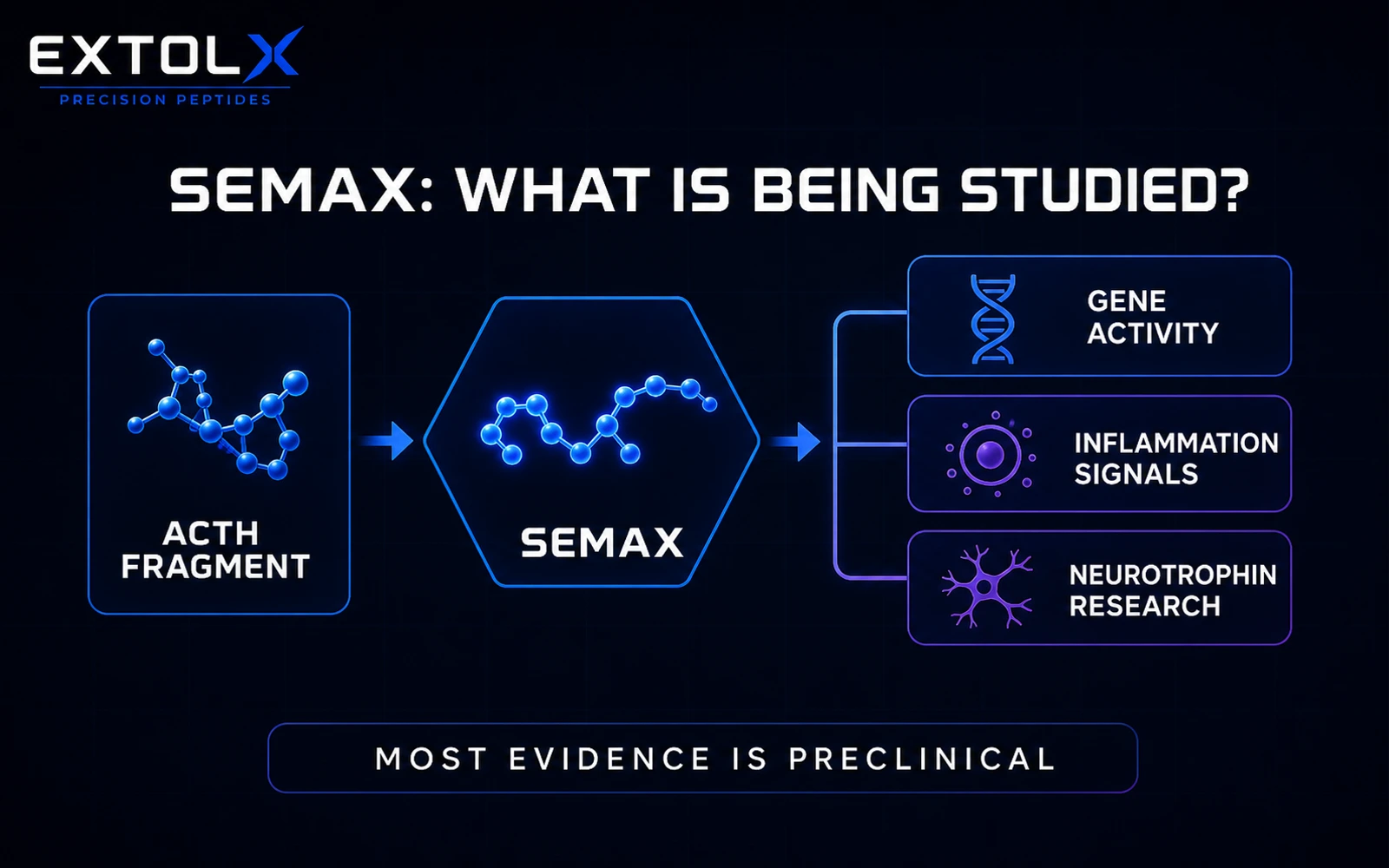
Semax is a laboratory-made peptide based on a small part of the natural hormone ACTH. Researchers have studied it in cells, animals and some regional clinical settings, but the accessible human evidence is much narrower than many online claims suggest.
The short version
- Semax is a seven-amino-acid peptide derived from a short ACTH fragment.
- Laboratory and animal studies explore gene activity, inflammatory signalling and proteins involved in nerve-cell growth.
- Those findings suggest research questions; they do not establish cognitive or neurological benefits in people.
- Some regional human and stroke-related reports exist, but accessible details, replication and large independent trials are limited.
- No robust multicentre evidence was identified for the broad “nootropic” claims commonly made online.
What is Semax?
Semax is a synthetic heptapeptide, meaning it contains seven amino acids. Its sequence is Met-Glu-His-Phe-Pro-Gly-Pro.
The first four amino acids come from ACTH(4–7), a small section of adrenocorticotropic hormone. Researchers added Pro-Gly-Pro to create the Semax sequence. This relationship helps explain its origin, but Semax should not be treated as though it were the full ACTH hormone.
How might it work?
The practical point is that no single, confirmed human mechanism explains Semax. Preclinical studies have reported changes in immune signalling, gene activity and neurotrophins—proteins involved in the growth and survival of nerve cells.
Some experiments use reduced blood flow to the brain as a model of injury. A molecular change in that model can help researchers form a hypothesis, but it does not show that Semax improves memory, attention or recovery in everyday human settings.
What does the evidence show?
Laboratory research
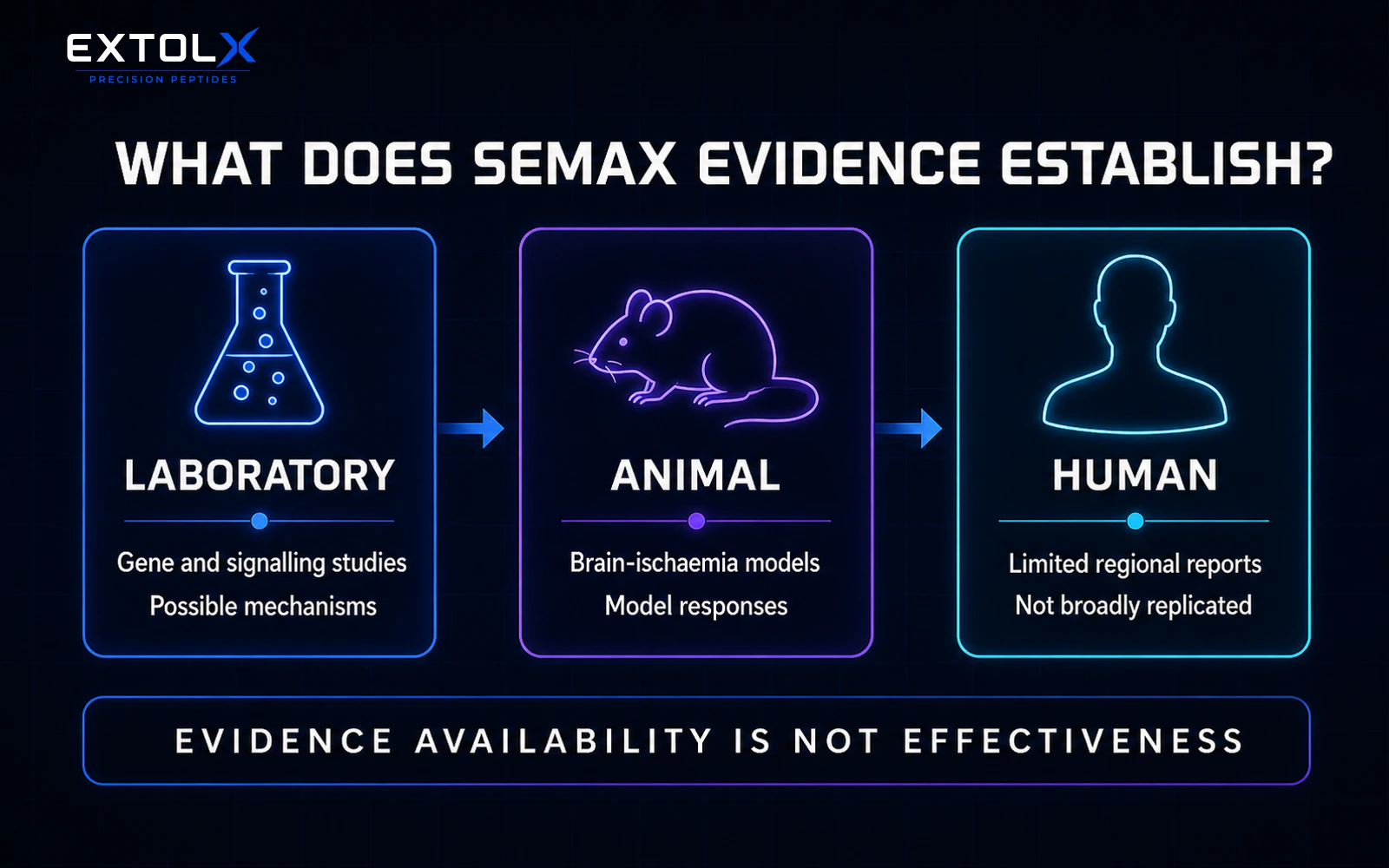
Cell and molecular studies give researchers ways to examine how Semax may affect gene expression and signalling pathways. These experiments are useful for identifying possible targets and choosing measurements for later studies.
They cannot show whether a person would experience a meaningful effect. Concentrations, exposure time and experimental conditions may differ substantially from conditions in the human body.
Animal research
Rat studies, including models of reduced brain blood flow, have examined immune responses, neurotrophin signalling and patterns of gene activity after Semax exposure. This is the most developed part of the evidence base.
Animal models simplify complex human conditions. They can reveal biological signals, but they cannot establish safety or effectiveness in people.
Human research
Regional clinical reports, including stroke-related research, are described in the literature. However, some reports are difficult to assess because full methods and results are not readily accessible, and independent replication is limited.
No large, independent, placebo-controlled multicentre trial was identified that establishes the broad memory, focus or performance claims often attached to Semax online.
| Evidence level | What is available | What it can establish |
|---|---|---|
| Laboratory | Gene-activity and signalling studies | Possible mechanisms to test |
| Animal | Several rat studies, including brain-ischaemia models | Responses in those models |
| Human | Limited regional clinical reports | Not broad, independently replicated benefits |
Where are evidence-transfer mistakes made?
- From a gene signal to a human outcome: altered gene activity does not prove better cognition or recovery.
- From an injury model to normal function: a rat model of reduced brain blood flow is not the same as memory or attention in a healthy person.
- From a regional report to broad certainty: small or difficult-to-access studies need independent replication.
- From biological origin to equivalence: Semax is based on ACTH(4–7), but it is not full-length ACTH.
What remains unknown?
- Which proposed mechanisms, if any, are important in humans.
- Whether findings can be reproduced by independent research groups.
- How results vary by population, formulation and study setting.
- The longer-term safety profile and the frequency of uncommon adverse events.
- Whether any measured biological change leads to a meaningful clinical outcome.
Regulatory context
Not authorised by the MHRA as a medicine; regulatory status differs internationally. A research-use label does not override the way a product is presented, promoted or used. Safety information from one formulation or jurisdiction cannot be transferred automatically to another.
What would better research look like?
A stronger evidence base would start with clearly characterised material and a registered study protocol. Human trials would need random assignment, a suitable placebo, enough participants to detect realistic differences and outcome measures chosen before the results are known.
Researchers would also need transparent adverse-event reporting, enough follow-up to examine durability and safety, and independent replication across more than one centre.
Plain-English glossary
- ACTH: A natural hormone involved in the body’s stress-response system.
- Heptapeptide: A peptide made from seven amino acids.
- Gene expression: The process by which cells use genetic instructions to make functional products.
- Neurotrophin: A protein involved in the growth, maintenance or survival of nerve cells.
- Preclinical: Research performed before reliable conclusions can be drawn from human trials, usually in cells or animals.
- Placebo-controlled: A study that compares an intervention with an inactive or matched control.
Explore Semax research material
ExtolX Semax 10MG is supplied as research material. Its listing and analytical documentation should be assessed in the context of a defined laboratory protocol.
References and further reading
- Semax and gene-expression responses in an experimental ischaemia model — PubMed
- Review of Semax research and proposed mechanisms — PubMed
- Semax literature search — PubMed
Research-use notice: ExtolX products are supplied strictly for legitimate laboratory research. They are not intended for human or veterinary use, consumption, diagnosis, treatment or prevention of disease.