
Evidence reviewed: 21 August 2026
Author: ExtolX Editorial Team
This is an educational overview of published research, not medical advice.

Selank is a laboratory-made peptide derived from tuftsin, a natural immune-system peptide. Most published work examines signalling and behaviour in laboratory or animal models; the available human research is too limited to support broad claims about anxiety, cognition or performance.
The short version
- Selank is a seven-amino-acid peptide based on tuftsin.
- Laboratory research explores neurotransmitter, immune and gene-expression pathways.
- Animal studies include behaviour, anxiety-like responses and learning tasks.
- Small regional human reports exist, but large independent placebo-controlled trials have not established the broad claims made online.
- A behavioural change in an animal test is not the same as a diagnosed condition or meaningful benefit in people.
What is Selank?
Selank is a synthetic heptapeptide, meaning it contains seven amino acids. Its sequence is Thr-Lys-Pro-Arg-Pro-Gly-Pro.
The first four amino acids match tuftsin, a natural peptide involved in immune signalling. A Pro-Gly-Pro sequence extends that fragment. Selank’s origin provides a starting point for research, but it does not mean Selank and tuftsin have identical behaviour.
How might Selank work?
No single human mechanism has been confirmed. Preclinical research has reported changes involving GABA and serotonin signalling, immune pathways and gene expression.
GABA and serotonin are chemical messengers used by the nervous system. Finding that a peptide affects one of these pathways in a model can guide further experiments, but it does not show that the peptide treats anxiety or improves cognition in people.
What does the evidence show?
Laboratory research
Laboratory studies examine receptor signalling, immune responses and patterns of gene activity. These experiments can identify possible mechanisms and show where a biological response occurs under controlled conditions.
They cannot establish a clinical effect. The concentration, exposure and isolated system used in a laboratory may not reflect what happens in a whole human body.
Animal research
Animal studies have used anxiety-like behaviour, learning and other experimental tasks. Results from these models form much of the basis for Selank’s proposed effects.
These tests measure specific animal responses under set conditions. They are not direct versions of human anxiety disorders, memory problems or day-to-day cognitive performance.
Human research
Small regional clinical reports have examined anxiety-related outcomes. However, accessible information about study methods is limited, and the findings have not been established through large, independent, multicentre trials.
No strong human evidence was identified for general cognitive enhancement or performance claims. Longer-term safety, interactions and how long Selank stays in the body are also not sufficiently characterised.
| Evidence level | What is available | What it can establish |
|---|---|---|
| Laboratory | Signalling, immune and gene-expression studies | Possible mechanisms to test |
| Animal | Behaviour and learning models | Responses in those particular models |
| Human | Small regional reports | Not broad or independently replicated benefits |
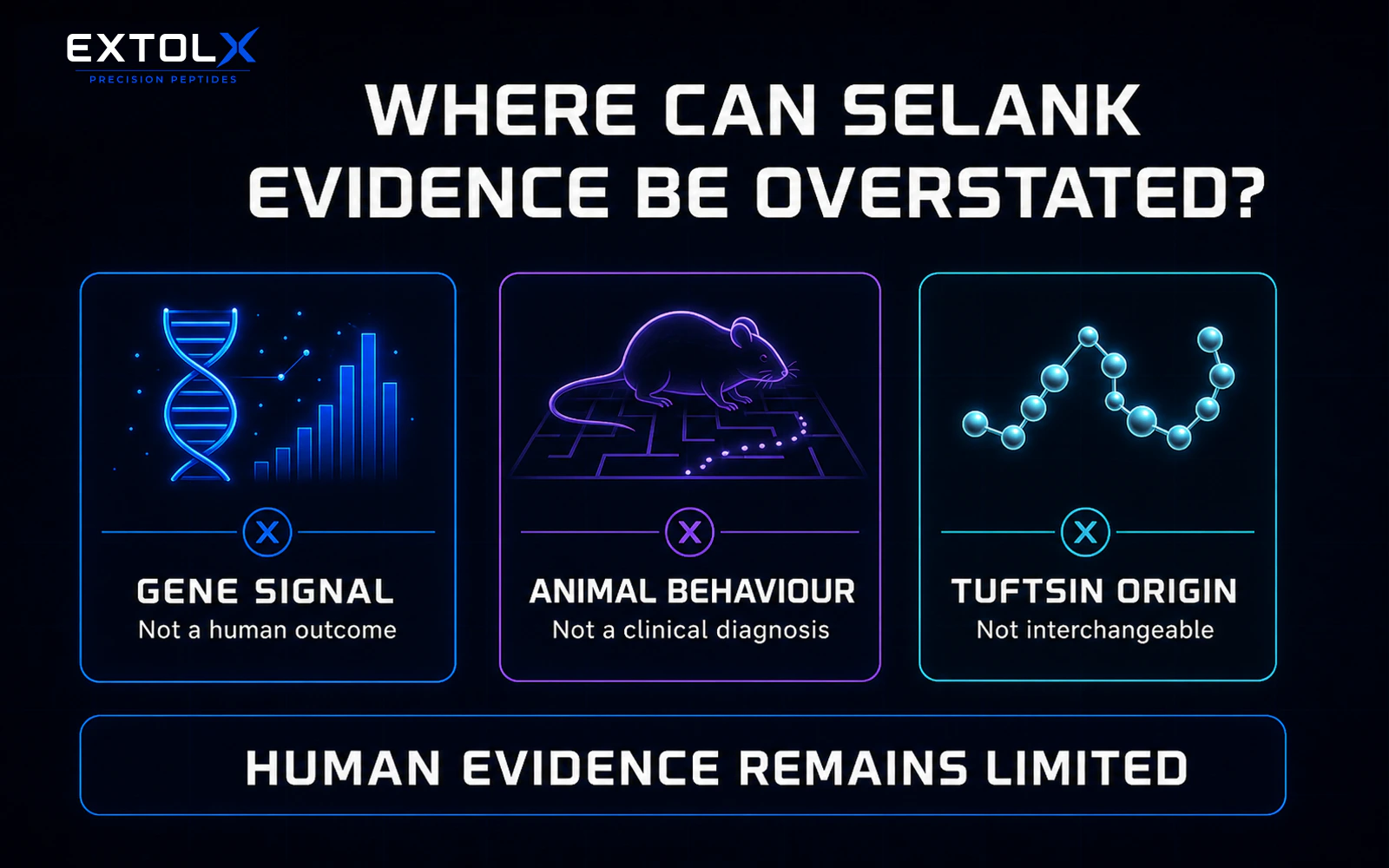
Where are evidence-transfer mistakes made?
- From animal behaviour to a human diagnosis: an anxiety-like test in an animal is not a clinical anxiety disorder.
- From a signalling change to a benefit: altered GABA, serotonin or immune signalling does not prove a useful outcome.
- From tuftsin to Selank: sharing part of a sequence does not make two peptides interchangeable.
- From a small report to a general claim: limited regional findings need transparent methods and independent replication.
What remains unknown?
- Which proposed mechanisms are relevant at realistic human exposures.
- Whether reported human findings can be reproduced independently.
- How long Selank and its breakdown products remain measurable in the body.
- Its longer-term safety profile and possible interactions.
- Whether any effect is meaningful outside a narrow research setting.
Regulatory context
Not authorised by the MHRA as a medicine; regulatory status differs internationally. A research-use label does not override the way a product is presented, promoted or used. Safety information from one formulation or jurisdiction cannot be transferred automatically to another.
What would better research look like?
Useful human evidence would require a registered, adequately powered, randomised and placebo-controlled trial. Researchers should define the population and outcomes in advance, describe the tested material clearly and report all adverse events.
Independent groups would then need to reproduce the result. Longer follow-up and measurements of exposure would help connect laboratory mechanisms with any observed human outcome.
Plain-English glossary
- Tuftsin: A natural four-amino-acid peptide involved in immune-system activity.
- Heptapeptide: A peptide made from seven amino acids.
- GABA: A chemical messenger that generally reduces activity in parts of the nervous system.
- Serotonin: A chemical messenger involved in several brain and body functions.
- Gene expression: The process by which cells use genetic instructions to make functional products.
- Placebo-controlled: A study that compares an intervention with an inactive or matched control.
Explore Selank research material
ExtolX Selank 10MG is supplied as research material. Its listing and analytical documentation should be assessed in the context of a defined laboratory protocol.
References and further reading
Research-use notice: ExtolX products are supplied strictly for legitimate laboratory research. They are not intended for human or veterinary use, consumption, diagnosis, treatment or prevention of disease.