
Evidence reviewed: 21 August 2026
Author: ExtolX Editorial Team
This is an educational overview of published research, not medical advice.
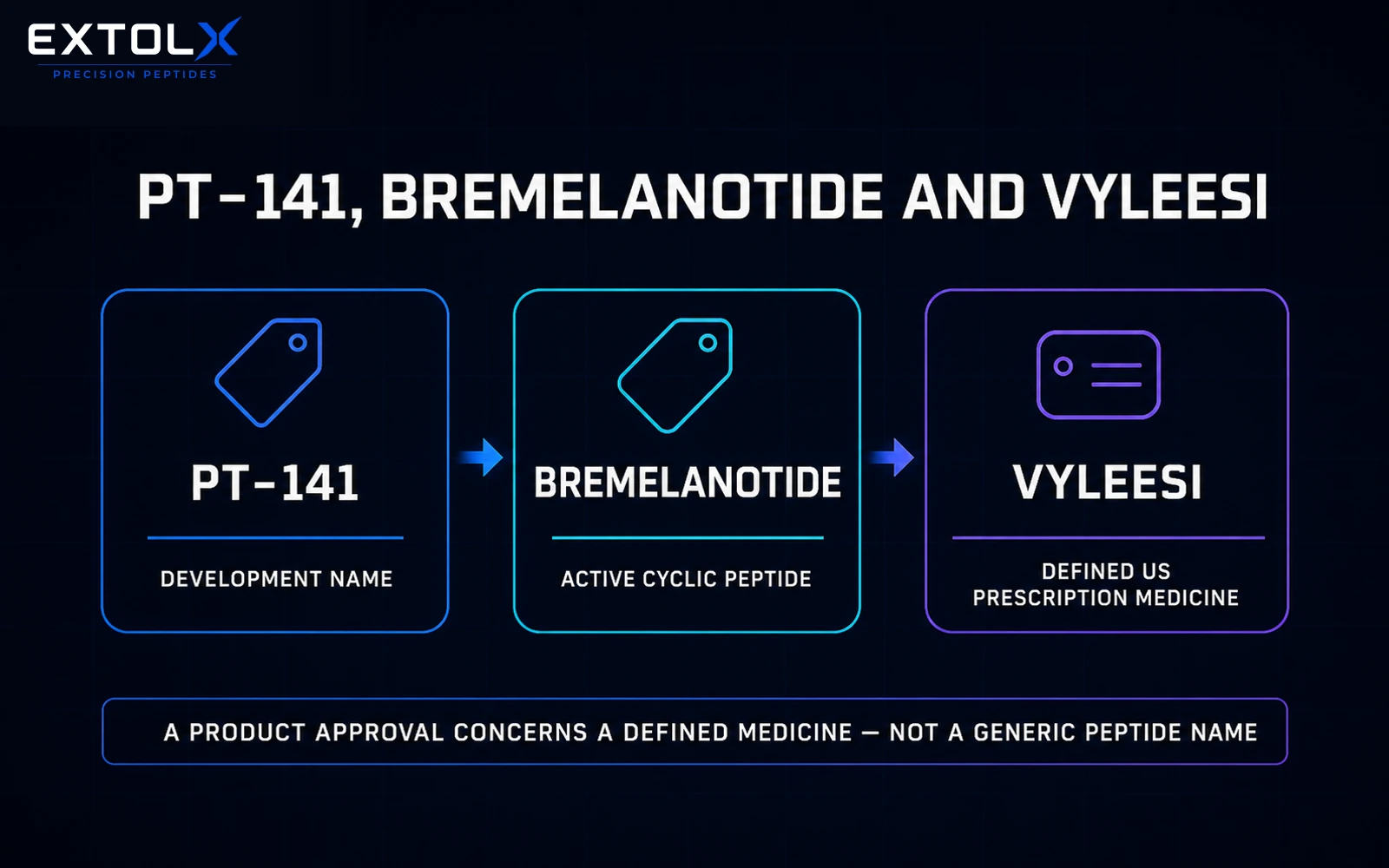
PT-141 is the development name commonly used for bremelanotide, a laboratory-designed peptide that activates part of the body’s melanocortin signalling system. Human trials and US approval relate to one specific finished medicine—not automatically to every research product labelled PT-141.
The short version
- PT-141 and bremelanotide refer to the same core cyclic peptide identity in the development literature.
- Bremelanotide was developed from melanotan-II research but has a different sequence and evidence base.
- It activates several melanocortin receptors, although the pathway responsible for the approved clinical effect is not fully established.
- Two large Phase 3 trials tested a defined finished product in a narrowly specified population.
- The FDA approval applies to Vyleesi, its formulation, presentation, indication and conditions of use.
- A shared peptide name does not establish that laboratory material is equivalent to the approved medicine.
What are PT-141 and bremelanotide?
Bremelanotide is a synthetic peptide made from seven amino acids joined in a ring. During its development it was widely called PT-141. The ring shape helps hold the molecule in a particular form, which can affect how it interacts with receptors and how stable it is.
PT-141 and bremelanotide can refer to the same active peptide, but that does not make every preparation interchangeable. A finished medicine also has a defined chemical form, concentration, inactive ingredients, container, manufacturing process and shelf-life standard.
How does melanocortin signalling work?
Receptors are the parts of cells that receive biological messages. The melanocortin family contains five of them, called MC1R to MC5R. They are found in different parts of the body and are involved in functions including pigmentation, energy balance and signalling in the brain.
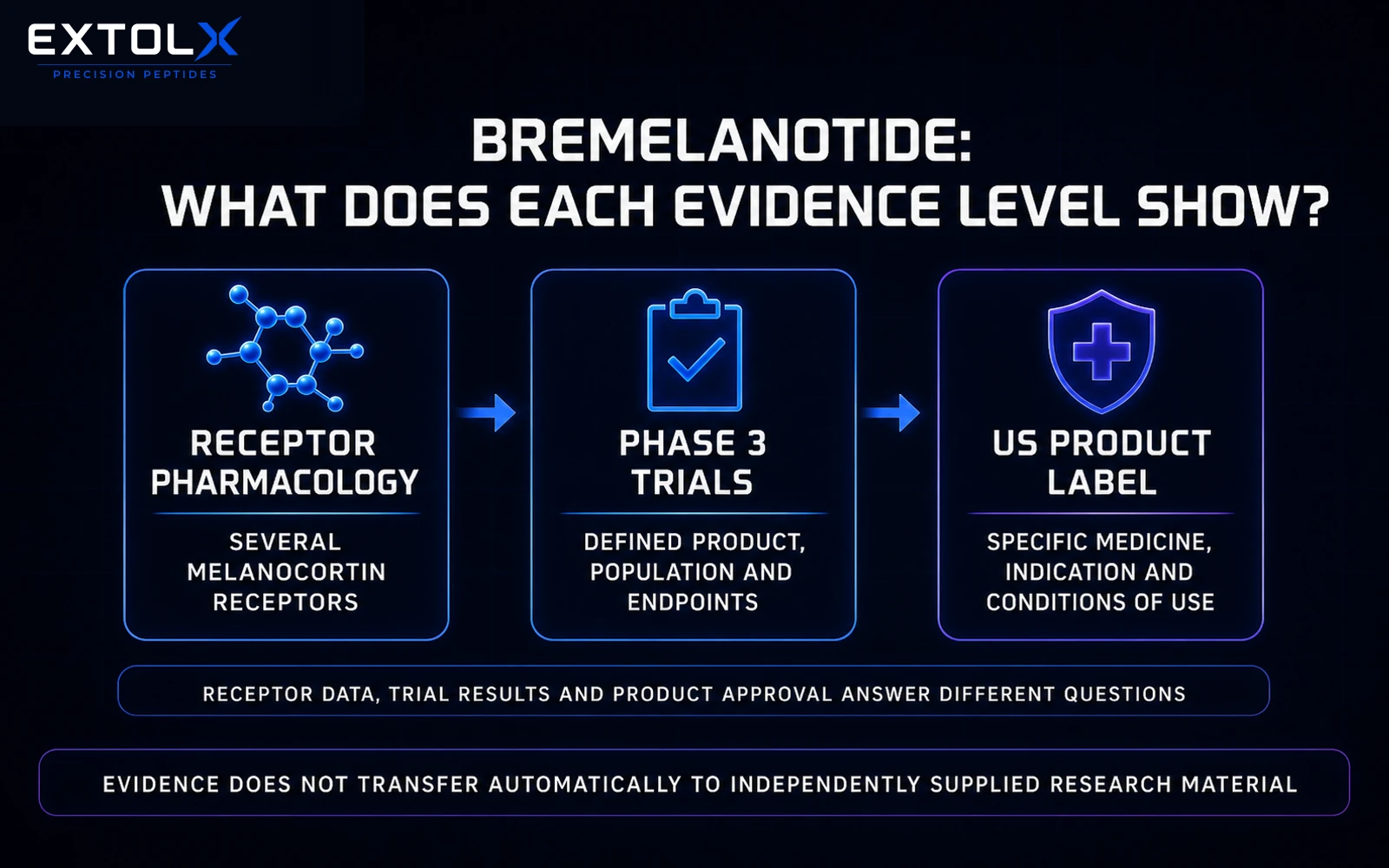
Bremelanotide can switch on several melanocortin receptors, including MC3R and MC4R. However, the current US product label says the exact way it produces its clinical effect is unknown. We can therefore describe which receptors it activates and what trials observed, but we should not present one unproven brain pathway as the full explanation.
What did human trials test?
The main RECONNECT research programme included two large Phase 3 trials. Participants were randomly assigned bremelanotide or a placebo, and neither participants nor researchers knew which was being used during the study. The trials tested a finished autoinjector medicine for 24 weeks in a carefully defined group of premenopausal women.
The trials mainly measured changes in sexual-desire scores and distress linked with low desire. The average results differed from placebo by enough to be unlikely to reflect chance alone. That does not automatically tell us how large or meaningful the difference was for an individual, and later independent researchers questioned parts of the measurement and interpretation.
Adverse effects were part of the evidence. Nausea, flushing and headache occurred more often with bremelanotide in the Phase 3 trials. Current US labelling also describes transient blood-pressure increases, heart-rate reductions and the possibility of focal hyperpigmentation.
What exactly did the FDA approve?
The FDA approved the prescription medicine Vyleesi in 2019. Current US labelling limits its indication to premenopausal women with acquired, generalised hypoactive sexual desire disorder that causes marked distress or interpersonal difficulty and is not explained by specified medical, psychiatric, relationship or drug-related factors.
The label expressly states that Vyleesi is not indicated for postmenopausal women or men and is not indicated to enhance sexual performance. It also defines contraindications, warnings, formulation and delivery system. Those boundaries are part of the approval; “bremelanotide is FDA-approved” is incomplete when detached from them.
Why approval does not transfer to research material
Regulators approve a particular medicinal product, not a molecule name in the abstract. Independently supplied PT-141 material has not been shown equivalent merely because its label uses a development name associated with bremelanotide.
- Identity: The sequence, cyclisation and salt form must be confirmed.
- Purity: Peptide-related impurities and residual manufacturing materials require suitable methods.
- Content: The amount of active peptide must be measured, not inferred from a vial label.
- Formulation: Excipients, pH and physical form can alter stability and behaviour.
- Presentation: The approved single-use device and its controls are part of the finished product.
- Evidence scope: Trial findings apply to the studied population, endpoints and medicine.
What remains unknown?
- Which receptor pathways are necessary for the observed clinical effects?
- How should the magnitude and clinical relevance of the Phase 3 outcome differences be interpreted?
- Which longer-term or uncommon risks require further surveillance?
- How do alternative formulations change stability, exposure and tolerability?
- Can independently supplied material be analytically and functionally compared with a defined reference?
- Which findings, if any, translate outside the exact population and product studied?
UK regulatory context
A US FDA approval does not create a UK marketing authorisation. Current UK medicine status should be checked through the MHRA products service. Regardless of jurisdiction, a research-use label does not convert independently supplied material into an approved medicine or a clinically equivalent product.
What could better research look like?
Laboratory studies could compare how a well-defined reference material activates each receptor, across a full range of concentrations. Repeating the work in more than one suitable cell system would help separate measured receptor activity from broader claims about effects.
Human research is easier to judge when it reports all planned outcomes, the actual size of the differences, how many people stopped treatment and what happened over longer follow-up. A different formulation would need its own identity, comparison, safety and exposure studies before researchers could relate its results to the approved product.
Plain-English glossary
- Cyclic peptide: A peptide whose structure forms a ring.
- Receptor agonist: A substance that activates a receptor.
- Finished medicine: The complete authorised product, including formulation, manufacture and presentation.
- Product equivalence: Evidence that two products match in the characteristics necessary for a particular comparison.
- Indication: The specific condition and population for which a medicine is authorised.
Explore PT-141 research material
ExtolX lists PT-141 10MG research material. Its identity and analytical documentation should be assessed as laboratory material. The listing must not be treated as the approved Vyleesi medicine or as evidence of equivalence with the product used in clinical trials.
References and further reading
- RECONNECT Phase 3 trials — PubMed
- Independent analysis of Phase 3 outcome measures — PubMed
- Phase 1 bremelanotide safety and pharmacokinetic study — PubMed
- Current US Vyleesi prescribing information — DailyMed
- MHRA products service
Research-use notice: ExtolX materials are supplied for laboratory research only and are not for human or veterinary use.