
Evidence reviewed: 21 August 2026
Author: ExtolX Editorial Team
This is an educational overview of published research, not medical advice.
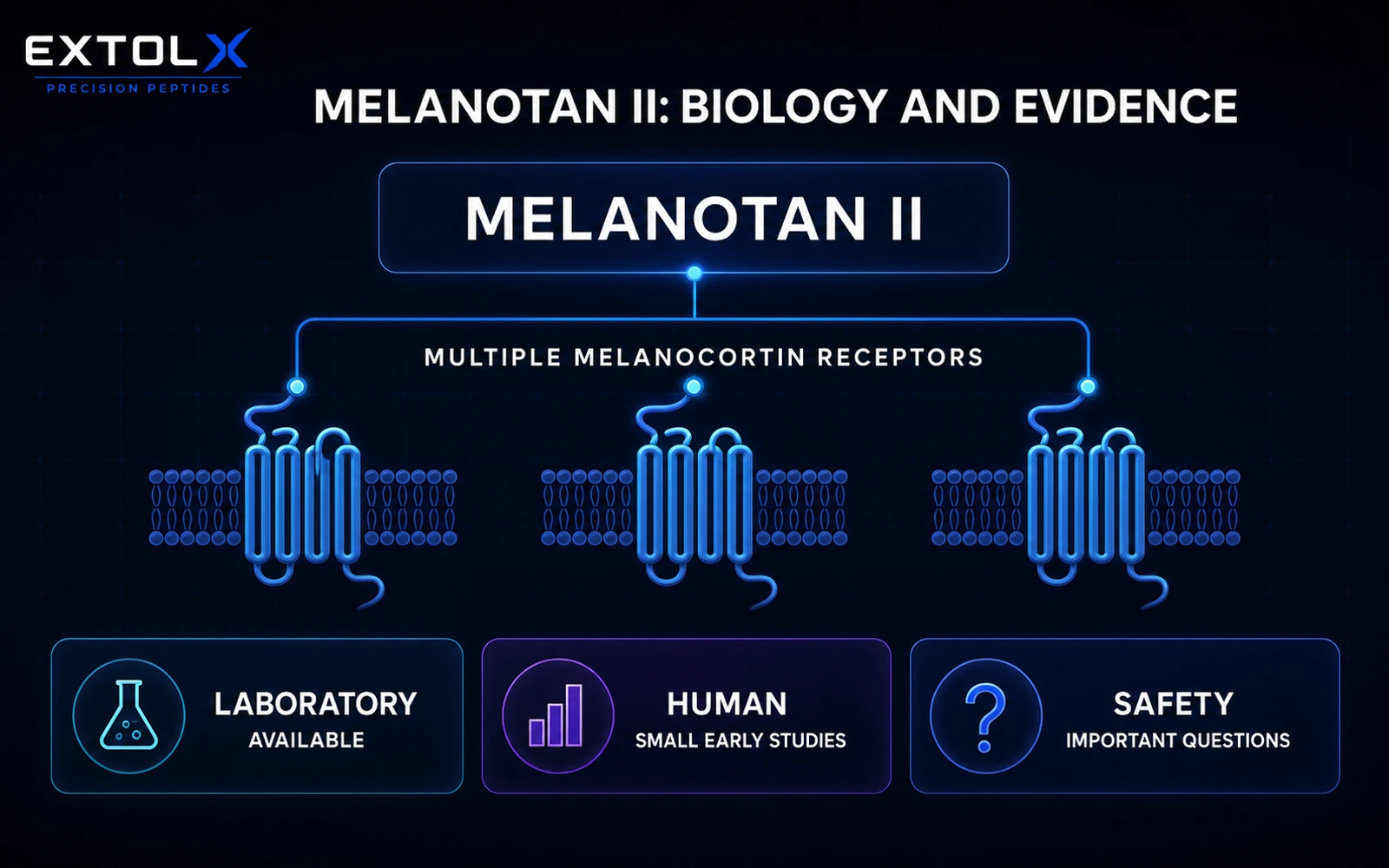
Melanotan II is a laboratory-made peptide based on alpha-melanocyte-stimulating hormone. Early human studies reported biological effects, but they were small and also recorded unwanted effects. They do not provide a complete account of safety or support the unlicensed products promoted online.
The short version
- Melanotan II is a cyclic peptide designed to mimic parts of alpha-MSH biology.
- It can activate several melanocortin receptor types rather than one single target.
- Small early human studies reported increased pigmentation and erectile responses.
- Those studies also reported effects including nausea, fatigue, yawning and spontaneous erections.
- Case reports and regulatory warnings raise safety questions but cannot show how often a problem occurs.
- Melanotan II is not authorised by the MHRA as a medicine.
What is Melanotan II?
Melanotan II is a synthetic cyclic peptide. “Cyclic” means its structure forms a ring, a design used to change how a peptide interacts with biological targets and how quickly it is broken down.
It is an analogue of alpha-melanocyte-stimulating hormone, usually shortened to alpha-MSH. An analogue is a modified molecule inspired by another molecule; it is not an identical copy.
Why do several receptor systems matter?
The practical point is that Melanotan II is not highly selective for a single receptor. It can engage several members of the melanocortin receptor family.
Melanocortin receptors are involved in different functions across the body. Activity at more than one receptor helps explain why early research observed effects beyond pigmentation. It also makes simple predictions difficult: a visible effect does not reveal every receptor involved or every other response that may occur.
What does the evidence show?
Laboratory research
Receptor studies helped establish that Melanotan II can activate multiple melanocortin receptor types. This work is useful for mapping targets and comparing receptor responses under controlled conditions.
Receptor activity alone does not establish a useful outcome or a safe exposure in people. Whole-body responses depend on distribution, breakdown, dose, formulation and individual biology.
Animal research
Animal research has explored melanocortin biology across pigmentation, feeding, sexual responses and other physiological systems. These models helped identify the peptide’s broad biological activity.
Animal findings do not determine the frequency or severity of human adverse effects. They are a step in the evidence chain, not a substitute for controlled human safety research.
Human research
A Phase 1 pilot study involving three men reported increased pigmentation. It also recorded nausea, fatigue, yawning and spontaneous erections. The study was useful as an early signal, but three participants cannot define effectiveness or safety for a wider population.
A separate crossover study involving ten men reported erectile responses, with nausea occurring frequently. Again, the small, short study cannot answer questions about uncommon events, longer-term exposure or different populations.
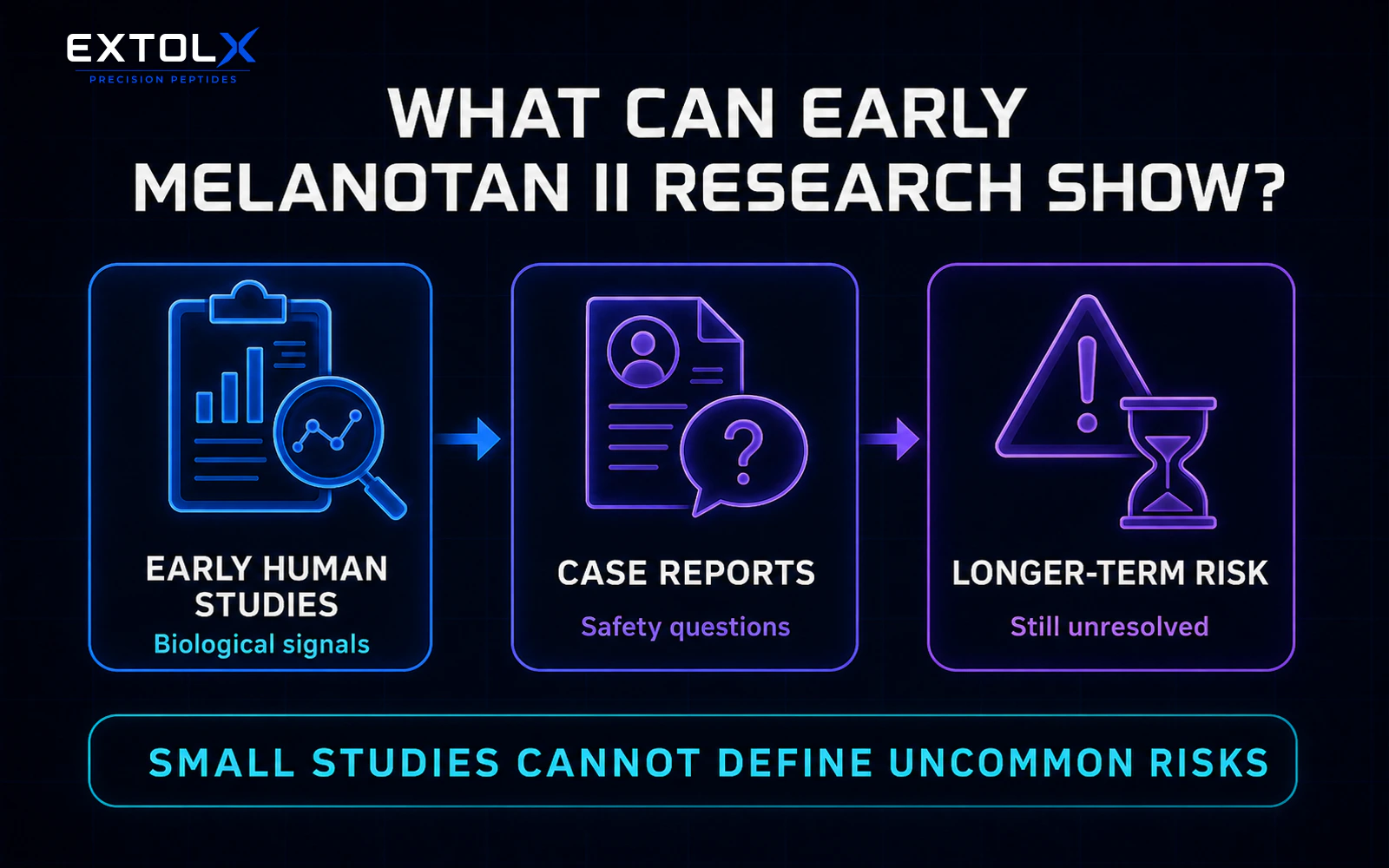
Published case reports and warnings about unlicensed melanotan products add safety signals. Case reports can identify a possible problem, but they cannot establish that the peptide caused it or calculate how often it occurs.
| Evidence level | What is available | Main limit |
|---|---|---|
| Laboratory | Receptor-activity studies | Cannot establish whole-person safety or benefit |
| Animal | Several physiological models | Responses may not transfer to humans |
| Human | Very small early studies and case reports | Cannot define uncommon or longer-term risks |
Where are evidence-transfer mistakes made?
- From receptor activity to safety: knowing that a receptor responds does not define a safe human exposure.
- From pigmentation to product quality: a visible response cannot confirm what an unlicensed product contains.
- From a small trial to general use: studies of three or ten men cannot represent wider populations or longer-term exposure.
- From a case report to incidence: a report can flag a possible risk but cannot show how common it is.
What remains unknown?
- The frequency of uncommon or delayed adverse events.
- The longer-term consequences of repeated exposure.
- How findings vary across sex, age, health status and other populations.
- How the composition and purity of unlicensed products compare with material used in research.
- Which receptor interactions are most important for each observed human response.
Regulatory context
Not authorised by the MHRA as a medicine. UK regulators have warned consumers about unlicensed melanotan products. A research-use label does not override the way a product is presented, promoted or used. Safety information from one formulation or jurisdiction cannot be transferred automatically to another.
What would better research look like?
Better evidence would require carefully characterised material, a registered protocol and staged human research with predefined outcomes. Studies would need enough participants and follow-up to examine both expected effects and less common adverse events.
Researchers should report receptor-relevant outcomes, laboratory measurements and all adverse events transparently. Independent replication would be essential, particularly because early studies were very small.
Plain-English glossary
- Alpha-MSH: A natural hormone that signals through melanocortin receptors.
- Analogue: A modified molecule based on another molecule.
- Cyclic peptide: A peptide whose structure forms a ring.
- Receptor: A cellular target that responds when a suitable molecule binds to it.
- Receptor selectivity: The extent to which a molecule favours one receptor over others.
- Crossover study: A study in which participants receive more than one study condition at different times.
Explore Melanotan II research material
ExtolX Melanotan II 10MG is supplied as research material. Its listing and analytical documentation should be assessed in the context of a defined laboratory protocol.
References and further reading
- Early Phase 1 research on a cyclic melanotropic peptide — PubMed
- Early crossover study of Melanotan II responses — PubMed
- UK guidance on advertising medicines — GOV.UK
Research-use notice: ExtolX products are supplied strictly for legitimate laboratory research. They are not intended for human or veterinary use, consumption, diagnosis, treatment or prevention of disease.