
Evidence reviewed: 23 August 2026
Author: ExtolX Editorial Team
This is an educational overview of published research, not medical advice.
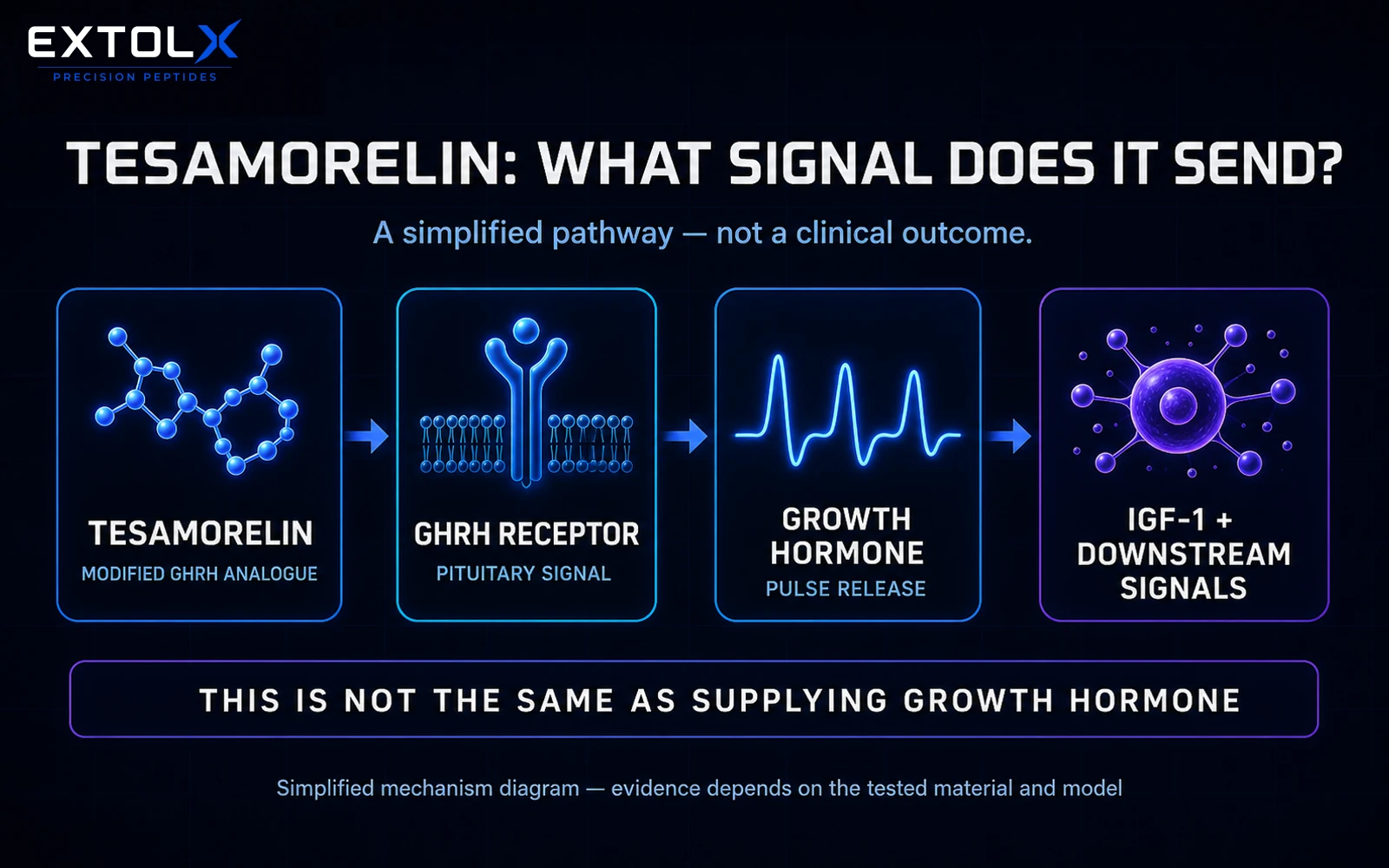
Tesamorelin is a laboratory-designed version of growth-hormone-releasing hormone, usually shortened to GHRH. It sends a signal to the pituitary gland, which can then release the body’s own growth hormone. That is different from supplying growth hormone directly.
A regulated tesamorelin medicine has been studied in people and is authorised in the United States for a narrow use in adults with HIV-associated lipodystrophy. Those findings belong to the exact medicine, formulation and populations studied. They do not establish what independently supplied research material will do.
The short version
- Tesamorelin is a modified 44-amino-acid analogue of human GHRH.
- Its main researched action is activation of the GHRH receptor in the pituitary gland.
- That signal can increase pulses of growth hormone and the downstream marker IGF-1.
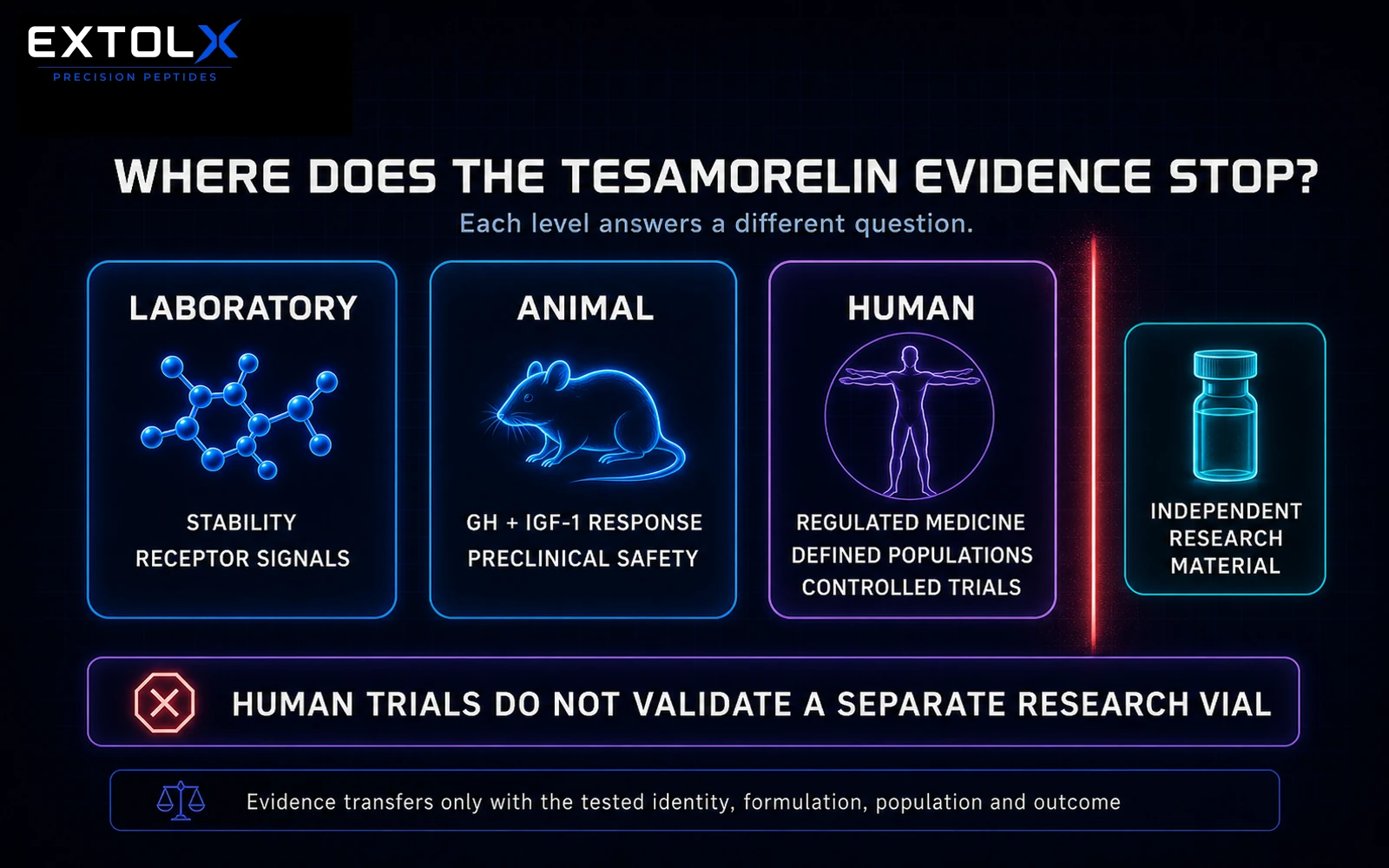
- Laboratory and animal studies helped establish its stability, signalling and preclinical safety profile.
- Controlled human trials used sponsor-manufactured pharmaceutical tesamorelin, mainly in adults with HIV and excess visceral abdominal fat.
- It is not a general weight-loss medicine, and the US product label states that it is weight neutral.
- Tesamorelin is prohibited at all times under the 2026 World Anti-Doping Code Prohibited List.
- Clinical findings cannot be transferred to an independent research vial.
On This Page
- The short version
- What is tesamorelin?
- How does the signal work?
- What does laboratory research show?
- What does animal research add?
- What has been tested in people?
- Where are evidence-transfer mistakes made?
- What remains unknown?
- What is the regulatory position?
- What does anti-doping regulation say?
- What would better research look like?
- Plain-English glossary
- Explore Tesamorelin research material
- References and further reading
What is tesamorelin?
Tesamorelin, also known in research as TH9507, is based on the full 44-amino-acid sequence of human GHRH. A small chemical group is attached at one end of the peptide. Early preclinical work found that this change made it more resistant to breakdown than natural GHRH.
That distinction matters. Tesamorelin is not growth hormone and it is not IGF-1. It is an upstream signal intended to activate the GHRH receptor, mainly in the pituitary gland.
How does the signal work?
The practical point is that tesamorelin starts a signalling chain rather than acting as the final hormone in that chain.
- Tesamorelin reaches the GHRH receptor. This receptor is found on growth-hormone-producing cells in the pituitary gland.
- The pituitary releases growth hormone. Research examines both the amount released and the normal pulse-like pattern of release.
- Downstream signals change. Growth hormone can influence the liver and other tissues, including production of insulin-like growth factor 1, or IGF-1.
- Researchers measure later effects. These may include body-composition scans, blood markers and metabolic measurements, depending on the study.
A pathway diagram explains the proposed sequence. It does not show that every step will change in the same way in every model or person.
What does laboratory research show?
Laboratory work is most useful for identity, stability and receptor questions. It can compare how quickly tesamorelin and natural GHRH are broken down, test receptor-linked signals and measure growth hormone release from controlled cell systems.
The original non-clinical programme reported slower breakdown of tesamorelin in plasma from several species than natural human GHRH. This helps explain why the modification was made. It does not establish a clinical outcome.
What does animal research add?
Animal studies connect the receptor mechanism with whole-body responses. Research in rats, dogs and pigs measured exposure, growth hormone, IGF-1 and organ-level findings.
These studies supported later human development, but they also showed why exposure matters. At high repeated exposures, some animal findings were linked to prolonged growth hormone or IGF-1 signalling. An animal safety programme can identify questions for human trials; it cannot define the effect or safety of an independently supplied material in people.
What has been tested in people?
The strongest human evidence concerns adults living with HIV who had excess visceral abdominal fat associated with lipodystrophy. Visceral fat is fat held deeper inside the abdomen around the organs.
Two large placebo-controlled phase 3 programmes enrolled more than 800 participants in total. Imaging showed a reduction in visceral abdominal fat during treatment with the regulated study medicine. Extension data also showed that the change was not maintained after treatment stopped.
Smaller controlled studies explored liver fat and metabolic measurements. One preliminary trial in 50 adults with HIV reported changes in liver fat measured by magnetic resonance spectroscopy. Another 12-month trial studied 60 adults with abdominal obesity and reduced growth hormone secretion. These studies answer narrower questions in selected populations and should not be treated as proof of a general effect.
Importantly, the trials used sponsor-manufactured medicine under controlled clinical conditions. They did not test ExtolX material, and they do not establish equivalence between a research vial and an authorised formulation.
Where are evidence-transfer mistakes made?
- Tesamorelin is treated as growth hormone. It acts earlier in the pathway by stimulating the GHRH receptor.
- A narrow HIV-related indication becomes a general claim. Evidence from adults with HIV-associated lipodystrophy cannot automatically be applied to other populations or purposes.
- A scan measurement becomes a broad health outcome. A change in visceral fat does not by itself establish longer-term cardiovascular or clinical benefit.
- Temporary study changes are described as permanent. Extension data showed that visceral fat could return after the regulated medicine was stopped.
- The active molecule is separated from its formulation. A named peptide is not enough to establish equivalence between pharmaceutical and independent research materials.
What remains unknown?
- The long-term cardiovascular effect of the authorised medicine.
- The meaning of prolonged IGF-1 elevation over longer periods.
- How findings differ outside the carefully selected populations already studied.
- Which outcomes remain after treatment stops.
- Whether newer research questions produce results that matter beyond imaging and laboratory markers.
- How any independently supplied material compares with the identity, purity, formulation and quality controls of a clinical-trial product.
What is the regulatory position?
The United States has authorised specific Egrifta formulations for reducing excess abdominal fat in adults with HIV and lipodystrophy. The current US prescribing information says the medicine is not indicated for weight-loss management and notes that long-term cardiovascular safety has not been established.
A European marketing-authorisation application for Egrifta was withdrawn in 2012 after the European Medicines Agency raised unresolved benefit-risk questions. A US authorisation does not create a UK authorisation, and neither status applies to ExtolX laboratory material.
What does anti-doping regulation say?
Tesamorelin is named in the World Anti-Doping Agency’s 2026 Prohibited List under growth-hormone-releasing factors and their analogues. It is prohibited both in and out of competition. This sporting rule is separate from medicines regulation and laboratory-research labelling.
What would better research look like?
The next useful studies should answer questions that current trials leave open. They would use a fully characterised formulation, preregistered outcomes and enough follow-up to measure both durability and uncommon unwanted effects.
- Direct comparison with an appropriate active control, not only placebo.
- Longer follow-up for cardiovascular, glucose and IGF-1-related outcomes.
- Clear separation of HIV-associated lipodystrophy from other causes of abdominal fat.
- Independent replication outside sponsor-led programmes.
- Analytical confirmation that the exact sequence, formulation and material tested are the ones described.
Plain-English glossary
- Analogue: A laboratory-designed molecule based on a natural molecule but modified in a defined way.
- GHRH: Growth-hormone-releasing hormone, the body’s signal that tells the pituitary to release growth hormone.
- Pituitary gland: A small gland at the base of the brain that releases several hormones.
- IGF-1: Insulin-like growth factor 1, a downstream growth-related signal influenced by growth hormone.
- Visceral fat: Fat stored deep inside the abdomen around the organs.
- Lipodystrophy: An abnormal pattern of body-fat loss or accumulation that can occur in defined medical conditions.
- Placebo-controlled trial: A study that compares an active intervention with an inactive comparison.
- Formulation: The complete prepared product, including the active molecule and the materials and manufacturing controls around it.
Explore Tesamorelin research material
ExtolX Tesamorelin 5MG and ExtolX Tesamorelin 10MG are listed as independent laboratory research materials with a stated purity of at least 99%. At the review date, the 10MG listing stated that a supplier Certificate of Analysis was available; the 5MG listing marked its certificate as pending.
These materials are not the authorised medicine or the sponsor-manufactured products used in clinical trials. Shared naming does not establish pharmaceutical equivalence.
References and further reading
- Non-clinical pharmacology and safety evaluation of TH9507 — PubMed
- Randomised placebo-controlled trial in adults with HIV and abdominal fat accumulation — PubMed
- Pooled phase 3 trial analysis — PubMed
- Controlled liver-fat study in adults with HIV — PubMed
- Controlled study in adults with abdominal obesity and reduced growth hormone secretion — PubMed
- Current US Egrifta WR prescribing information — DailyMed
- Withdrawal of the European Egrifta application — European Medicines Agency
- 2026 World Anti-Doping Code Prohibited List — WADA
Research-use notice: ExtolX products are supplied strictly for legitimate laboratory research. They are not intended for human or veterinary use, consumption, diagnosis, treatment or prevention of disease.