
Evidence reviewed: 23 August 2026
Author: ExtolX Editorial Team
This is an educational overview of published research, not medical advice.
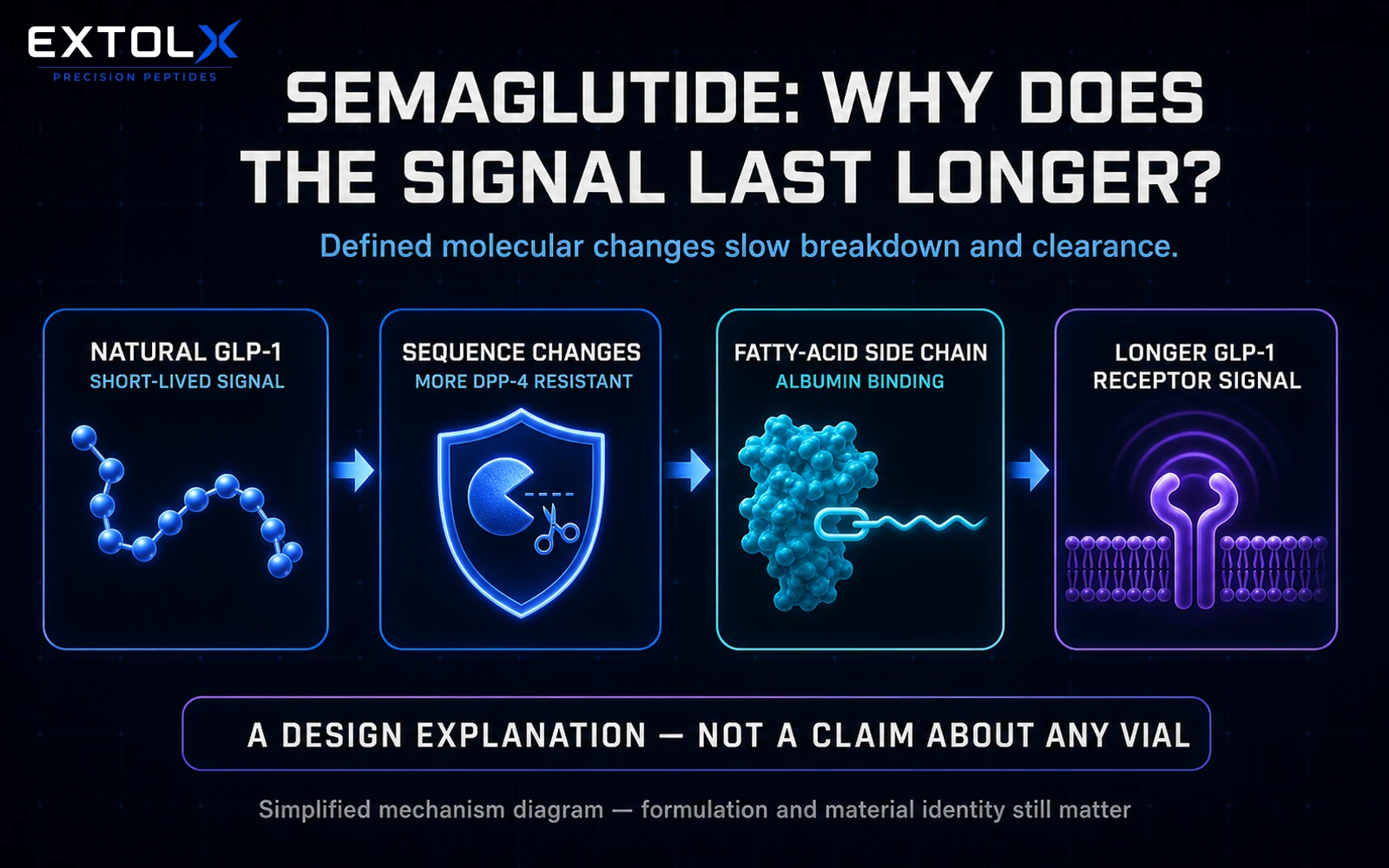
Semaglutide is a laboratory-designed version of GLP-1, a hormone released after eating. Its sequence and side chain have been modified so that it is broken down more slowly and can remain in the circulation for longer than natural GLP-1.
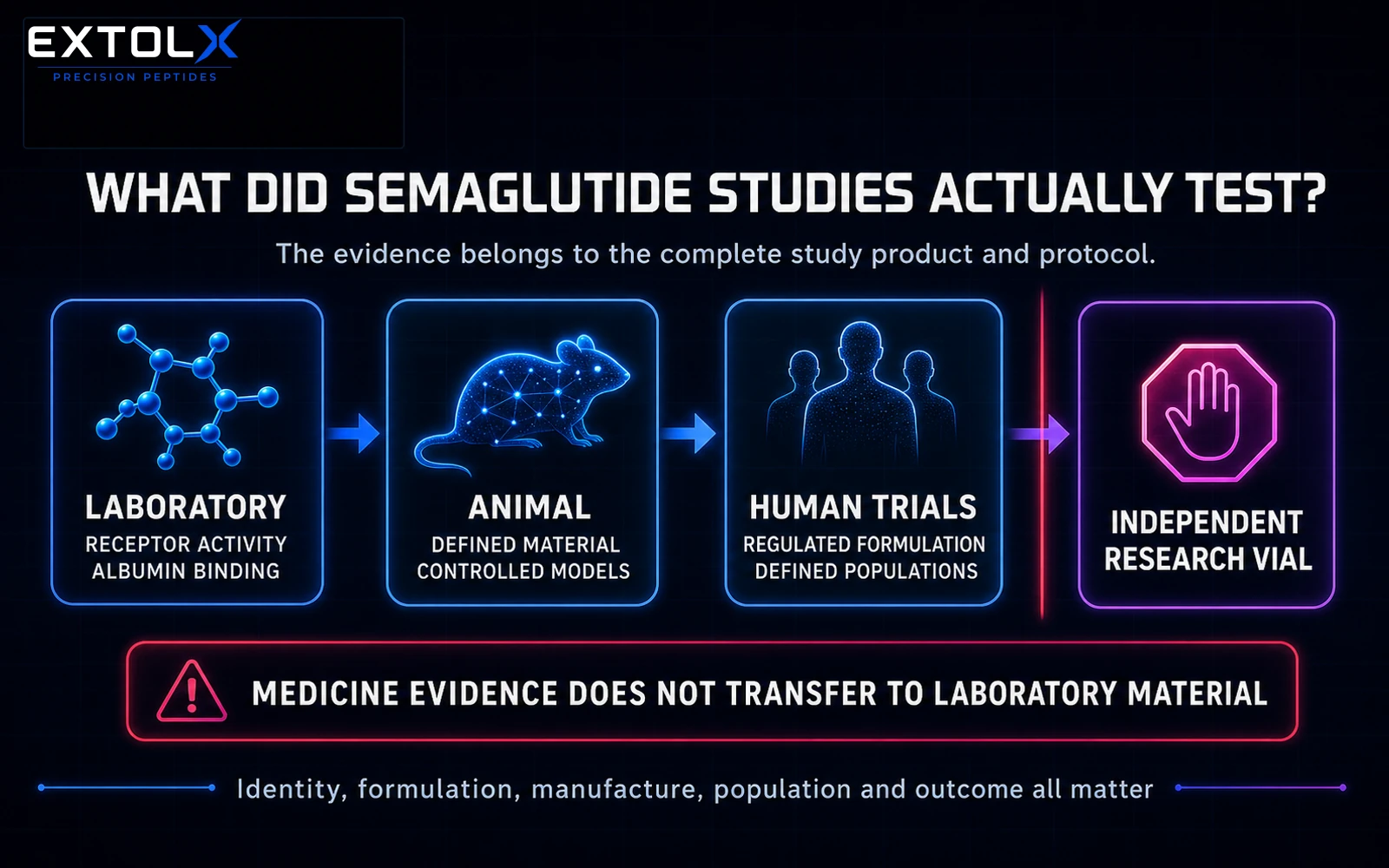
Semaglutide has an unusually large human evidence base because several regulated medicines contain it. That evidence is specific to the pharmaceutical formulations, manufacturing controls, populations and outcomes used in those trials. It does not turn independently supplied laboratory material into a medicine.
The short version
- Semaglutide is a modified analogue of human GLP-1.
- It activates the GLP-1 receptor, which is involved in post-meal insulin signalling, glucagon regulation, digestion and fullness.
- Defined sequence changes make it more resistant to enzymatic breakdown.
- A fatty-acid side chain helps it bind to albumin, a common blood protein, which slows clearance.
- Laboratory and animal studies explain parts of its receptor action and longer exposure.
- Large controlled human trials have tested regulated semaglutide medicines in defined metabolic and cardiovascular populations.
- UK licences apply to named pharmaceutical products and their approved uses, not to generic research vials.
- Semaglutide markers are on WADA’s 2026 Monitoring Program, which is separate from the Prohibited List.
On This Page
- The short version
- What is semaglutide?
- How does GLP-1 receptor signalling work?
- What does laboratory research show?
- What does animal research add?
- What has been tested in people?
- Where are evidence-transfer mistakes made?
- What remains unknown?
- What is the UK regulatory position?
- What does anti-doping regulation say?
- What would better research look like?
- Plain-English glossary
- Explore Semaglutide research material
- References and further reading
What is semaglutide?
Natural GLP-1 is a peptide hormone made in the gut. It helps coordinate the body’s response to food, but enzymes remove it quickly from the circulation.
Semaglutide keeps the broad GLP-1 shape while changing selected parts of the molecule. One substitution improves resistance to the enzyme DPP-4. A fatty-acid side chain increases binding to albumin. Together, these design choices lengthen how long the signal remains available.
The research codes NN9535 and NNC 0113-0217 may appear in older development literature. A research code identifies the molecule’s development history; it does not establish that every product carrying the same name is the same finished formulation.
How does GLP-1 receptor signalling work?
The practical point is that the GLP-1 receptor is a message receiver, not a single-purpose switch. Its effect depends on the tissue, the glucose level and the wider biological context.
- In the pancreas, GLP-1 receptor signalling supports insulin release when glucose is raised and can reduce glucagon signalling.
- In the digestive system, it can slow how quickly food leaves the stomach.
- In nervous-system pathways, it contributes to fullness and food-intake regulation.
- Across a longer period, regulated-medicine trials measure outcomes such as blood sugar, body weight and cardiovascular or kidney events in selected populations.
These connected effects help explain the research programme, but they do not mean that every GLP-1-related outcome is caused by the same pathway or will appear in every study.
What does laboratory research show?
Laboratory studies established the molecule’s receptor activity, resistance to DPP-4 breakdown and binding to albumin. They also compare semaglutide with natural GLP-1 and earlier analogues in receptor-expressing cell systems.
This work explains why semaglutide can provide a longer GLP-1 receptor signal. A receptor assay does not show a clinical benefit, and albumin binding in a controlled system does not define the performance of an uncharacterised finished product.
What does animal research add?
Animal research connects receptor activity with whole-body signalling. Rodent studies have examined food intake, body weight, glucose control and the brain pathways engaged after semaglutide exposure.
One detailed mouse and rat programme mapped semaglutide access and activation across selected brain regions. The authors reported direct access to some areas near brain fluid spaces and wider indirect neural activation. This supports a more distributed mechanism than a single “appetite centre”. It remains animal evidence and should not be used to claim a precise subjective effect in people.
What has been tested in people?
The human evidence is extensive, but it is not one undivided block. Different trials test different regulated semaglutide products, populations, comparisons and outcomes.
Blood-sugar research
The SUSTAIN programme tested an injectable pharmaceutical formulation in adults with type 2 diabetes. Controlled trials measured long-term blood sugar, body weight and unwanted effects against placebo or active medicines.
Weight-management research
The STEP programme tested a different licensed use in adults with overweight or obesity. STEP 1 was a large randomised trial that compared regulated semaglutide medicine with placebo alongside a structured lifestyle programme.
Cardiovascular and kidney outcomes
Later trials asked whether changes extended beyond blood tests and body weight. SELECT enrolled more than 17,000 adults with established cardiovascular disease and overweight or obesity but without diabetes. FLOW studied adults with type 2 diabetes and chronic kidney disease. Both were controlled outcome trials of specified pharmaceutical formulations in tightly defined populations.
These programmes provide strong evidence for the medicines and questions they tested. They do not provide evidence for an independent lyophilised research material, a different formulation or a person outside the study population.
Where are evidence-transfer mistakes made?
- Natural GLP-1 and semaglutide are treated as interchangeable. Semaglutide is deliberately modified and remains available for much longer.
- All semaglutide products are treated as one formulation. Licensed injected and oral medicines use different formulations and evidence packages.
- Medicine trials are applied to a research vial. The trial product’s manufacture, excipients, quality system and clinical oversight are part of the evidence.
- One population becomes everyone. A result in people with type 2 diabetes, cardiovascular disease or chronic kidney disease answers a defined question.
- A result for semaglutide becomes a class claim. Other GLP-1 receptor agonists have different structures, exposure patterns and trial data.
- A measurement becomes a promise. Average group results do not predict an individual outcome.
What remains unknown?
- How long the balance of effects and unwanted effects changes over periods longer than the main trials.
- Which biological pathways account for each outcome and how much is mediated by body-weight change.
- Why individual responses and tolerability vary.
- What happens across populations not represented well in the major programmes.
- How outcomes compare directly across different GLP-1 and multi-receptor medicines.
- Whether any independent research material matches the identity, purity, stability, formulation and exposure of a regulated trial product.
What is the UK regulatory position?
The MHRA lists licensed semaglutide medicines in the UK under brand names including Wegovy, Ozempic and Rybelsus. Their licences cover particular products and approved uses. They are prescription-only medicines supplied through regulated routes.
Those licences do not apply to a vial sold as laboratory research material. An independent product is not made equivalent to a medicine by sharing the active molecule’s name.
What does anti-doping regulation say?
WADA’s 2026 Monitoring Program includes markers of semaglutide and tirzepatide in and out of competition. The Monitoring Program tracks substances that are not on the Prohibited List so that WADA can detect patterns of use. Monitoring is not the same as prohibition, and sport-specific or medical rules can still apply separately.
What would better research look like?
The evidence base is already large, so the most useful next studies are not simply more short trials. They should explain durability, direct comparisons and who experiences which outcome.
- Longer follow-up after treatment changes or stops.
- Direct head-to-head trials using clinically meaningful outcomes.
- Mechanistic studies that separate the effect of reduced food intake and body-weight change from other receptor-linked effects.
- Broader representation of age, ethnicity, disability and coexisting conditions.
- Transparent reporting of formulation, manufacture, missing data and discontinuation.
- Independent replication of important secondary findings.
Plain-English glossary
- GLP-1: A natural gut hormone released after food that helps coordinate insulin, glucagon, digestion and fullness signals.
- Analogue: A molecule based on a natural molecule but modified in a defined way.
- Receptor agonist: A molecule that activates a receptor.
- DPP-4: An enzyme that rapidly breaks down natural GLP-1 and some other peptides.
- Albumin: A common blood protein. Binding to it can slow how quickly a molecule is cleared.
- Formulation: The active molecule together with the other materials and manufacturing design that make the finished product.
- Outcome trial: A study designed to measure events that matter directly, rather than only short-term laboratory markers.
- Monitoring Program: WADA surveillance of substances that are not on the Prohibited List.
Explore Semaglutide research material
ExtolX Semaglutide 10MG and ExtolX Semaglutide 20MG are listed as independent laboratory research materials with a stated purity of at least 99%. At the review date, both product listings stated that a supplier Certificate of Analysis was available.
These products are not licensed semaglutide medicines and are not the sponsor-manufactured formulations used in SUSTAIN, STEP, SELECT, FLOW or other clinical programmes.
References and further reading
- Discovery and design of once-weekly semaglutide — PubMed
- Semaglutide neural-pathway research in rodents — JCI Insight
- SUSTAIN 2 controlled type 2 diabetes trial — PubMed
- STEP 1 controlled obesity trial — PubMed
- SELECT cardiovascular outcome trial — PubMed
- FLOW kidney outcome trial — PubMed
- UK licensing context for GLP-1 medicines — MHRA
- 2026 Monitoring Program — WADA
Research-use notice: ExtolX products are supplied strictly for legitimate laboratory research. They are not intended for human or veterinary use, consumption, diagnosis, treatment or prevention of disease.