
Evidence reviewed: 23 August 2026
Author: ExtolX Editorial Team
This is an educational overview of published research, not medical advice.
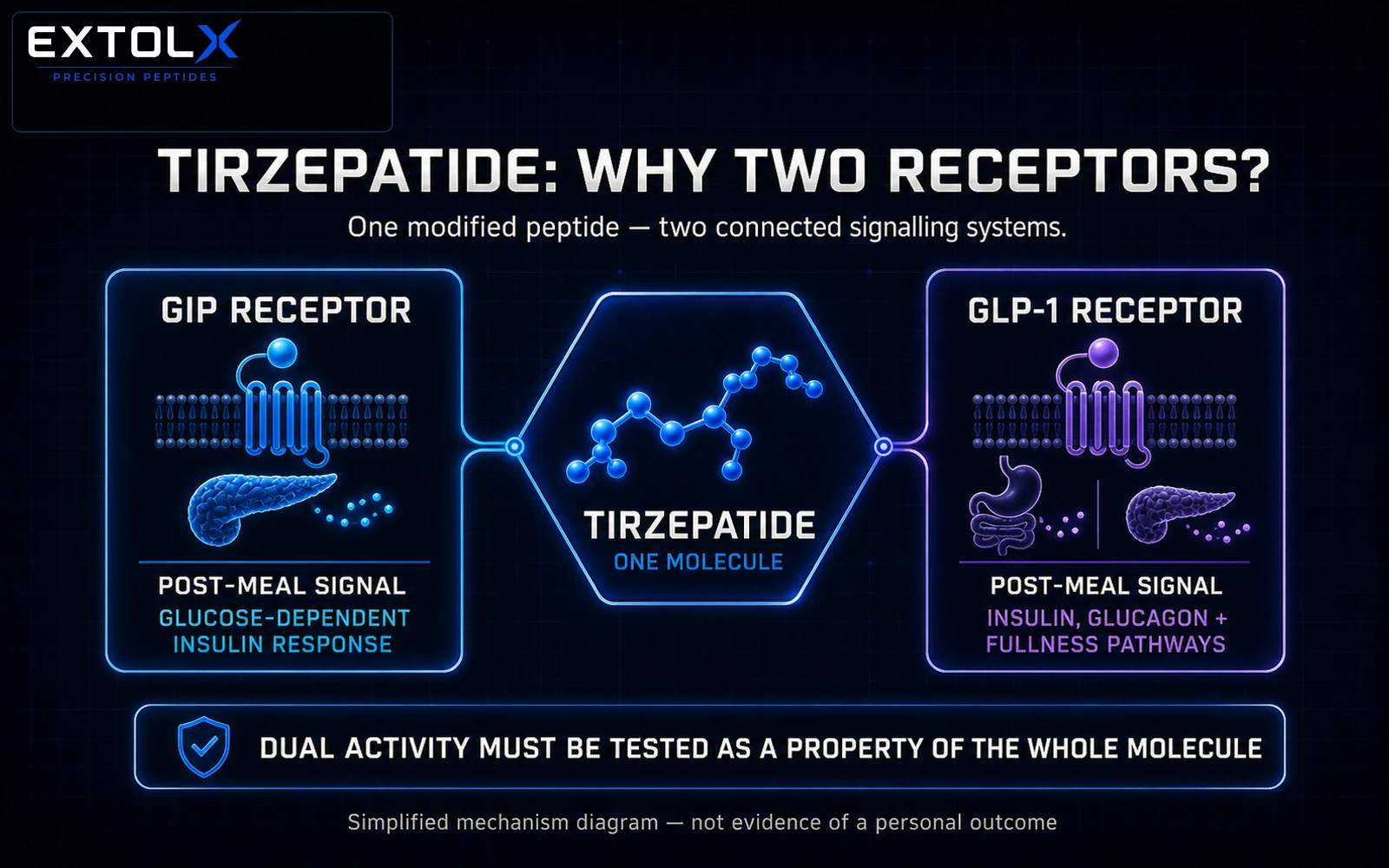
Tirzepatide is a laboratory-designed peptide that activates two hormone receptors involved in the body’s response to food: the GIP receptor and the GLP-1 receptor. That is why it is called a dual-receptor agonist.
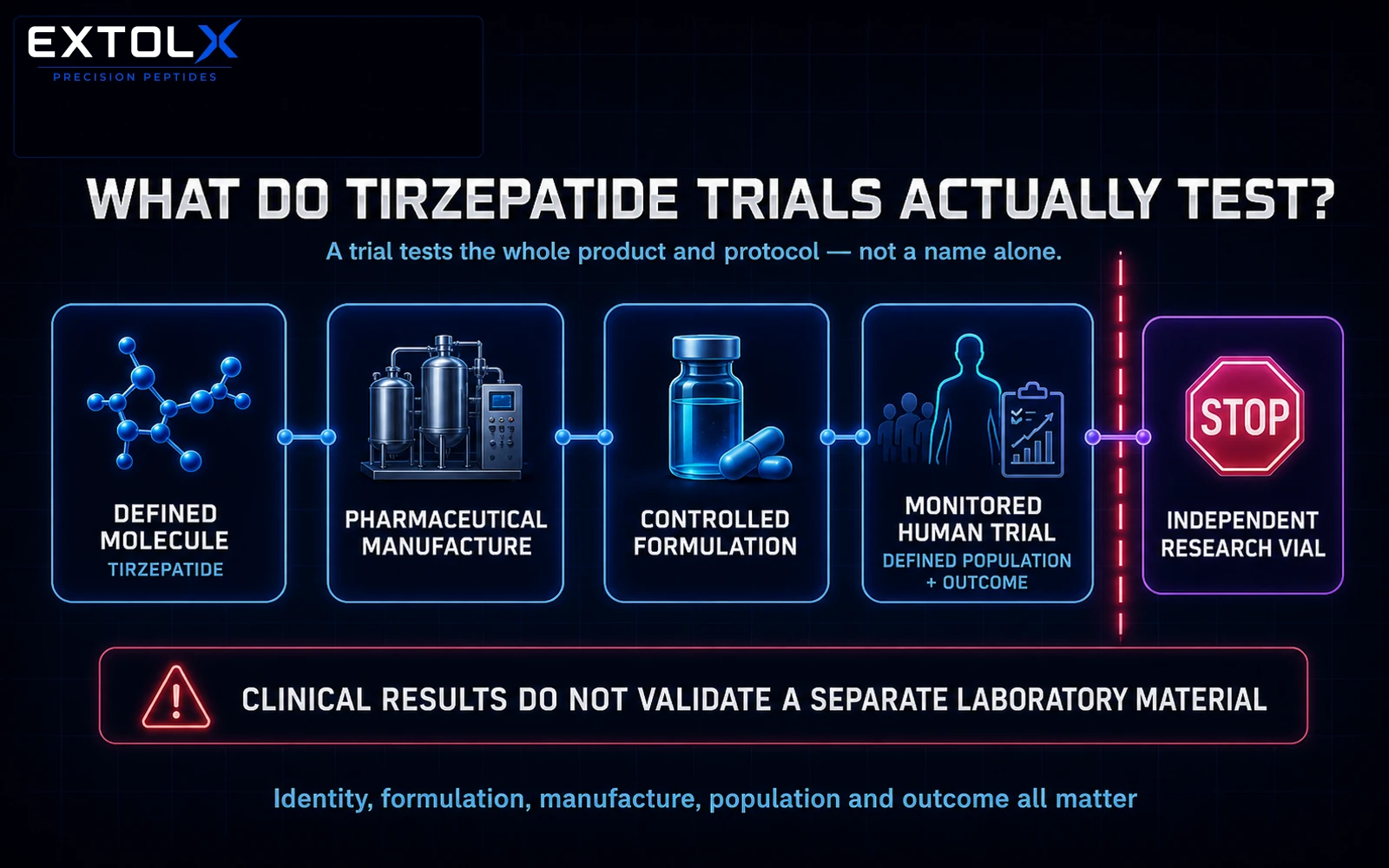
It is tempting to describe tirzepatide as “GIP plus GLP-1”, but that is too simple. One molecule interacts with both receptors, and its strength and signalling pattern at each receptor are not identical to the natural hormones. Human evidence comes from regulated pharmaceutical tirzepatide, not from independently supplied research material.
The short version
- Tirzepatide, originally called LY3298176, is a modified 39-amino-acid peptide.
- It activates both the GIP and GLP-1 receptors.
- A fatty-acid side chain helps extend how long it remains in the circulation.
- Cell studies show that its activity is not equally balanced at the two receptors.
- Animal research connected dual-receptor signalling with metabolic changes before human trials began.
- Large controlled human programmes have tested regulated tirzepatide medicine in type 2 diabetes, obesity and selected related conditions.
- UK authorisation applies to Mounjaro as a defined prescription medicine, not to independent research material.
- WADA monitors markers of tirzepatide in 2026; monitoring is not the same as being on the Prohibited List.
On This Page
- The short version
- What is tirzepatide?
- Why use two receptor systems?
- What does laboratory research show?
- What does animal research add?
- What has been tested in people?
- Where are evidence-transfer mistakes made?
- What remains unknown?
- What is the UK regulatory position?
- What does anti-doping regulation say?
- What would better research look like?
- Plain-English glossary
- Explore Tirzepatide research material
- References and further reading
What is tirzepatide?
Tirzepatide is a synthetic peptide built from features of GIP, with selected changes that allow it to activate both the GIP and GLP-1 receptors. It also carries a fatty-acid side chain that supports binding to albumin and slower clearance.
GIP stands for glucose-dependent insulinotropic polypeptide. GLP-1 stands for glucagon-like peptide 1. Both are incretin hormones, meaning they are released around meals and help coordinate the body’s response to incoming nutrients.
The development code LY3298176 appears in early studies. The code, generic name and brand name are related, but they are not interchangeable labels for every material. A finished medicine also includes its formulation, manufacturing controls and quality system.
Why use two receptor systems?
The practical research question is whether one molecule can coordinate two related signals in a useful and predictable way.
The GIP receptor
GIP is released after food and helps the pancreas increase insulin when glucose is raised. GIP receptors also appear in other tissues, and researchers continue to study how those signals contribute to the overall response.
The GLP-1 receptor
GLP-1 receptor signalling also supports glucose-dependent insulin release. It can reduce glucagon signalling, slow stomach emptying and contribute to fullness through digestive and nervous-system pathways.
One molecule does not mean equal signalling
Cell studies describe tirzepatide as an imbalanced and biased dual agonist. In plain English, it does not activate both receptors with exactly the same strength or copy every signal produced by the natural hormones. That makes its combined action a distinct research question.
What does laboratory research show?
Laboratory studies test receptor binding, the cellular messenger cAMP and what happens after a receptor is activated. They compare tirzepatide with natural GIP, natural GLP-1 and single-receptor agonists.
This work established that tirzepatide can activate both receptors while producing different signalling patterns at each. It helps explain the molecule’s design, but it cannot show a clinical outcome.
What does animal research add?
Preclinical studies tested whether dual-receptor activity produced measurable whole-body changes before larger human programmes began. Research in mouse models examined glucose, insulin, food intake, body weight and energy use.
These experiments supported the decision to move into clinical trials. They do not prove that both receptors contribute in the same way in humans, and they do not establish the effect of an independently supplied material.
What has been tested in people?
Human research is extensive and includes several large programmes. Each programme answers a defined question using regulated sponsor-manufactured tirzepatide.
Type 2 diabetes research
The SURPASS programme tested blood-sugar control, body weight and unwanted effects in adults with type 2 diabetes. SURPASS-1 was a placebo-controlled phase 3 trial in adults whose diabetes was not adequately controlled with diet and exercise alone.
Obesity research
The SURMOUNT programme studied adults with overweight or obesity in several settings. SURMOUNT-1 enrolled more than 2,500 adults without diabetes and measured body-weight change and safety over 72 weeks.
Research beyond blood sugar and body weight
Later controlled trials asked narrower questions in selected conditions. SYNERGY-NASH used liver biopsies to study metabolic dysfunction-associated steatohepatitis with fibrosis. SUMMIT studied adults with obesity-related heart failure with preserved ejection fraction and measured clinical events and health status.
These results have expanded the evidence base for regulated tirzepatide medicine. They do not mean every finding applies to every person, and they do not establish the identity, exposure, effectiveness or safety of a separate research vial.
Where are evidence-transfer mistakes made?
- Tirzepatide is described as two drugs mixed together. It is one molecule with activity at two receptors.
- GIP and GLP-1 effects are simply added. The interaction and signalling balance are properties of the combined molecule and must be tested directly.
- Semaglutide evidence is borrowed. Tirzepatide and semaglutide have different structures, receptor profiles and evidence packages.
- One trial population becomes all populations. Diabetes, obesity, liver disease and heart-failure studies have different entry criteria and outcomes.
- A medicine name is treated as a quality specification. The clinical evidence includes pharmaceutical manufacture, formulation and monitored storage.
- Average trial results become an individual prediction. Group averages do not establish what will happen in a particular person.
What remains unknown?
- How much each receptor contributes to each human outcome.
- Which cellular signalling differences are clinically important.
- How effects and unwanted effects change over periods longer than the main trials.
- What happens after treatment is stopped across different populations.
- How tirzepatide compares directly with newer multi-receptor medicines on long-term clinical outcomes.
- Which secondary findings will be reproduced independently.
- Whether an independent research material matches the exact identity, purity, formulation, stability and exposure of a regulated trial product.
What is the UK regulatory position?
The MHRA has authorised Mounjaro, a regulated tirzepatide medicine, for specified uses in the UK. It is a prescription-only product with a defined formulation, manufacturer and product information.
That authorisation does not apply to independently supplied tirzepatide research material. The generic name identifies a molecule; it does not transfer a medicine’s licence or evidence package to another product.
What does anti-doping regulation say?
WADA’s 2026 Monitoring Program includes markers of tirzepatide and semaglutide in and out of competition. The programme is used to observe patterns involving substances that are not on the Prohibited List. Monitoring should not be described as a ban, and it is separate from medicine and sport-specific rules.
What would better research look like?
The next useful step is to explain the dual mechanism more precisely and test long-term outcomes directly.
- Mechanistic studies that can separate GIP-receptor and GLP-1-receptor contributions.
- Longer follow-up during and after treatment.
- Direct comparisons with established single- and dual-receptor medicines.
- Trials powered for clinical outcomes rather than only laboratory or imaging markers.
- Broader population representation and transparent discontinuation reporting.
- Independent replication using fully characterised pharmaceutical material.
Plain-English glossary
- GIP: A natural hormone released after food that helps coordinate insulin and nutrient-related signals.
- GLP-1: A natural gut hormone involved in insulin, glucagon, digestion and fullness signals.
- Incretin: A gut hormone that helps the body respond to food, including glucose-dependent insulin release.
- Dual-receptor agonist: One molecule designed to activate two different receptors.
- Biased signalling: A receptor response in which some internal signalling routes are favoured over others.
- cAMP: A small messenger inside cells that researchers measure after some receptors are activated.
- Albumin: A common blood protein. Binding to it can slow clearance of a molecule.
- Formulation: The active molecule together with the other materials and manufacturing design in the finished product.
Explore Tirzepatide research material
ExtolX Tirzepatide 10MG, ExtolX Tirzepatide 20MG and ExtolX Tirzepatide 30MG are listed as independent laboratory research materials with a stated purity of at least 99%. At the review date, all three product listings stated that a supplier Certificate of Analysis was available.
These products are not Mounjaro and are not the sponsor-manufactured formulations used in SURPASS, SURMOUNT, SYNERGY-NASH, SUMMIT or other clinical programmes.
References and further reading
- Discovery, preclinical work and early clinical proof of concept for LY3298176 — PubMed
- Research on tirzepatide’s imbalanced and biased dual-receptor signalling — PubMed
- SURPASS-1 controlled type 2 diabetes trial — PubMed
- SURMOUNT-1 controlled obesity trial — PubMed
- SYNERGY-NASH phase 2 trial — PubMed
- SUMMIT heart-failure outcome trial — PubMed
- UK licensing context for tirzepatide and other GLP-1-related medicines — MHRA
- 2026 Monitoring Program — WADA
Research-use notice: ExtolX products are supplied strictly for legitimate laboratory research. They are not intended for human or veterinary use, consumption, diagnosis, treatment or prevention of disease.