
Evidence reviewed: 24 August 2026
Author: ExtolX Editorial Team
This is an educational overview of published research, not medical advice.
CJC-1295 with DAC is a laboratory-designed version of growth hormone-releasing hormone. Its defining feature is an albumin-binding group intended to keep the molecule in circulation for longer.
That design has been demonstrated in laboratory and animal work, and small studies in healthy adults measured longer-lasting changes in growth hormone and IGF-1. Those studies did not establish a treatment benefit, long-term safety or equivalence with independently supplied research material.
The short version
- CJC-1295 with DAC is a 29-amino-acid analogue of growth hormone-releasing hormone, usually shortened to GHRH.
- The drug affinity complex, or DAC, is designed to form a bond with albumin, a common protein in blood.
- It is not the same research identity as the shorter-acting material often sold as “CJC-1295 no DAC” or modified GRF(1–29).
- Laboratory and animal studies support the albumin-binding mechanism and show changes in growth-hormone signalling.
- Human studies were small, early-stage and conducted mainly in healthy adults. They measured hormone biomarkers rather than clinical outcomes.
- CJC-1295 is not an authorised medicine and is explicitly prohibited by the 2026 World Anti-Doping Agency list.
On This Page
- The short version
- What is CJC-1295 with DAC?
- How does the DAC change the research question?
- What does the laboratory evidence show?
- What have animal studies added?
- What has human research found?
- Where do evidence-transfer mistakes happen?
- What remains unknown?
- What is the regulatory position?
- What about anti-doping rules?
- What would better research look like?
- Plain-English glossary
- Explore CJC-1295 with DAC research material
- References and further reading
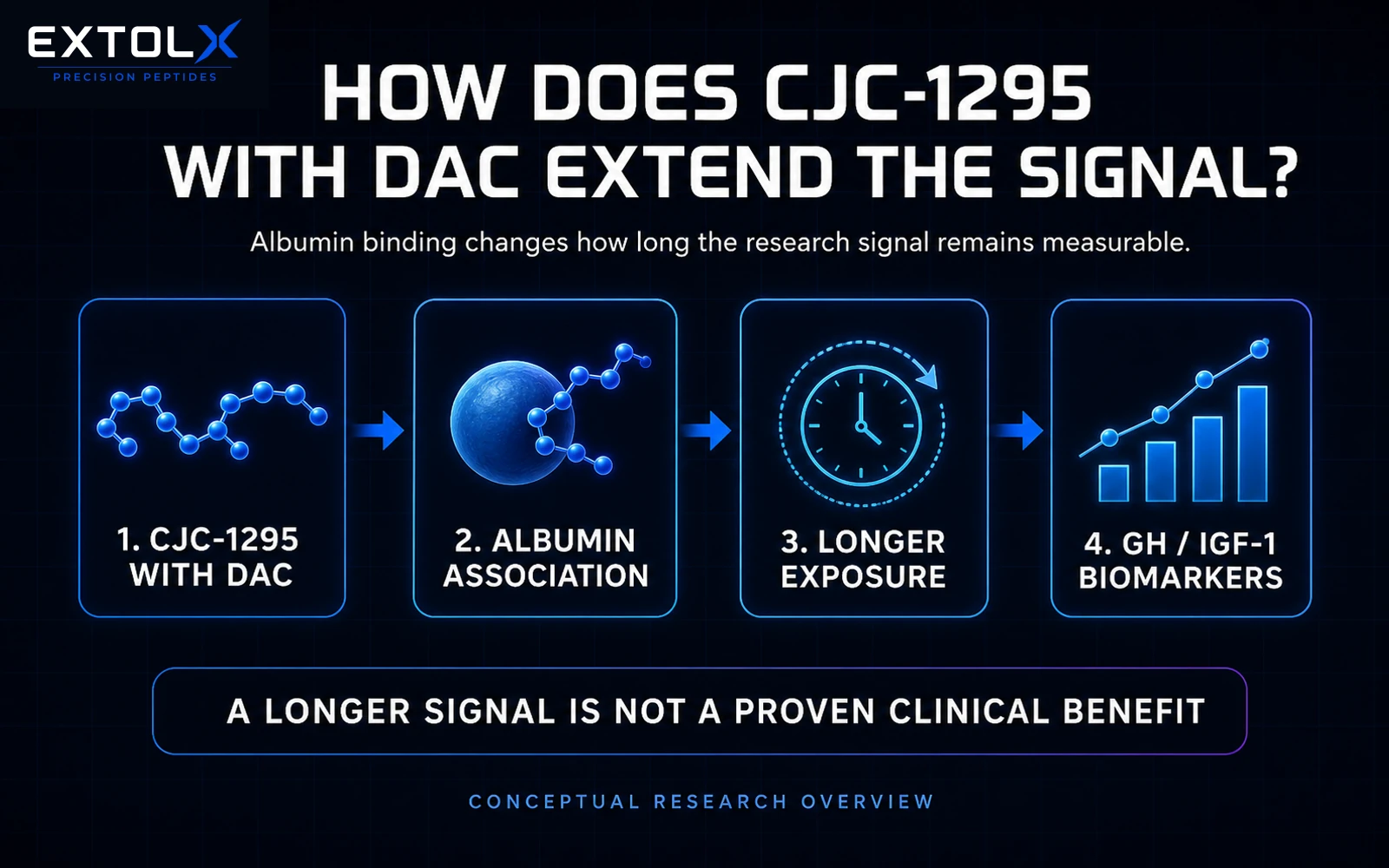
What is CJC-1295 with DAC?
The practical distinction is in the name: with DAC describes a long-acting albumin-binding design. It should not be treated as another name for the no-DAC material.
Natural GHRH is a hormone signal made in the hypothalamus, a part of the brain. It travels to the pituitary gland and helps trigger the release of growth hormone. Natural GHRH is broken down quickly.
CJC-1295 is a synthetic analogue based on the first 29 amino acids of GHRH. Several amino-acid changes were introduced to make it more resistant to breakdown. A reactive group—the DAC—was also added so the molecule could attach to albumin.
Albumin circulates for much longer than an unprotected small peptide. Attaching the peptide to albumin is therefore intended to extend how long the signal remains measurable.
How does the DAC change the research question?
The DAC changes exposure, not the standard of evidence. A molecule that lasts longer still needs controlled studies to show what its extended signal means in people.
In the original development work, a maleimide group on CJC-1295 reacted with a free sulphur-containing site on albumin called cysteine-34. Researchers described this as in-vivo bioconjugation: the bond forms after the material enters a biological system.
Once associated with albumin, CJC-1295 can continue stimulating the GHRH receptor at the pituitary. The immediate measurements are growth hormone and IGF-1. IGF-1 is a downstream signal influenced by growth hormone.
These are biomarkers—measurable biological changes. A biomarker can show that a pathway responded, but it does not by itself establish a meaningful health outcome.
What does the laboratory evidence show?
The laboratory evidence supports the intended molecular design. It does not answer whether the material produces a useful or safe clinical effect.
Researchers made three maleimide-containing analogues of human GRF(1–29), attached them to human albumin outside the body and tested them in cultured rat pituitary cells. The albumin conjugates were more resistant to an enzyme that normally breaks down GHRH and remained capable of stimulating growth-hormone release.
This work established two important points: the albumin-binding chemistry could occur, and the resulting conjugate could still activate the intended signalling pathway in that assay.
It did not test a complete human body, a disease, a long-term outcome or the independently supplied ExtolX material.
What have animal studies added?
Animal studies show that the albumin-binding design can extend exposure in a living system. Species and model differences still limit what can be transferred to humans.
In rats, the original development study found an immunoreactive CJC-1295 signal at the albumin band within 15 minutes and beyond 24 hours. The peptide remained detectable in plasma beyond 72 hours, and the growth-hormone response over two hours was greater than with the shorter GRF(1–29) comparator.
A separate study used mice genetically unable to produce their own GHRH. CJC-1295 altered growth and hormone measures in this specialised model. That model is valuable for testing GHRH biology, but it does not represent the general population or establish a clinical use.
What has human research found?
The human evidence shows prolonged hormone signalling in healthy adults. It does not show a proven treatment effect.
Early healthy-volunteer trials
Two randomised, double-blind, placebo-controlled, ascending-exposure trials lasted 28 and 49 days. Participants were healthy adults aged 21 to 61.
The studies measured CJC-1295 in the body and changes in growth hormone and IGF-1. After a single exposure, average growth-hormone concentrations remained raised for six days or more and average IGF-1 remained raised for nine to eleven days. The estimated terminal half-life was about 5.8 to 8.1 days.
These findings describe pharmacokinetics—how long the studied material remained measurable—and pharmacodynamics—what biological signals changed. The trials were not designed to show whether participants became healthier or experienced a lasting clinical benefit.
Growth-hormone pulse study
A further small study took blood samples every 20 minutes overnight in healthy men. One week after CJC-1295 exposure, average and lowest growth-hormone levels were higher while the pulse pattern remained present.
Again, the outcome was hormone secretion—not a patient-centred result. The published programme did not progress into a modern body of large, long-duration trials demonstrating clinical effectiveness.
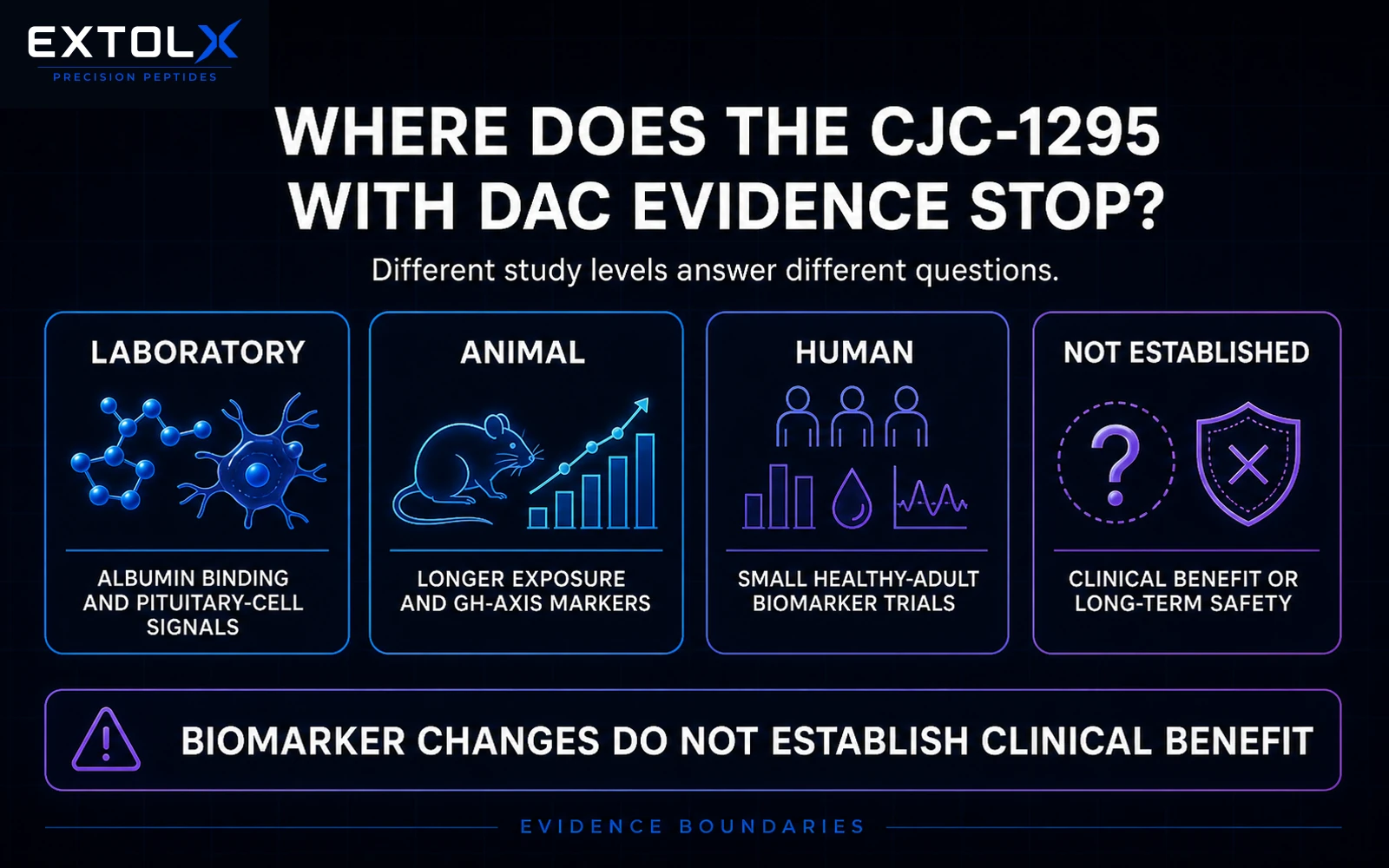
Where do evidence-transfer mistakes happen?
The most common mistake is treating all products called “CJC-1295” as the same material. They are not necessarily interchangeable.
- With DAC is not no DAC: the albumin-binding group changes exposure and therefore changes the research question.
- A hormone rise is not a clinical benefit: GH and IGF-1 are pathway measurements, not proof of improved health, recovery or performance.
- Natural GHRH is not the synthetic analogue: the analogue contains structural changes intended to alter stability and duration.
- A named molecule is not every formulation: free base, acetate and trifluoroacetate forms, excipients and manufacturing controls may differ.
- A sponsor-manufactured trial material is not an independent research vial: identity labels alone do not establish pharmaceutical equivalence.
What remains unknown?
The major unknown is whether the prolonged biomarker signal translates into any useful clinical outcome with an acceptable long-term risk profile.
- There is no large modern trial programme establishing effectiveness for a defined condition.
- Long-term safety and uncommon unwanted effects are not well characterised.
- The consequences of maintaining altered GH and IGF-1 signalling over long periods remain uncertain.
- Published findings cannot establish the identity, salt form, impurity profile or biological equivalence of every independently supplied material.
- There is no evidence that findings from CJC-1295 with DAC can be transferred to a no-DAC material or to a blend.
What is the regulatory position?
CJC-1295 with DAC is not an authorised medicine. The early human studies did not create an approved indication.
In December 2024, the US Food and Drug Administration proposed that CJC-1295-related free-base, acetate and DAC forms should not be added to the section 503A bulk substances list. FDA’s current compounding-risk information also identifies limited clinical data, peptide-quality and immune-response concerns, and serious reactions associated with CJC-1295, including increased heart rate and a systemic widening of blood vessels.
That US compounding process is not a medicine approval system and does not regulate the ExtolX catalogue. It is relevant because it illustrates how regulators separate a named bulk substance from an approved, quality-controlled medicine.
What about anti-doping rules?
Athletes subject to the World Anti-Doping Code should treat this point as clear: the 2026 Prohibited List names CJC-1295 among growth hormone-releasing hormone analogues prohibited at all times.
Research-use labelling does not change an athlete’s responsibility under anti-doping rules.
What would better research look like?
Better evidence would start by defining the exact molecule and asking a clinically meaningful question rather than relying on hormone measurements alone.
- Confirm the sequence, DAC chemistry, salt form, purity, aggregation and impurity profile of the studied material.
- Use a registered, randomised and adequately powered comparison in a clearly defined population.
- Pre-specify patient-centred outcomes as well as GH and IGF-1 biomarkers.
- Include enough follow-up to assess sustained effects, uncommon events and consequences of prolonged signalling.
- Publish complete methods and results so independent researchers can evaluate the work.
Plain-English glossary
- Albumin: A common blood protein that transports many substances and remains in circulation for a relatively long time.
- Analogue: A laboratory-designed molecule based on a natural one but changed in specific ways.
- Biomarker: A measurable biological sign, such as a hormone concentration.
- DAC: Drug affinity complex; the reactive group intended to form a bond with albumin.
- GHRH: Growth hormone-releasing hormone, the natural signal that helps the pituitary release growth hormone.
- IGF-1: Insulin-like growth factor 1, a downstream signal influenced by growth hormone.
- Half-life: The time taken for the measured amount of a substance in the body to fall by half.
Explore CJC-1295 with DAC research material
ExtolX catalogues CJC-1295 with DAC research material in two separately listed amounts: CJC-1295 with DAC 2MG and CJC-1295 with DAC 5MG. Both listings describe white to off-white lyophilised powder with a catalogue purity specification of at least 99%.
At the review date, the 2MG page marked its certificate of analysis as pending. The 5MG page linked a third-party Janoshik certificate for that SKU and stated amount. Documentation for one SKU should not be transferred to another.
The product pages state that the counter-ion and formulation of the ExtolX batches have not been confirmed. These independently supplied laboratory materials are not the sponsor-manufactured material used in the cited human studies and should not be treated as equivalent to a medicine.
References and further reading
- Albumin bioconjugation, pituitary-cell and rat study — PubMed
- GHRH-knockout mouse study — PubMed
- Randomised healthy-adult pharmacology trials — PubMed
- Growth-hormone pulsatility study — PubMed
- CJC-1295 study record — ClinicalTrials.gov
- 2024 CJC-1295 compounding briefing — FDA
- Bulk substances that may present significant safety risks — FDA
- 2026 Prohibited List — WADA
- UK medicine-authorisation information — MHRA
Research-use notice: ExtolX materials are supplied for laboratory research only and are not for human or veterinary use.