
Evidence reviewed: 24 August 2026
Author: ExtolX Editorial Team
This is an educational overview of published research, not medical advice.
Ipamorelin is a synthetic five-amino-acid research peptide that activates the ghrelin receptor. Its best-established effect is a short-lived increase in measured growth-hormone release.
Most of the evidence is pharmacological: receptor assays, animal studies and small human studies measuring hormone signals. One controlled clinical study tested a digestive-recovery outcome after surgery and did not find a statistically significant benefit over placebo.
The short version
- Ipamorelin is a synthetic pentapeptide, meaning it contains five amino-acid units.
- It activates the growth hormone secretagogue receptor, also called the ghrelin receptor.
- It is not a GHRH analogue and is not growth hormone.
- Laboratory and animal research shows receptor activity and changes in pituitary growth-hormone release.
- An early human study characterised how long ipamorelin remained measurable and the short growth-hormone response it produced.
- A placebo-controlled postoperative study did not show a significant improvement in its main or secondary outcomes.
- Ipamorelin is not an authorised medicine and is explicitly prohibited by the 2026 World Anti-Doping Agency list.
On This Page
- The short version
- What is ipamorelin?
- How does the signal work?
- What does the laboratory evidence show?
- What have animal studies added?
- What has human research found?
- Where do evidence-transfer mistakes happen?
- What remains unknown?
- What is the regulatory position?
- What about anti-doping rules?
- What would better research look like?
- Plain-English glossary
- Explore Ipamorelin research material
- References and further reading
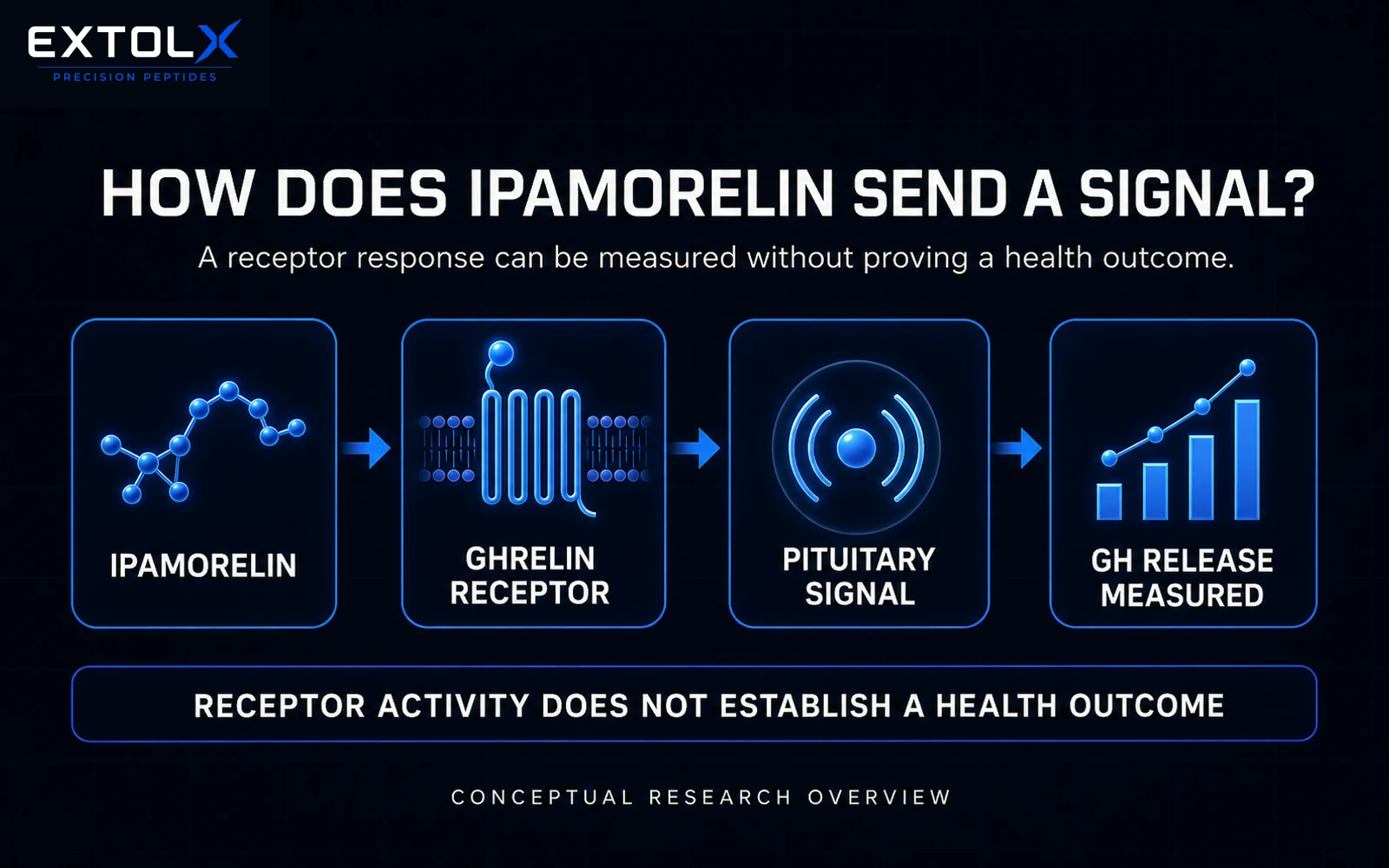
What is ipamorelin?
The key point is that ipamorelin imitates one part of ghrelin signalling. It is not natural ghrelin and should not inherit every effect attributed to that hormone.
Ghrelin is a natural hormone involved in appetite, digestive movement and communication with the pituitary gland. Its receptor is called GHS-R1a, short for growth hormone secretagogue receptor type 1a.
Ipamorelin is a laboratory-designed agonist for that receptor. An agonist is a molecule that switches a receptor on. Its sequence includes modified amino acids that are not found in ordinary proteins in the same form.
The original pharmacology programme described ipamorelin as more selective for growth-hormone release than some earlier growth hormone-releasing peptides. “More selective” does not mean that every other effect is absent, nor does it establish safety in unstudied settings.
How does the signal work?
Ipamorelin’s immediate research effect is receptor activation. What happens after that depends on the tissue, model, formulation and outcome being studied.
At the pituitary gland, activating the ghrelin receptor can trigger a pulse of growth hormone. Growth hormone can then influence downstream signals including IGF-1.
The ghrelin receptor is also involved in digestive movement. That is why ipamorelin was studied both as a hormone secretagogue and as an experimental way to influence recovery of bowel function after surgery.
These are separate questions. A growth-hormone response does not predict a digestive outcome, and neither one establishes a general health, recovery or performance effect.
What does the laboratory evidence show?
The laboratory work supports receptor activity and pituitary signalling. It does not establish how an independently supplied vial behaves in people.
In cultured rat pituitary cells, ipamorelin stimulated growth-hormone release. Experiments using receptor antagonists supported a mechanism similar to other growth hormone-releasing peptides rather than direct activation of the GHRH receptor.
Later tissue experiments also explored digestive smooth-muscle responses. These controlled preparations help researchers identify possible pathways, but they remove much of the complexity found in a living animal or person.
What have animal studies added?
Animal studies show that ipamorelin can affect several systems. They also demonstrate why one result should not be turned into a broad claim.
Early work in rats and conscious pigs recorded growth-hormone release after ipamorelin exposure. Studies in adult female rats examined bone growth and bone-mineral measures, while other rat experiments examined digestive movement after surgery.
In a rat model of postoperative ileus—the temporary slowing of the bowel after surgery—ipamorelin altered some movement and feeding measurements. This provided a reason to test the idea in humans. It did not guarantee that the human trial would succeed.
What has human research found?
The human evidence answers two narrow questions: what short-term hormone signal occurred in healthy volunteers, and whether one intravenous clinical programme improved postoperative bowel recovery.
Healthy-volunteer hormone study
A 1999 study used five escalating intravenous infusion levels, with eight healthy male volunteers at each level. Researchers measured ipamorelin and growth-hormone concentrations.
Ipamorelin showed an estimated terminal half-life of about two hours. Growth hormone rose as a single episode, reached its peak at about 40 minutes and then declined towards negligible levels.
This was a pharmacokinetic and pharmacodynamic study. It did not test growth, body composition, recovery, sleep, wellbeing or any other customer-relevant outcome.
Postoperative ileus study
A later multicentre, double-blind, placebo-controlled phase 2 study enrolled 117 adults undergoing bowel surgery; 114 were included in the main analysis. The studied material was given intravenously in hospital and was intended to test recovery of bowel function.
The median time to tolerating a standard solid meal was 25.3 hours with ipamorelin and 32.6 hours with placebo. The difference was not statistically significant, and the study found no significant differences in its key or secondary effectiveness analyses.
The result matters because it shows the gap between a plausible animal mechanism and a controlled human outcome. FDA’s later review concluded that the evidence did not support effectiveness for postoperative ileus or growth-hormone deficiency.
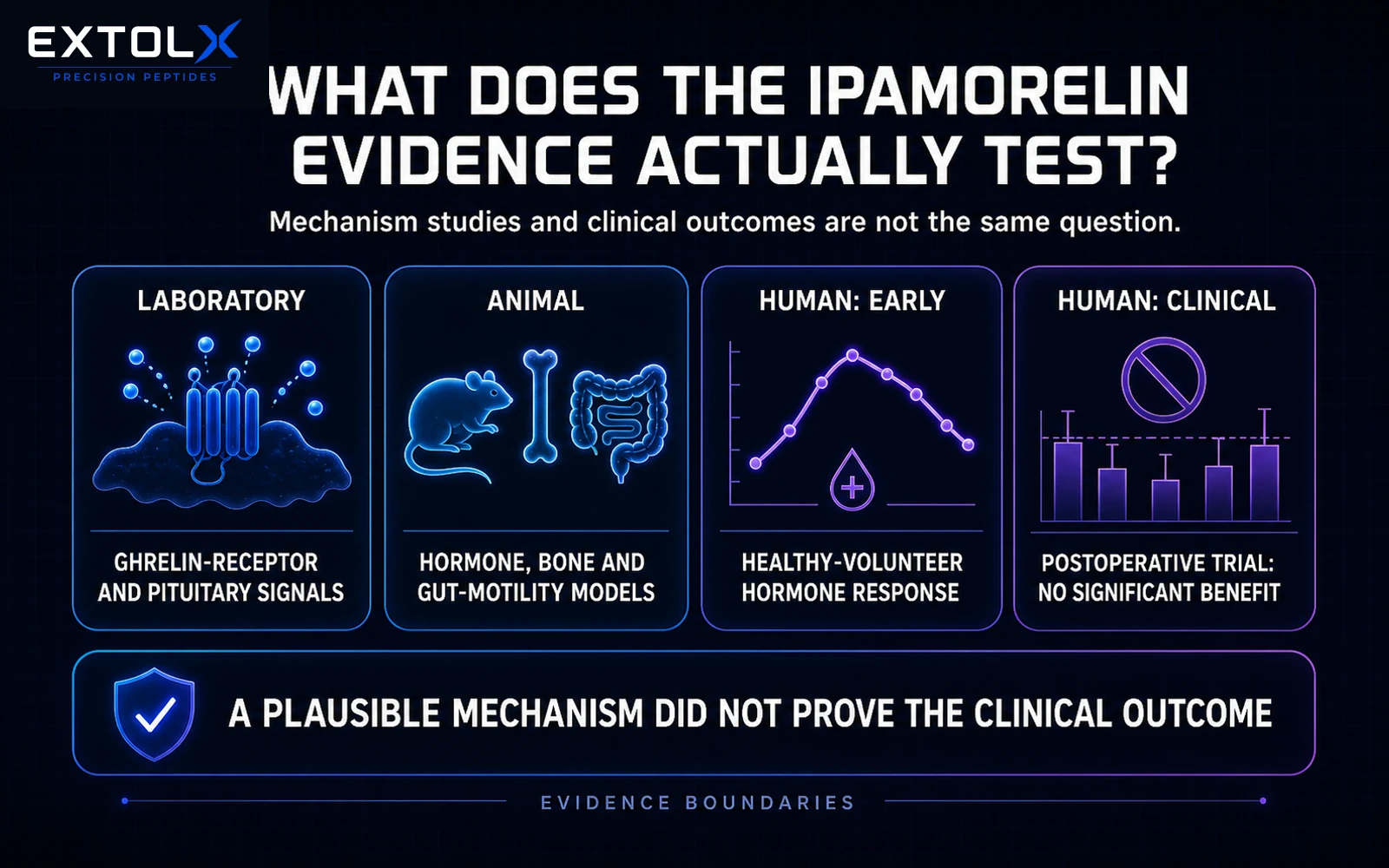
Where do evidence-transfer mistakes happen?
The central mistake is using evidence for one molecule, route or endpoint to answer a different question.
- Ipamorelin is not ghrelin: it activates the receptor but does not reproduce the complete natural hormone.
- It is not GHRH: ipamorelin and CJC-1295 act through different receptor systems.
- It is not a blend result: evidence for ipamorelin alone does not prove what happens with CJC-1295 or any other component.
- Growth-hormone release is not a health outcome: it shows pathway engagement, not effectiveness.
- Animal digestive movement is not human surgical recovery: the controlled human proof-of-concept study did not confirm the hoped-for benefit.
- An intravenous hospital formulation is not independent research material: route, form, manufacturing and quality controls can all change the research question.
What remains unknown?
There is no established clinical use for ipamorelin, and important safety and formulation questions remain unresolved.
- No controlled evidence establishes a benefit for growth-hormone deficiency, body composition, sleep, recovery or performance.
- FDA found no effectiveness data for the proposed subcutaneous use considered in its compounding review.
- Information about safety through several proposed routes is incomplete.
- FDA has highlighted possible immune responses caused by aggregates or peptide-related impurities and the extra analytical complexity created by modified amino acids.
- The free-base or acetate form of independently supplied material may not be confirmed, and evidence should not be transferred between forms without verification.
What is the regulatory position?
Ipamorelin is not an authorised medicine. A clinical study or a compounded preparation does not have the same status as an approved medicinal product.
FDA’s 2024 review concluded that available clinical information was limited and did not support effectiveness for the proposed uses it assessed. FDA also placed ipamorelin acetate in a category of nominated bulk substances that may present significant safety risks for certain compounded uses.
The agency noted serious events, including deaths, in an intravenous postoperative programme, while also stating that the causal role of ipamorelin was unclear. It reported insufficient information to know whether other proposed routes would cause harm. This uncertainty should not be rewritten as proof of either safety or danger in a different material.
What about anti-doping rules?
The 2026 World Anti-Doping Agency Prohibited List explicitly names ipamorelin among growth hormone secretagogues and their mimetics. It is prohibited at all times for athletes subject to the Code.
What would better research look like?
Better research would define one exact material and test one meaningful outcome in a population for whom the question matters.
- Verify sequence, salt form, purity, aggregation, impurities and formulation before the study starts.
- Use a registered, randomised and adequately powered comparison.
- Separate hormone biomarkers from clinical outcomes and pre-specify both.
- Include a route and formulation that match the research question.
- Provide sufficient follow-up and transparent reporting of all unwanted events.
- Study ipamorelin alone before making claims about a blend or interaction.
Plain-English glossary
- Agonist: A molecule that switches on a receptor.
- Ghrelin receptor: A biological message receiver involved in growth-hormone release, appetite and digestive movement.
- Growth hormone secretagogue: A substance that stimulates the release of growth hormone.
- Half-life: The time taken for the measured amount of a substance in the body to fall by half.
- Pentapeptide: A peptide made from five amino-acid units.
- Placebo: An inactive comparison used to test whether a measured change is caused by the studied intervention.
- Postoperative ileus: A temporary slowing or stopping of normal bowel movement after surgery.
Explore Ipamorelin research material
ExtolX catalogues ipamorelin research material in two separately listed amounts: Ipamorelin 5MG and Ipamorelin 10MG. Both pages describe white to off-white lyophilised powder with a catalogue purity specification of at least 99%.
At the review date, the 5MG page marked its certificate of analysis as pending. The 10MG page linked a third-party Janoshik certificate for that SKU and stated amount. The certificate status of one listing should not be transferred to the other.
The product pages state that the free-base or acetate form of the ExtolX batches has not been confirmed. These independently supplied laboratory materials are not the formulations used in the cited human trials and should not be treated as equivalent to a medicine.
References and further reading
- Original receptor, pituitary-cell and animal pharmacology study — PubMed
- Longitudinal bone-growth study in rats — PubMed
- Postoperative ileus model in rats — PubMed
- Healthy-volunteer pharmacokinetic and hormone-response study — PubMed
- Randomised postoperative ileus proof-of-concept trial — PubMed
- Postoperative gastrointestinal-recovery trial record — ClinicalTrials.gov
- 2024 ipamorelin compounding review — FDA
- Bulk substances that may present significant safety risks — FDA
- 2026 Prohibited List — WADA
- UK medicine-authorisation information — MHRA
Research-use notice: ExtolX materials are supplied for laboratory research only and are not for human or veterinary use.