
Evidence reviewed: 24 August 2026
Author: ExtolX Editorial Team
This is an educational overview of published research, not medical advice.
Epitalon is a synthetic peptide made from four amino acids: alanine, glutamic acid, aspartic acid and glycine. It is often discussed alongside pineal-gland biology, melatonin and telomeres, but the evidence behind those topics is uneven.
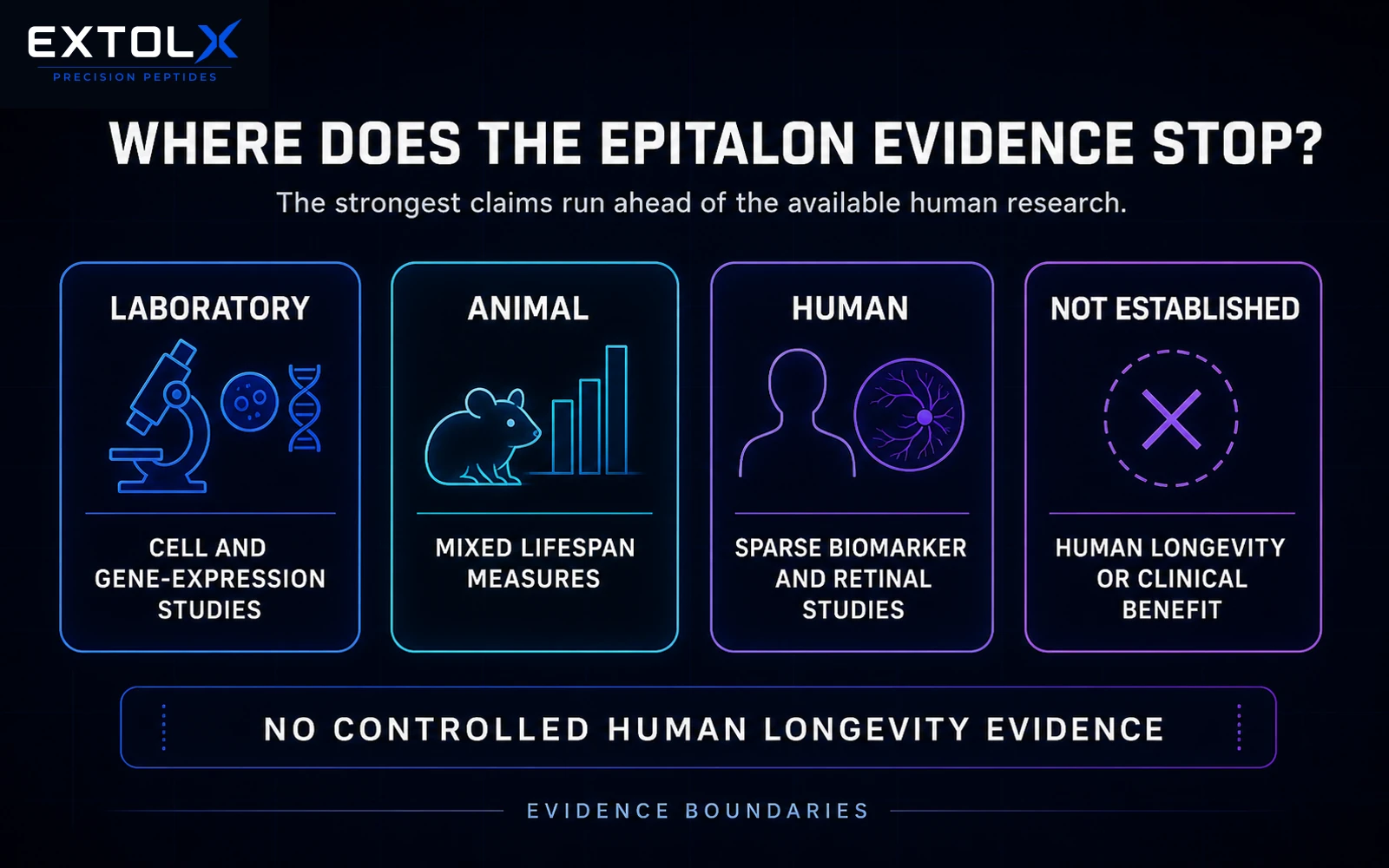
The best-known telomerase findings come from cells grown in a laboratory. Animal lifespan results are mixed, and the small human literature does not establish that Epitalon slows ageing, extends life or treats insomnia.
The short version
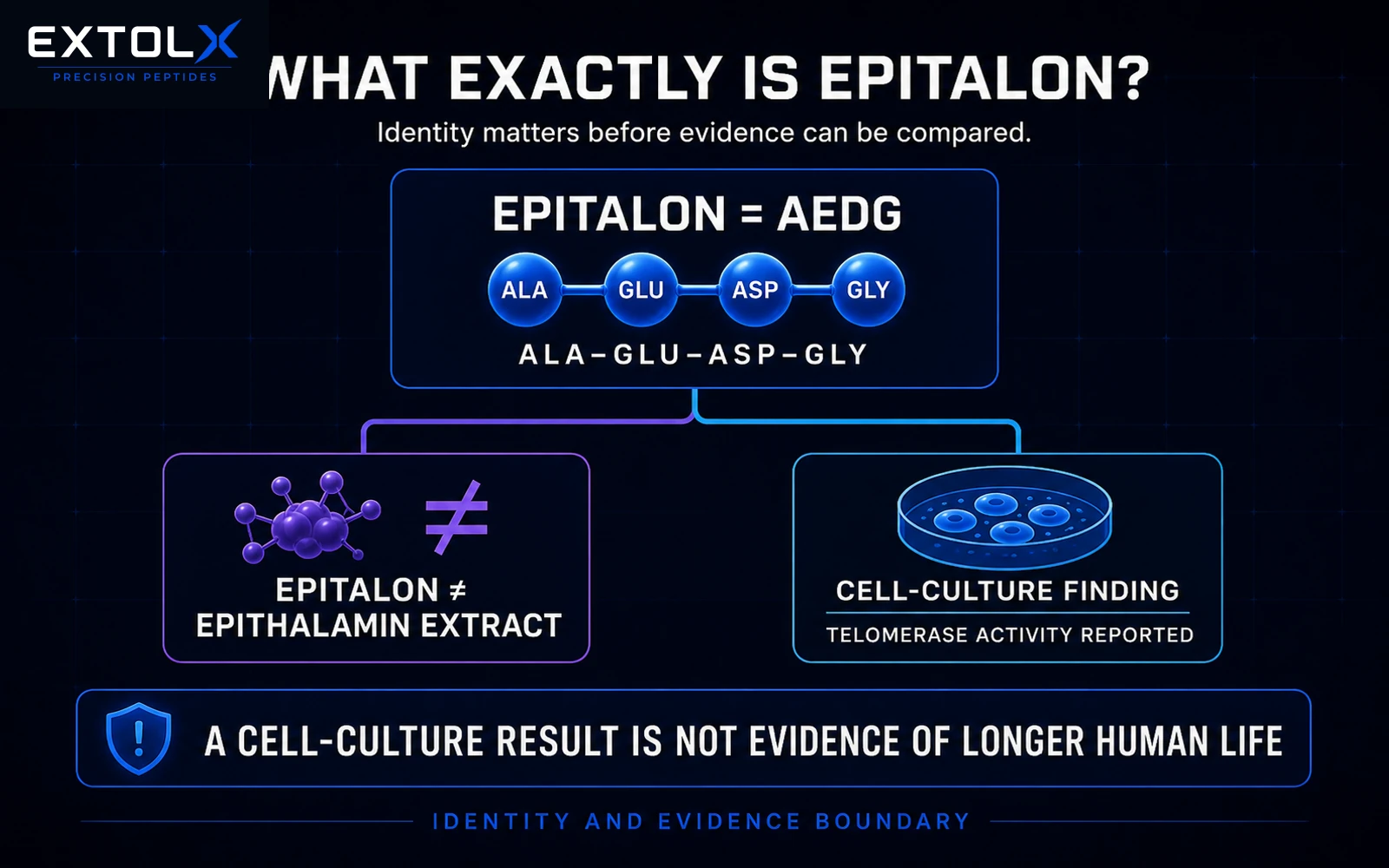
- Epitalon, also spelled Epithalon, is the tetrapeptide Ala-Glu-Asp-Gly, abbreviated AEDG.
- It is not the same as Epithalamin, a complex extract obtained from animal pineal tissue.
- Laboratory studies have reported changes in telomerase activity, telomere length and gene expression in cultured cells.
- A cell living longer in a dish does not show that a person will live longer.
- Some animal studies reported changes in maximum lifespan or selected ageing markers, while one mouse study found no change in average lifespan.
- Human research is sparse, short and often unclear about formulation. There is no controlled human longevity programme.
- Epitalon is not an authorised medicine. FDA’s 2026 evaluation found insufficient effectiveness and safety evidence for the compounded use it assessed.
On This Page
- The short version
- What is Epitalon?
- How might Epitalon work?
- What does the laboratory evidence show?
- What have animal studies found?
- What has human research shown?
- Where do evidence-transfer mistakes happen?
- What remains unknown?
- What is the regulatory position?
- What about anti-doping rules?
- What would better research look like?
- Plain-English glossary
- Explore Epitalon research material
- References and further reading
What is Epitalon?
The first practical point is identity. Epitalon is one defined four-amino-acid sequence; Epithalamin is a mixture of peptides extracted from pineal tissue.
The four amino acids in Epitalon are usually written as Ala-Glu-Asp-Gly or AEDG. The alternative spellings Epithalon and Epithalone appear in the literature and online. Those spelling changes do not create a new sequence.
Epitalon was developed from research on Epithalamin, but findings from the extract cannot automatically be assigned to the synthetic tetrapeptide. A mixture can contain many biologically active components, whereas AEDG is one small molecule.
Free-base and acetate forms also need to be distinguished. They share the same active peptide but differ in salt form and molecular weight. A study that does not identify its exact form leaves an important evidence gap.
How might Epitalon work?
There is no single established mechanism that explains the broad claims made for Epitalon. Several research pathways have been proposed, but most remain early-stage.
The most prominent idea involves telomerase, an enzyme that can add DNA repeats to the ends of chromosomes. Those chromosome ends are called telomeres. Telomeres generally shorten as cells divide, although their biology varies by cell type and disease.
Researchers have also examined circadian genes and melatonin-related signals. Circadian genes help coordinate the body’s daily timing system. Melatonin is a hormone associated with the light–dark cycle.
Changing one laboratory marker does not establish a useful overall effect. Telomerase is also biologically complex because many cancer cells use telomere-maintenance pathways to continue dividing. That does not prove Epitalon causes cancer, but it shows why “more telomerase” cannot automatically be described as beneficial.
What does the laboratory evidence show?
The laboratory evidence supports the claim that Epitalon can alter telomere-related measurements in selected cell systems. It does not establish an anti-ageing effect in humans.
A 2003 study added Epitalon to telomerase-negative human fetal fibroblasts grown in culture. The researchers reported expression of the catalytic part of telomerase, measurable enzyme activity and telomere elongation.
A 2025 study examined normal and cancer-derived human cell lines. It reported longer telomeres through telomerase or an alternative telomere-maintenance pathway, depending on the cell type.
These experiments are useful for identifying molecular effects. Cultured cells do not reproduce metabolism, immunity, tissue interactions, long-term tumour surveillance or the many other systems that determine an organism’s lifespan.
What have animal studies found?
Animal studies have produced interesting but inconsistent lifespan signals. They do not show that the same result occurs in humans.
One experiment exposed fruit flies to Epitalon during development and reported longer adult lifespan at several very low concentrations. The pattern was not dose-dependent, which makes the biological interpretation less straightforward.
A study of 108 female mice found no change in average lifespan, food intake or body weight. It reported a longer maximum lifespan and longer survival among the last 10% of animals, together with changes in selected ageing and tumour measurements.
FDA’s 2026 review noted that several mouse studies came from the same research group, used only female animals, tested fixed exposure levels and did not provide the broad toxicology programme needed to assess long-term human use. FDA concluded that the available animal studies were too limited in scope and duration to resolve safety questions.
What has human research shown?
The human literature is much smaller than online descriptions often suggest. It does not contain a modern controlled programme showing longer life or slower ageing.
Circadian-marker study
A 2021 study involved 75 middle-aged women who mainly worked night shifts. Thirty-five with age-normal melatonin-metabolite levels formed a comparison group. Forty with lower levels were randomised to placebo or a sublingual AEDG spray for 20 days.
The paper reported changes in a urinary melatonin metabolite and the expression of selected circadian genes in blood cells. It did not measure insomnia outcomes, specify blinding or establish that the findings translated into better sleep or health. The studied spray also does not establish evidence for a differently formulated research vial.
Retinal study
A 2002 publication reported retinal measurements in people with retinitis pigmentosa alongside animal work. The abstract described a controlled clinical trial and reported positive findings, but gave very limited information about randomisation, masking and the exact human formulation.
This isolated study has not developed into a modern replicated evidence programme. It cannot support broader claims about sleep, ageing or lifespan.
What the regulatory review found
FDA’s July 2026 review located only a small number of human studies. It found no clinical trial in people with insomnia, no study of the proposed subcutaneous compounded use, no human pharmacokinetic data and no clinical study designed to assess safety of Epitalon free base or acetate.
Where do evidence-transfer mistakes happen?
Most overclaiming begins by moving a result from one identity or evidence level to another.
- Epitalon is not Epithalamin: evidence for a pineal extract cannot be assigned to the AEDG tetrapeptide.
- A cell line is not a person: telomerase activity and telomere elongation in culture do not demonstrate longer human life.
- Maximum lifespan is not average lifespan: one mouse study changed selected late-survival measures without changing the group’s mean lifespan.
- A melatonin metabolite is not sleep: changing a biochemical marker does not establish improved insomnia or sleep quality.
- A retinal result is not an anti-ageing result: evidence from one condition and outcome cannot support unrelated claims.
- Free base, acetate and independent material are not automatically equivalent: identity, impurities, aggregation and formulation must be verified.
What remains unknown?
The largest evidence gap is the absence of rigorous human studies testing the claims most often associated with Epitalon.
- No controlled human study shows that Epitalon extends lifespan or slows biological ageing.
- No clinical trial establishes effectiveness for insomnia.
- There are no adequate human studies defining how long free-base or acetate Epitalon remains in the body.
- Long-term safety, immune responses, reproductive effects and cancer-related risks are not characterised.
- Published studies often leave the exact salt form, formulation and analytical controls unclear.
- Results from a small number of research groups require independent replication.
What is the regulatory position?
Epitalon is not an authorised medicine. An online product, a research chemical or an orphan-drug designation is not a marketing authorisation.
FDA reviewed Epitalon free base and acetate for possible inclusion on the US section 503A bulk substances list in July 2026. Its briefing concluded that the available evidence did not support effectiveness for insomnia and that important safety, characterisation and formulation information was missing. FDA’s balancing recommendation weighed against adding either form to the list; the briefing also stated that the advisory process was not itself a final regulatory determination.
The same FDA review reported no authorised Epitalon products in the United Kingdom, European Union, Canada or Australia at the time of its assessment. A previous US orphan-drug designation relating to retinitis pigmentosa had been withdrawn in 2016.
What about anti-doping rules?
Epitalon is not explicitly named in the 2026 World Anti-Doping Agency Prohibited List. That is not the same as formal clearance.
The list is non-exhaustive in several categories, and classifications can depend on structure or biological effect. Athletes should use their anti-doping organisation’s formal checking process rather than relying on an article or product label.
What would better research look like?
Better research would replace broad “anti-ageing” language with a defined material, a specific hypothesis and outcomes that matter to people.
- Confirm the exact AEDG sequence, free-base or acetate form, purity, aggregation and impurity profile.
- Replicate key cell findings independently and examine both normal and disease-relevant cell systems.
- Use animal studies designed to assess dose response, both sexes, toxicology and complete lifespan distributions—not selected endpoints alone.
- Register adequately powered, randomised human trials for one clearly defined question.
- Measure the relevant clinical outcome directly rather than relying only on telomeres, gene expression or melatonin metabolites.
- Include long follow-up and transparent safety reporting before making any claim about ageing or lifespan.
Plain-English glossary
- AEDG: The one-letter shorthand for Epitalon’s four amino acids: alanine, glutamic acid, aspartic acid and glycine.
- Circadian genes: Genes involved in coordinating biological changes across the day–night cycle.
- Epithalamin: A mixture of peptides extracted from animal pineal tissue; not the same as synthetic Epitalon.
- Free base and acetate: Different chemical forms of the same active peptide that may differ in molecular weight and formulation behaviour.
- Telomerase: An enzyme that can add DNA repeats to chromosome ends.
- Telomere: A repeated DNA structure at the end of a chromosome.
- Tetrapeptide: A peptide made from four amino-acid units.
Explore Epitalon research material
The ExtolX Epitalon 10MG research material is listed as white to off-white lyophilised powder with a catalogue purity specification of at least 99%. The page identifies the free-base formula C14H22N4O9, molecular weight 390.35 g/mol and CAS number 307297-39-8.
At the review date, the live product page linked a third-party Janoshik certificate for the 10MG SKU. That analytical document applies to the listed batch and does not establish pharmaceutical equivalence, clinical effectiveness or human-use status.
The ExtolX material is independently supplied for laboratory research. It is not the spray, retinal formulation or other material used in the cited human studies and should not be treated as equivalent to them.
References and further reading
- Telomerase and telomere study in human fibroblast culture — PubMed
- Telomere-maintenance study in normal and cancer-derived cell lines — PubMed
- Fruit-fly lifespan study — PubMed
- Female-mouse lifespan and tumour study — PubMed
- Retinal animal and human study — PubMed
- AEDG circadian-gene study in night-shift workers — primary paper
- 2026 Epitalon evidence and compounding review — FDA
- July 2026 Pharmacy Compounding Advisory Committee materials — FDA
- 2026 Prohibited List — WADA
- UK medicine-authorisation information — MHRA
Research-use notice: ExtolX materials are supplied for laboratory research only and are not for human or veterinary use.