
Evidence reviewed: 23 August 2026
Author: ExtolX Editorial Team
This is an educational overview of published research, not medical advice.
SS-31 is a small synthetic peptide designed to concentrate around mitochondria, the structures that help cells release usable energy. It is also widely known as elamipretide, although that shared name needs careful handling.
Elamipretide has been tested as a sponsor-manufactured medicine in several human conditions. A defined pharmaceutical formulation is now authorised in the United States for a narrow use in Barth syndrome. That does not make every material labelled SS-31 or elamipretide the authorised medicine.
The short version
- SS-31 is a synthetic tetrapeptide, meaning it contains four amino-acid building blocks.
- Laboratory research focuses on cardiolipin, a specialised fat molecule in the inner mitochondrial membrane.
- Cell and animal studies investigate mitochondrial structure, energy transfer and injury models.
- Human results have varied by condition. A large primary mitochondrial myopathy trial did not meet either primary endpoint.
- A very small Barth syndrome programme supported accelerated US approval of the medicine Forzinity for a defined population, with confirmatory research required.
- Medicine evidence does not establish the identity, quality, safety or performance of independent research material.
On This Page
- The short version
- What is SS-31?
- How might it interact with mitochondria?
- What does the laboratory evidence show?
- What have animal studies added?
- What has controlled human research found?
- Where do evidence-transfer mistakes happen?
- What remains unknown?
- What is the regulatory position?
- What about anti-doping rules?
- What would better research look like?
- Plain-English glossary
- Explore SS-31 research material
- References and further reading
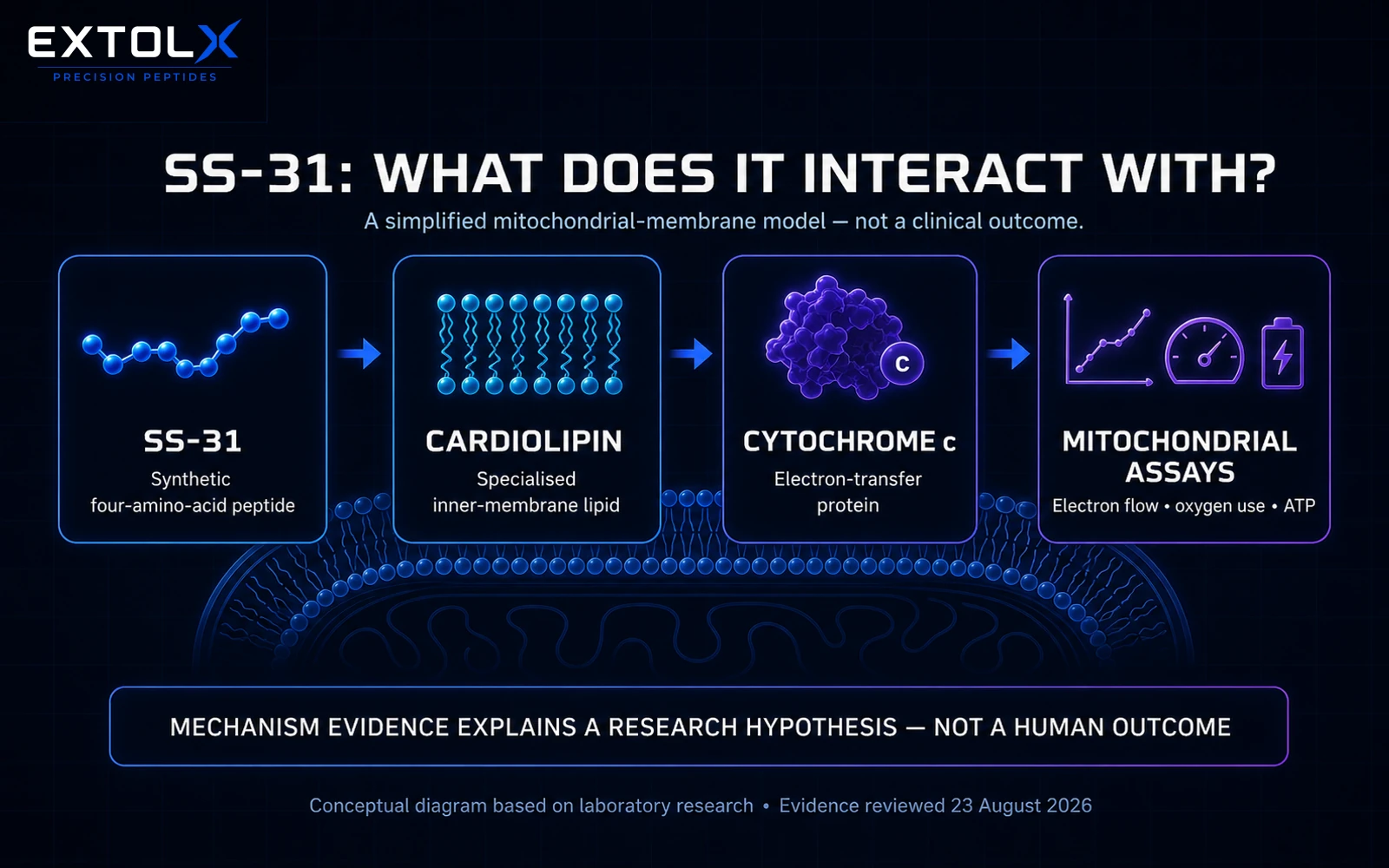
What is SS-31?
The practical point is that SS-31 is a purpose-built peptide, not a natural mitochondrial hormone. Its four-amino-acid sequence includes unusual chemical features intended to help it associate with mitochondrial membranes.
The research names SS-31, elamipretide, Bendavia and MTP-131 have been used for the same core peptide during different stages of development. They do not tell us whether two finished materials have the same salt form, formulation, purity profile, manufacturing controls or stability.
How might it interact with mitochondria?
The key proposed interaction involves cardiolipin. Cardiolipin is a specialised phospholipid—one of the fat-like molecules that form membranes—and is concentrated in the inner membrane of mitochondria.
That membrane is folded into structures called cristae. Many of the protein systems that transfer electrons and help make ATP, the cell’s immediately usable energy currency, sit along these folds.
Laboratory experiments indicate that SS-31 can associate with cardiolipin-containing membranes and change the way cardiolipin interacts with cytochrome c, an electron-carrying protein. Researchers have reported changes in electron transfer, oxygen consumption and ATP production in isolated experimental systems.
This is a proposed molecular explanation. It does not mean that adding SS-31 to an isolated membrane predicts what will happen in a whole animal, a person with a mitochondrial disorder or any other human population.
What does the laboratory evidence show?
Laboratory work supports a direct research question around mitochondrial membranes. Experiments using model membranes, isolated mitochondria and related biochemical systems have examined SS-31 binding, cytochrome-c behaviour, oxygen use and ATP synthesis.
One frequently cited study found that SS-31 interacted with cardiolipin-containing membranes and altered electron-transfer behaviour in its experimental systems. This supports a mechanism worth investigating, but isolated mitochondria do not reproduce the regulation, distribution and competing processes found in a living body.
What have animal studies added?
Animal studies ask whether the membrane-level idea still produces measurable changes in a living system. Research has covered kidney ischaemia, cardiac arrest, traumatic brain injury and other models involving mitochondrial stress.
For example, a rat kidney ischaemia study reported preservation of mitochondrial cristae and faster recovery of ATP-related processes after blood flow returned. Other animal studies have reported changes in injury markers and functional measurements.
These models are useful for testing timing and biological plausibility. They remain models of deliberately created injury in animals. They cannot establish effectiveness in a human disease, and positive findings in one organ or injury model cannot be transferred to unrelated conditions.
What has controlled human research found?
The human evidence is mixed rather than uniformly positive. The condition being studied, the endpoint chosen and the exact pharmaceutical product all matter.
Primary mitochondrial myopathy
A small crossover trial in 30 adults produced signals in some patient-reported measurements, but its primary walking-distance endpoint did not reach statistical significance.
The larger MMPOWER-3 trial then randomised 218 people with genetically confirmed primary mitochondrial myopathy. After 24 weeks, elamipretide did not improve either primary endpoint—six-minute walking distance or the trial’s fatigue score—compared with placebo.
This larger negative result is important. Post-hoc subgroup findings can generate new hypotheses, but they do not reverse the prespecified result of the overall trial.
Barth syndrome
Barth syndrome is an ultra-rare inherited condition involving abnormal cardiolipin metabolism. Twelve participants entered a randomised, placebo-controlled crossover study of pharmaceutical elamipretide. Neither primary endpoint was met during the controlled part.
Some measurements improved during the later open-label extension, when everyone knew they were receiving the study medicine and there was no concurrent placebo comparison. The US Food and Drug Administration subsequently granted Forzinity accelerated approval to improve muscle strength in adults and children with Barth syndrome weighing at least 30 kg.
The approval relied on knee-extensor muscle strength as an intermediate endpoint considered reasonably likely to predict clinical benefit. A confirmatory randomised trial is required. Accelerated approval is therefore not the same as complete confirmation of broader benefit.
Other conditions
Smaller studies have examined heart failure and other settings. Some reported changes in intermediate measurements, but these early studies were not designed to establish long-term clinical outcomes. Evidence in one disease cannot be treated as evidence in another simply because mitochondria are involved in both.
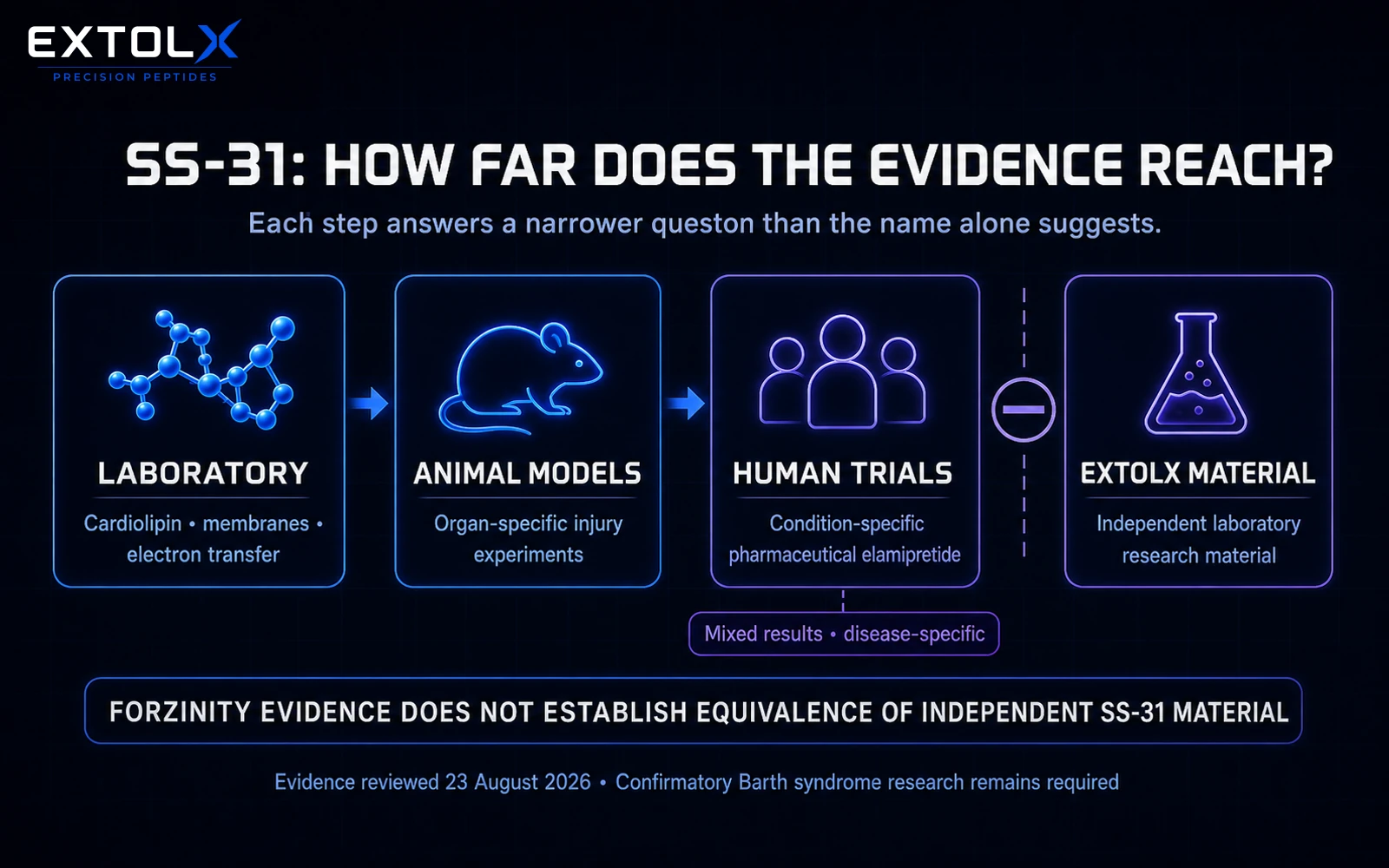
Where do evidence-transfer mistakes happen?
- Mechanism to outcome: Cardiolipin binding in a laboratory system does not establish a human benefit.
- Animal model to human disease: A result in an induced injury model does not prove an effect in a person.
- One condition to another: Barth syndrome, primary mitochondrial myopathy and heart failure are different research questions.
- Open-label change to controlled proof: Improvement during an extension without a concurrent placebo group is harder to interpret than a successful randomised comparison.
- Medicine to research material: Forzinity evidence applies to its defined active ingredient, formulation, manufacture, population and labelled use—not to every vial carrying an SS-31 name.
What remains unknown?
Important uncertainties include which mitochondrial disorders, if any, are most responsive; whether intermediate changes translate into outcomes that matter to patients; and how results hold up over longer controlled follow-up.
For independent research materials, further questions include exact chemical form, formulation, impurity profile, stability and equivalence to the materials used in published experiments. A shared core sequence does not answer those questions.
What is the regulatory position?
Forzinity is a regulated US medicine with accelerated approval for a narrow Barth syndrome indication. The approval is tied to a specific manufacturer, finished formulation, quality system and label, and it carries a requirement for confirmatory research.
The ExtolX SS-31 listing is an independent laboratory research material. It is not Forzinity, is not supplied as a medicine and is not authorised for human or veterinary use. The existence of a US medicine does not create product equivalence or a UK authorisation for this material.
What about anti-doping rules?
SS-31 is not specifically named in the 2026 WADA Prohibited List. That should not be read as an assurance that every use is permitted: the List contains non-exhaustive categories and can change each year. Athletes and support personnel need a current ruling from their anti-doping organisation for their exact circumstances.
What would better research look like?
- Condition-specific trials with prespecified outcomes that reflect how people feel and function.
- Sample sizes large enough to distinguish genuine effects from chance.
- Randomised, blinded comparisons maintained for clinically meaningful periods.
- Replication by groups independent of the product sponsor.
- Transparent reporting of negative findings, withdrawals and all prespecified analyses.
- Analytical confirmation of the exact material and formulation used in every study.
Plain-English glossary
- Mitochondrion: A structure inside a cell that helps convert fuel into usable energy.
- Cardiolipin: A specialised fat-like molecule concentrated in the inner mitochondrial membrane.
- Cristae: Folds in the inner mitochondrial membrane where many energy-transfer proteins sit.
- ATP: A molecule cells use as an immediately available energy source.
- Primary endpoint: The main result a trial is designed to test.
- Open-label extension: A follow-up period in which participants and researchers know what treatment is being given.
- Accelerated approval: A regulatory route based on an intermediate or surrogate measure that requires later confirmation of clinical benefit.
Explore SS-31 research material
The ExtolX SS-31 10MG research material is listed as a white to off-white lyophilised powder with a catalogue specification of at least 99%. A third-party Janoshik analytical certificate is linked from the live product page.
This material is not the authorised Forzinity medicine or the sponsor-manufactured product used in clinical trials. Shared naming does not establish pharmaceutical equivalence.
References and further reading
- SS-31, cardiolipin and mitochondrial electron transfer — PubMed
- SS-31 in a rat kidney-ischaemia model — PubMed
- MMPOWER-2 crossover trial — PubMed
- MMPOWER-3 randomised trial — PubMed
- Barth syndrome crossover trial and extension — PubMed
- Forzinity Drug Trials Snapshot — US FDA
- Ongoing Forzinity confirmatory requirement — US FDA
- 2026 Prohibited List — WADA
Research-use notice: ExtolX materials are supplied strictly for legitimate laboratory research. They are not intended for human or veterinary use, consumption, diagnosis, treatment or prevention of disease.