
Evidence reviewed: 25 August 2026
Author: ExtolX Editorial Team
This is an educational guide for laboratory research audiences. It does not provide medical advice, dosage or administration guidance.
A Certificate of Analysis, usually shortened to COA, is a batch-specific summary of test results. It can help a researcher check what was tested, how the result compared with a specification and which batch the document describes.
A COA is not a universal seal of quality. Its value depends on traceability, sampling, the suitability of each method, the underlying records and whether the reported tests answer the questions that matter.
The short version
- A COA should identify the material, batch or lot, tests, acceptance limits, actual results, dates and responsible issuer.
- The batch number on the document should match the batch being evaluated.
- Identity, purity, content, water, residual solvents, sterility and endotoxin are different questions.
- A result is meaningful only if the method is suitable for its stated purpose.
- A chromatographic purity percentage does not, by itself, prove molecular identity or total peptide content.
- “Pass” is less informative than an actual numerical result and its acceptance limit.
- External laboratory testing can add independence, but laboratory accreditation is not product approval and applies only to the relevant scope.
- A COA does not establish safety, effectiveness, clinical equivalence or suitability for human use.
On This Page
- The short version
- What is a Certificate of Analysis?
- What should a reader check first?
- Does a COA prove identity?
- Does a purity percentage show how much peptide is in the vial?
- What other tests might matter?
- What does laboratory accreditation tell you?
- Can an external COA replace all incoming checks?
- Does a COA establish animal or human effects?
- Where do COA interpretation mistakes happen?
- What remains unknown from a summary COA?
- What would stronger analytical documentation look like?
- Plain-English glossary
- How this applies to ExtolX research materials
- References and further reading
What is a Certificate of Analysis?
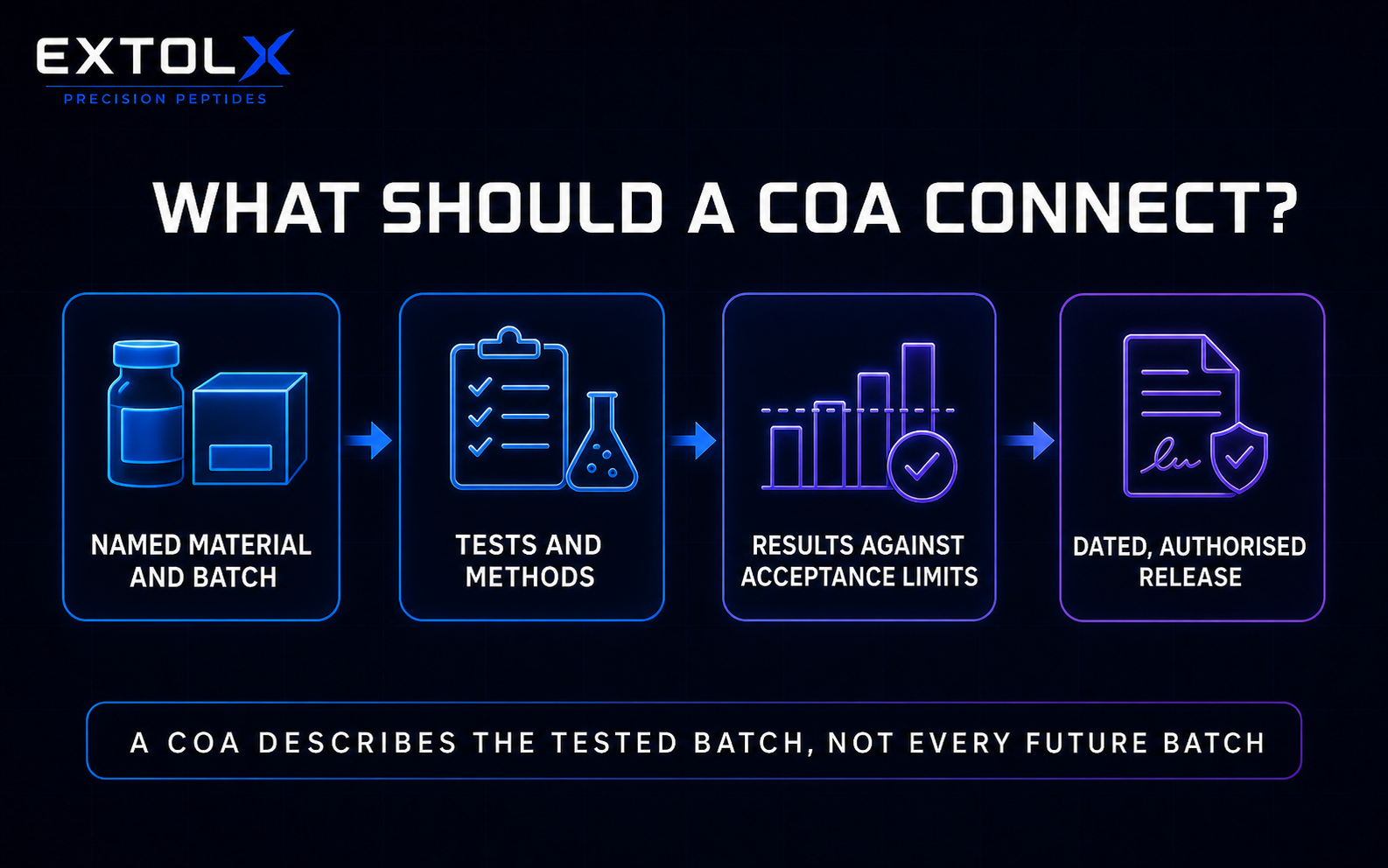
The practical point is that a COA is a report about a specific batch. It should not be read as a timeless description of every batch sold under the same product name.
ICH Q7 guidance describes a COA for an active pharmaceutical ingredient as a document that lists the material, grade where relevant, batch number, date of release, tests performed, acceptance limits and numerical results. It also expects the certificate to be dated and signed by authorised quality personnel.
That guidance applies in a regulated manufacturing context. A research-material certificate may use a different format, but the same basic questions remain useful: what sample was tested, which batch did it represent, what method was used, what result was obtained and who authorised the report?
What should a reader check first?
Start with traceability before looking at the headline percentage. A technically impressive result is of little value if it cannot be connected to the material in front of the researcher.
- Material name: does it clearly identify the tested substance and relevant molecular form?
- Batch or lot number: does it match the supplied batch?
- Sample source: is it clear who submitted or sampled the material?
- Test date and report date: was the testing performed within a meaningful period?
- Method: is the technique named clearly enough to understand what it measured?
- Acceptance limit: is there a defined requirement against which the result was judged?
- Actual result: is a number or clear observation reported rather than only “pass”?
- Issuer and authorisation: is the laboratory or quality unit identifiable, with appropriate approval?
Does a COA prove identity?
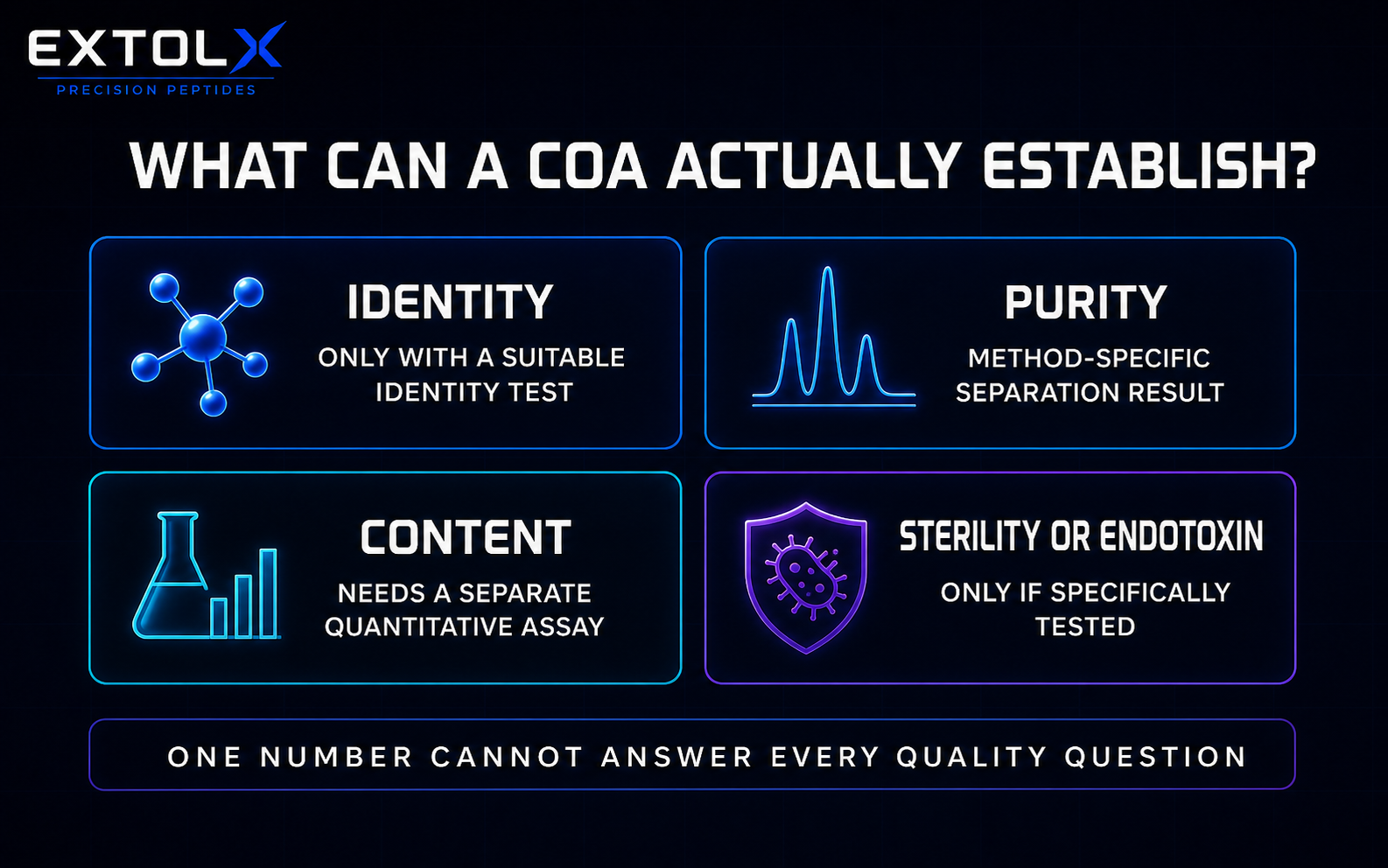
Only if the certificate includes a suitable identity test and the result supports the proposed identity.
Identity asks, “Is this the molecule it is claimed to be?” ICH Q2(R2) explains that an identification procedure should distinguish the target from materials with closely related structures. For a peptide, useful evidence may include mass spectrometry, sequence information, comparison with a qualified reference or another structurally informative technique.
A matching retention time in one chromatography method may support identity, especially when a suitable reference is used, but it is not automatically unique. Two different compounds can sometimes behave similarly under one set of chromatographic conditions.
Does a purity percentage show how much peptide is in the vial?
Not necessarily. Purity and content are different measurements.
A result such as “99% by HPLC” often describes the proportion of detected chromatographic peak area assigned to the main peak under one method. It does not automatically mean that 99% of the vial’s total mass is the target peptide.
Water, counter-ions, residual solvents, non-UV-absorbing substances and materials that the method does not retain or detect may not be represented by that percentage. A separate quantitative assay is normally needed to answer how much target material is present.
What other tests might matter?
The useful test set depends on the material and the intended laboratory work. A long list is not automatically better; each method should address a defined quality question.
- Assay or content: estimates the amount of target material using a quantitative method.
- Water: measures moisture that may contribute to total vial mass or affect stability.
- Residual solvents: checks for solvents that may remain from manufacture.
- Related substances: looks for selected impurities, variants or breakdown products.
- Counter-ion: identifies or measures an ion paired with the peptide, where relevant.
- Sterility: is a separate microbiological test and cannot be inferred from chemical purity.
- Endotoxin: is a separate test for bacterial endotoxin and is not established by an HPLC or mass result.
What does laboratory accreditation tell you?
Accreditation can provide evidence that a laboratory has been assessed for competence, impartiality and consistent operation. ISO/IEC 17025 is the main international standard used for testing and calibration laboratories.
The boundary matters: accreditation applies to a defined scope. It does not mean that every test offered by the organisation is accredited, and it does not approve the product, supplier or any biological claim.
When accreditation is relevant, readers should check the laboratory’s current scope and whether it covers the named method and type of material.
Can an external COA replace all incoming checks?
No. Even regulated manufacturers do not treat supplier certificates as self-validating.
ICH Q7 allows reliance on some supplier COA results only when the supplier has been evaluated and certificate reliability is checked at appropriate intervals. It still expects identity testing of each batch in the relevant manufacturing context, subject to limited stated exceptions.
For a research laboratory, the appropriate verification plan depends on risk, material variability and what the experiment needs to establish. A third-party report can strengthen the evidence chain without removing the need for matching, review and fit-for-purpose controls.
Does a COA establish animal or human effects?
No. A COA is analytical evidence about a sample or batch. It does not test safety, effectiveness, clinical outcomes or how a material behaves in an intact organism.
Even a well-characterised research material is not made equivalent to a clinical-trial product by analytical similarity alone. Manufacture, formulation, stability, biological activity and the complete regulated evidence package also matter.
Where do COA interpretation mistakes happen?
- Product name to batch identity: a shared catalogue name does not show that the document belongs to the supplied lot.
- Main-peak area to total content: chromatographic area percentage is not automatically a mass balance.
- One identity signal to complete characterisation: closely related compounds may require more than one analytical principle.
- External laboratory to regulatory approval: independent testing does not approve the product or a human use.
- Accredited laboratory to accredited method: the exact test may sit outside the laboratory’s accredited scope.
- One batch to every batch: a certificate does not remove the need for ongoing batch traceability.
- Chemical purity to microbiological status: sterility and endotoxin require separate tests.
What remains unknown from a summary COA?
A summary certificate may not show how the sample was taken, whether it was representative of the batch, how the method was validated, the raw chromatogram or spectrum, system-suitability results, measurement uncertainty or any investigation of unexpected results.
It may also say nothing about stability after the test date. A passing release result is not proof that the material remains unchanged under every storage or handling condition.
What would stronger analytical documentation look like?
- A clear link between the submitted sample, product and batch.
- Defined specifications with justified acceptance criteria.
- Named methods that are suitable for identity, purity, content and other reported attributes.
- Actual numerical results, units and relevant detection or reporting limits.
- Reference-material and system-suitability information where needed.
- Access to chromatograms, spectra or supporting data for technical review.
- Authorised review, dates and an identifiable laboratory or quality unit.
- A plan for resolving out-of-specification or inconsistent findings.
Plain-English glossary
- Batch or lot: a defined quantity produced or handled under a shared set of conditions.
- Specification: the tests, methods and acceptance limits a material is expected to meet.
- Acceptance limit: the numerical range or other criterion used to decide whether a result conforms.
- Identity: evidence that the material is the molecule claimed.
- Purity: the proportion of the detected material assigned to the target under a stated method.
- Assay: a quantitative test intended to estimate how much target material is present.
- Orthogonal methods: different analytical approaches used together because they provide independent information.
- Scope of accreditation: the specific tests or capabilities for which a laboratory has been accredited.
How this applies to ExtolX research materials
Where a certificate is linked from an ExtolX product page, readers should match its batch information to the supplied material and interpret each reported result within the limits of the named method.
Batch documentation supports laboratory evaluation. It does not change the research-only status of the material or turn preclinical literature into a claim about the supplied batch.
References and further reading
- Q7 Good Manufacturing Practice Guidance for Active Pharmaceutical Ingredients — FDA and ICH
- CGMP questions and answers on component testing and certificates — FDA
- Specifications: Test Procedures and Acceptance Criteria Q6A — ICH
- Validation of Analytical Procedures Q2(R2) — ICH
- ISO/IEC 17025:2017 overview — ISO
- ExtolX Research Use Policy
Research-use notice: ExtolX materials are supplied strictly for legitimate laboratory research. They are not intended for human or veterinary use, consumption, diagnosis, treatment or prevention of disease.
A useful distinction here is that a COA should be read as batch-specific evidence, not as a general quality label for an entire product line. Matching the batch identifier, methods, actual results, specifications, and release details is what makes the document traceable. Keeping those elements consistent also makes later document reviews much easier.
Thank you — that is an important distinction. A COA is meaningful only when it can be tied to the exact batch and its test methods, specifications, actual results, dates and authorised release. It should not be treated as a blanket guarantee for every batch or as evidence beyond the specific tests reported.