
Evidence reviewed: 25 August 2026
Author: ExtolX Editorial Team
This is an educational guide for laboratory research audiences. It does not provide medical advice, dosage or administration guidance.
Acetic Acid Water is an aqueous laboratory solution containing acetic acid. Its practical purpose is to provide an acidic environment for experiments where pH may affect solubility, stability or analytical behaviour.
The important point is that “acidic” does not mean “suitable for everything”. The exact material, concentration, temperature, container and test method all influence what happens next.
The short version
- Acetic acid is a weak acid that lowers the pH of water.
- A 1% label states a concentration, but a complete laboratory record should also define how that percentage was calculated.
- An acidic environment may change whether a research material dissolves, remains intact or behaves consistently in an assay.
- The same solution can affect different peptides or analytical methods differently.
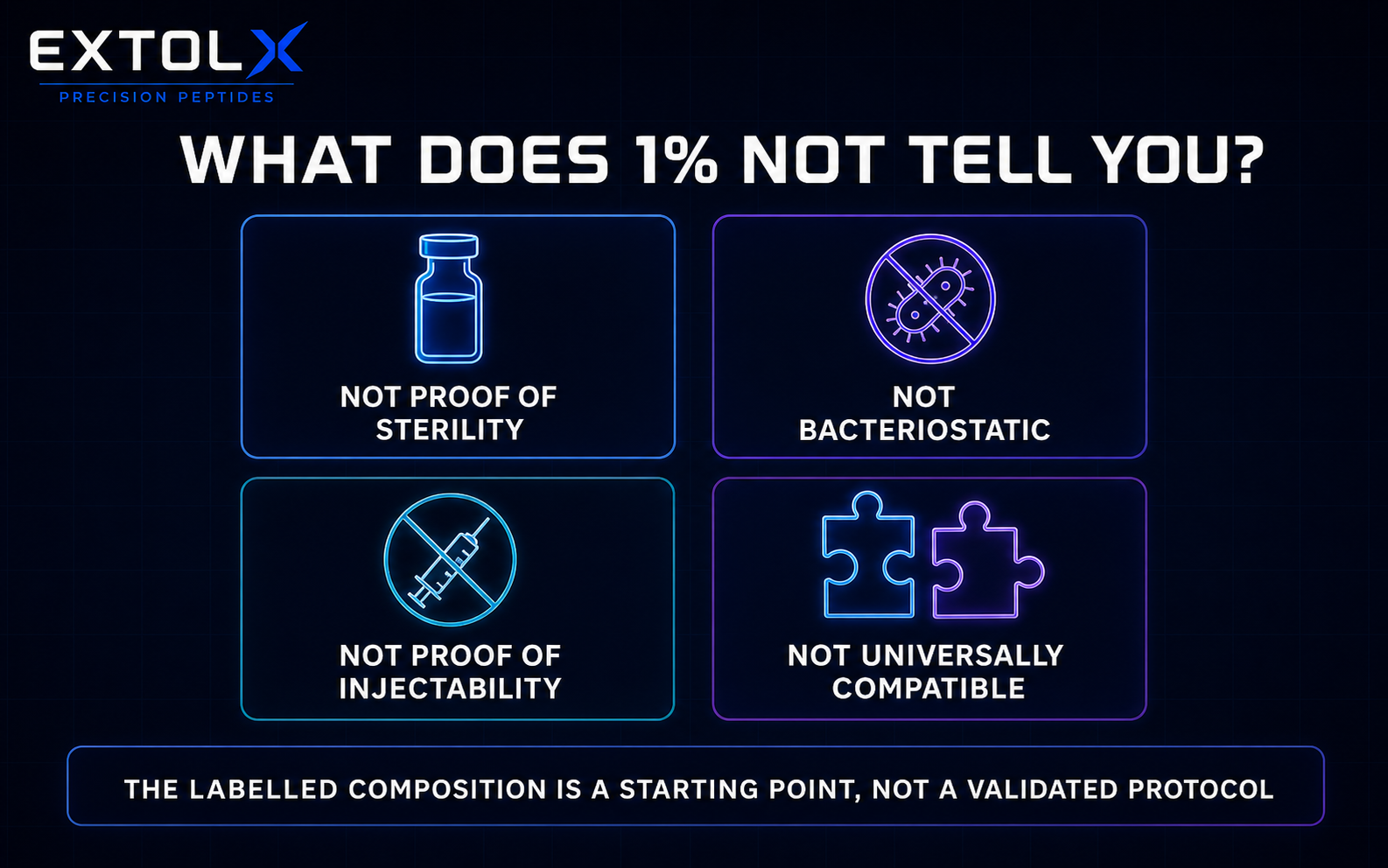
- A stated acetic-acid concentration does not establish sterility, bacteriostatic activity, injectability or universal compatibility.
- Suitability should be tested using the exact material, container, time, temperature and downstream method.
- The ExtolX product is supplied for controlled laboratory research only.
On This Page
- The short version
- What is Acetic Acid Water?
- How does acetic acid change the solution?
- Why can pH change solubility or stability?
- What does laboratory evidence need to establish?
- Do animal or human studies prove laboratory compatibility?
- Where do interpretation mistakes happen?
- What remains unknown without product-specific testing?
- What is the regulatory and safety context?
- What would a better compatibility study look like?
- Plain-English glossary
- Explore Acetic Acid Water research material
- References and further reading
What is Acetic Acid Water?
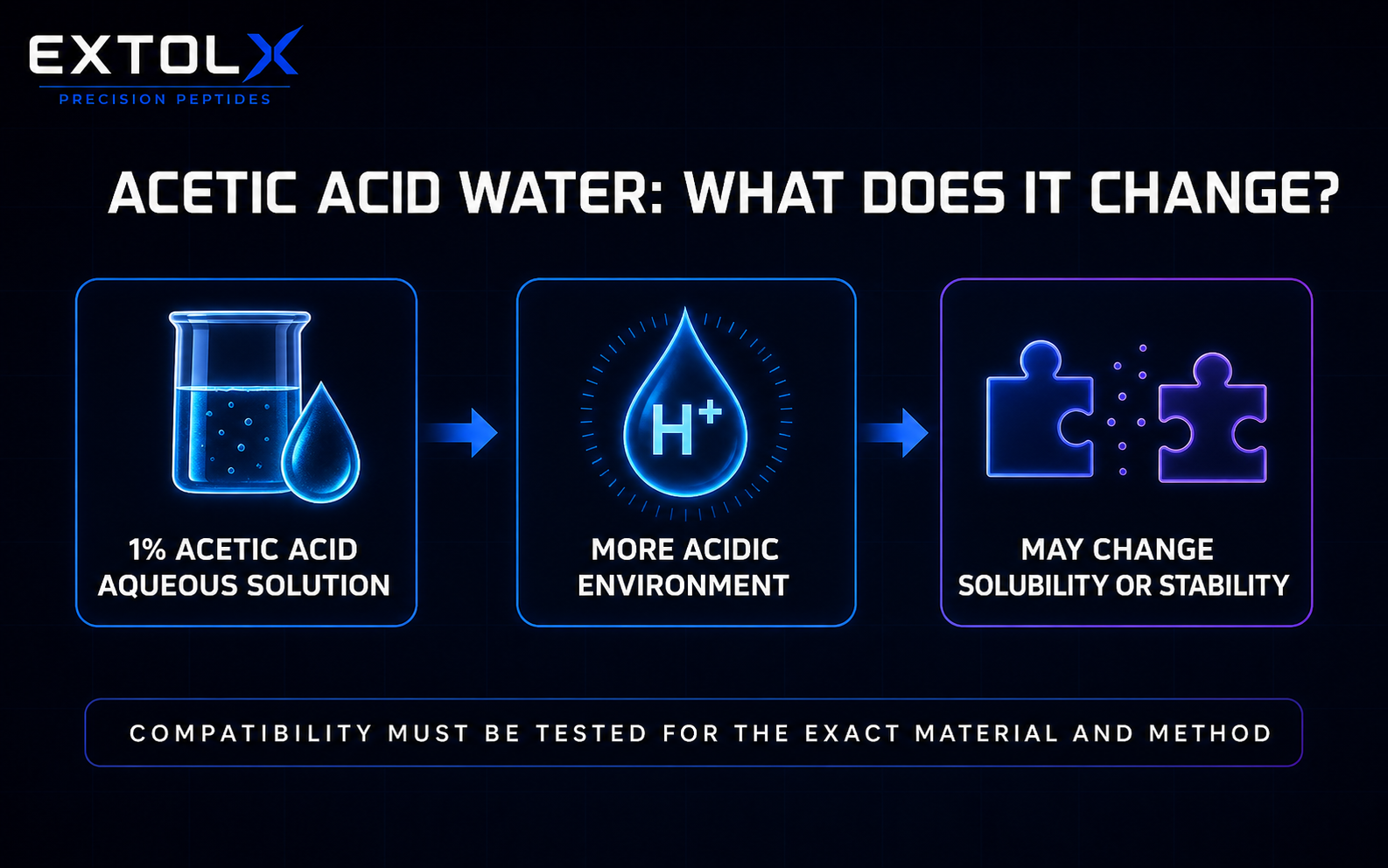
In plain terms, it is acetic acid diluted in water. Acetic acid is the small organic acid also known as ethanoic acid. Its molecular formula is C2H4O2.
The ExtolX catalogue identifies Acetic Acid Water 3ML as a 1% acetic acid aqueous solution supplied in a 3 ml presentation. That describes the stated composition and volume; it is not a universal experimental protocol.
A percentage should be read together with its basis. Depending on the specification, 1% may be defined by volume, mass or another documented convention. Researchers should use the supplier label and batch documentation rather than filling in a missing definition by assumption.
How does acetic acid change the solution?
The practical point is that acetic acid releases some hydrogen ions when it is mixed with water. This makes the solution more acidic and lowers its pH.
Acetic acid is described as a weak acid because only part of it separates into hydrogen ions and acetate ions in water. “Weak” describes this chemical behaviour; it does not mean that laboratory handling controls are unnecessary.
The final pH is not determined by the percentage alone. Water quality, temperature, other dissolved substances and any buffering system can all change the measured value. If pH matters to an experiment, it should be measured rather than guessed.
Why can pH change solubility or stability?
Many research materials contain chemical groups that gain or lose electrical charge as pH changes. That can alter how strongly the material interacts with water, a container surface, a chromatography column or another component of the experiment.
An acidic environment may improve solubility for one material and reduce it for another. It may also change the speed of breakdown reactions. A clear solution at the start does not prove that the material will remain chemically unchanged over time.
This is why published conditions should be transferred carefully. A method validated for one peptide, concentration or container does not automatically apply to a different research material.
What does laboratory evidence need to establish?
For this subject, the useful evidence is mainly analytical. A compatibility study should show what was mixed, the measured pH, the time and temperature, and how change was detected.
- Solubility: does the material dissolve at the required laboratory concentration without visible particles or unacceptable loss?
- Chemical stability: does a suitable analytical method detect new breakdown products or a falling main-material signal?
- Recovery: how much of the material can be measured after contact with the solution and container?
- Method compatibility: does the acidic solution interfere with the detector, column, assay chemistry or sample preparation?
- Time dependence: are results different immediately after preparation and after the planned experimental interval?
Do animal or human studies prove laboratory compatibility?
No. Animal or human information about acetic acid cannot validate a particular laboratory solvent, research material or analytical workflow.
Compatibility is a property of the complete experimental system. The relevant evidence comes from measurements made with the exact solution, target material, container and method. Biological evidence at another level does not answer that question.
Where do interpretation mistakes happen?
- Concentration to pH: a 1% concentration does not guarantee one fixed pH in every system.
- Clear appearance to stability: a solution can look clear while chemical breakdown is occurring.
- Acidity to sterility: an acidic environment is not proof that a product is sterile.
- Acidity to preservation: the solution should not be called bacteriostatic unless that function has been specifically established for the product and conditions.
- One material to another: compatibility data cannot be transferred automatically between different peptides or formulations.
- Laboratory reagent to clinical product: a research-only solution is not made suitable for human or veterinary use by sharing a familiar chemical name.
What remains unknown without product-specific testing?
The label alone cannot establish the exact pH of every batch, microbial status, post-opening lifetime or compatibility with a particular research material. Those questions need batch documentation or a suitable experimental test.
It also does not show whether the solution will affect a later analytical step. Changes in retention time, detector response, ionisation or sample recovery may matter even when the target material appears to dissolve.
What is the regulatory and safety context?
Classification depends on the specific product, composition, presentation and intended purpose. The ExtolX solution is presented as a laboratory research material and is not represented as sterile, bacteriostatic or injectable.
Laboratory personnel should follow the supplier label, safety information, local risk assessment and appropriate protective measures. Information about concentrated or regulated acetic-acid products should not be copied to a dilute research solution without checking the actual concentration and documentation.
What would a better compatibility study look like?
- Record the exact acetic-acid concentration and how the percentage is defined.
- Measure pH with a suitable calibrated method.
- Use the intended research material, concentration, container and temperature.
- Include a blank solution and an appropriate comparison condition.
- Check immediately and across the full experimental time window.
- Use a validated or fit-for-purpose method to measure recovery and breakdown products.
- Document visible change, precipitation, adsorption and downstream assay interference.
- Repeat the work where batch-to-batch variation could affect the conclusion.
Plain-English glossary
- Aqueous: made with water as the main liquid.
- Weak acid: an acid that only partly separates into ions in water.
- pH: a measure of how acidic or alkaline a solution is.
- Buffer: a mixture designed to resist large changes in pH.
- Solubility: how much of a material can dissolve under defined conditions.
- Stability: the extent to which a material remains chemically and physically unchanged over time.
- Compatibility: evidence that materials and methods can be used together without unacceptable change or interference.
Explore Acetic Acid Water research material
The ExtolX Acetic Acid Water 3ML product page lists a 1% acetic acid aqueous solution in a 3 ml laboratory presentation, SKU ADW3.
The listing does not represent the material as sterile, bacteriostatic, injectable or universally compatible with peptide products. Researchers remain responsible for product-specific compatibility, stability and method validation.
References and further reading
- Acetic acid identity, properties and laboratory safety summary — PubChem
- Safety data for a 1% acetic acid aqueous solution — Fisher Scientific
- Validation of Analytical Procedures Q2(R2) — ICH
- Analytical Procedure Development Q14 — ICH
- ExtolX Research Use Policy
Research-use notice: ExtolX materials are supplied strictly for legitimate laboratory research. They are not intended for human or veterinary use, consumption, diagnosis, treatment or prevention of disease.