
Evidence reviewed: 23 August 2026
Author: ExtolX Editorial Team
This is an educational overview of published research, not medical advice.
AOD-9604 is a synthetic peptide related to a small section near the end of human growth hormone. It is often discussed as though it were a smaller version of growth hormone with predictable fat-metabolism effects. The evidence does not support that shortcut.
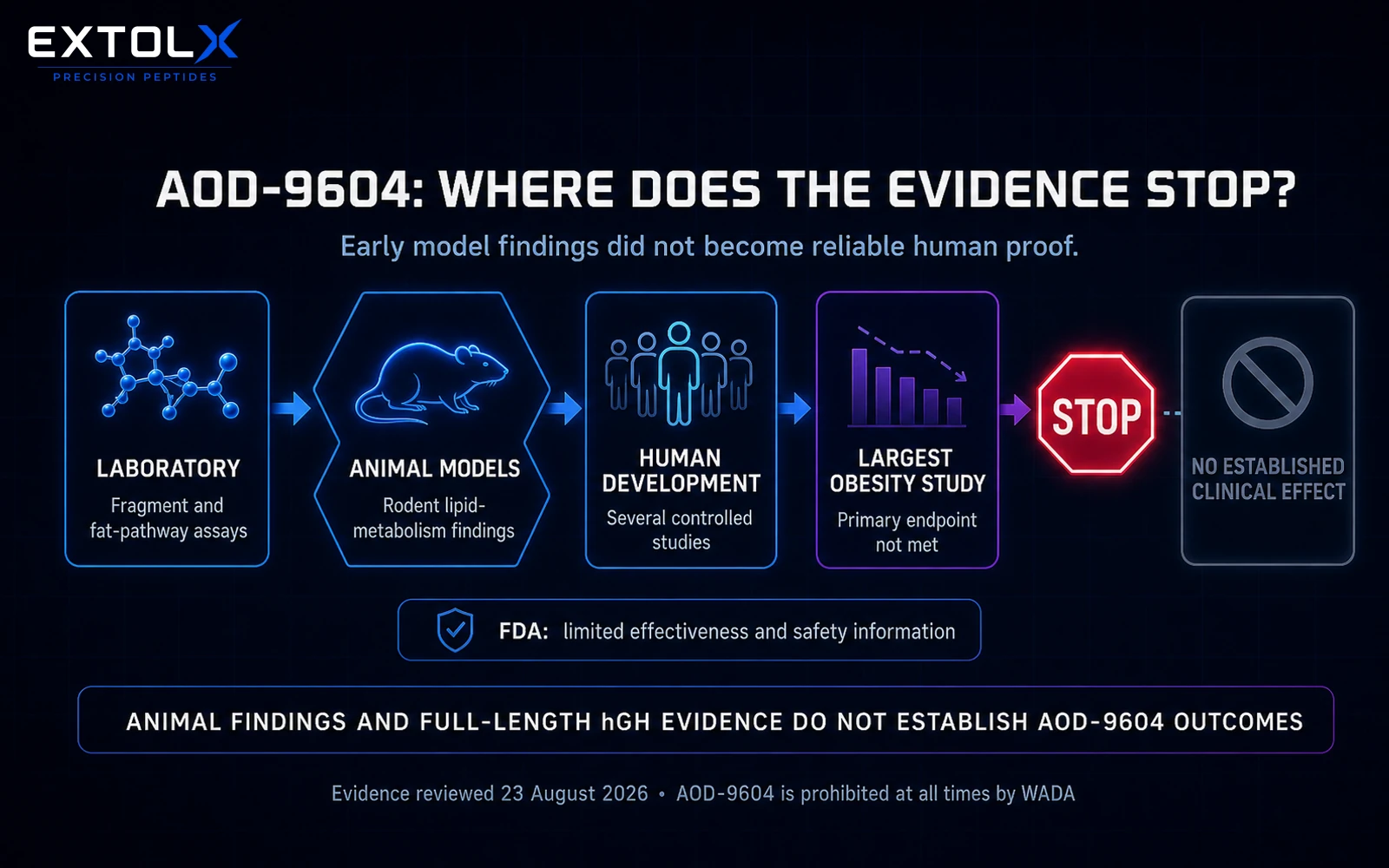
Early animal studies produced a research hypothesis. Human development then included several controlled studies, but the largest identified obesity study did not show a significant advantage over placebo on its main weight-loss endpoint. Development for obesity was stopped.
The short version
- AOD-9604 is a modified 16-amino-acid peptide related to residues 177–191 of human growth hormone.
- It is not full-length growth hormone and should not inherit claims made for that hormone.
- Laboratory and animal studies explored lipid-metabolism pathways, but the exact mechanism remains uncertain.
- Published human information is incomplete and much of it comes from summaries rather than full trial reports.
- A 536-participant obesity study did not meet its primary weight-loss endpoint.
- The FDA has highlighted limited effectiveness and safety information when assessing AOD-9604-related bulk substances.
- AOD-9604 is explicitly prohibited at all times under the 2026 WADA Prohibited List.
On This Page
- The short version
- What is AOD-9604?
- Why was this part of growth hormone studied?
- How might AOD-9604 work?
- What does the laboratory evidence show?
- What have animal studies found?
- What has human research shown?
- Where do evidence-transfer mistakes happen?
- What remains unknown?
- What is the regulatory position?
- What about anti-doping rules?
- What would better research look like?
- Plain-English glossary
- Explore AOD-9604 research material
- References and further reading
What is AOD-9604?
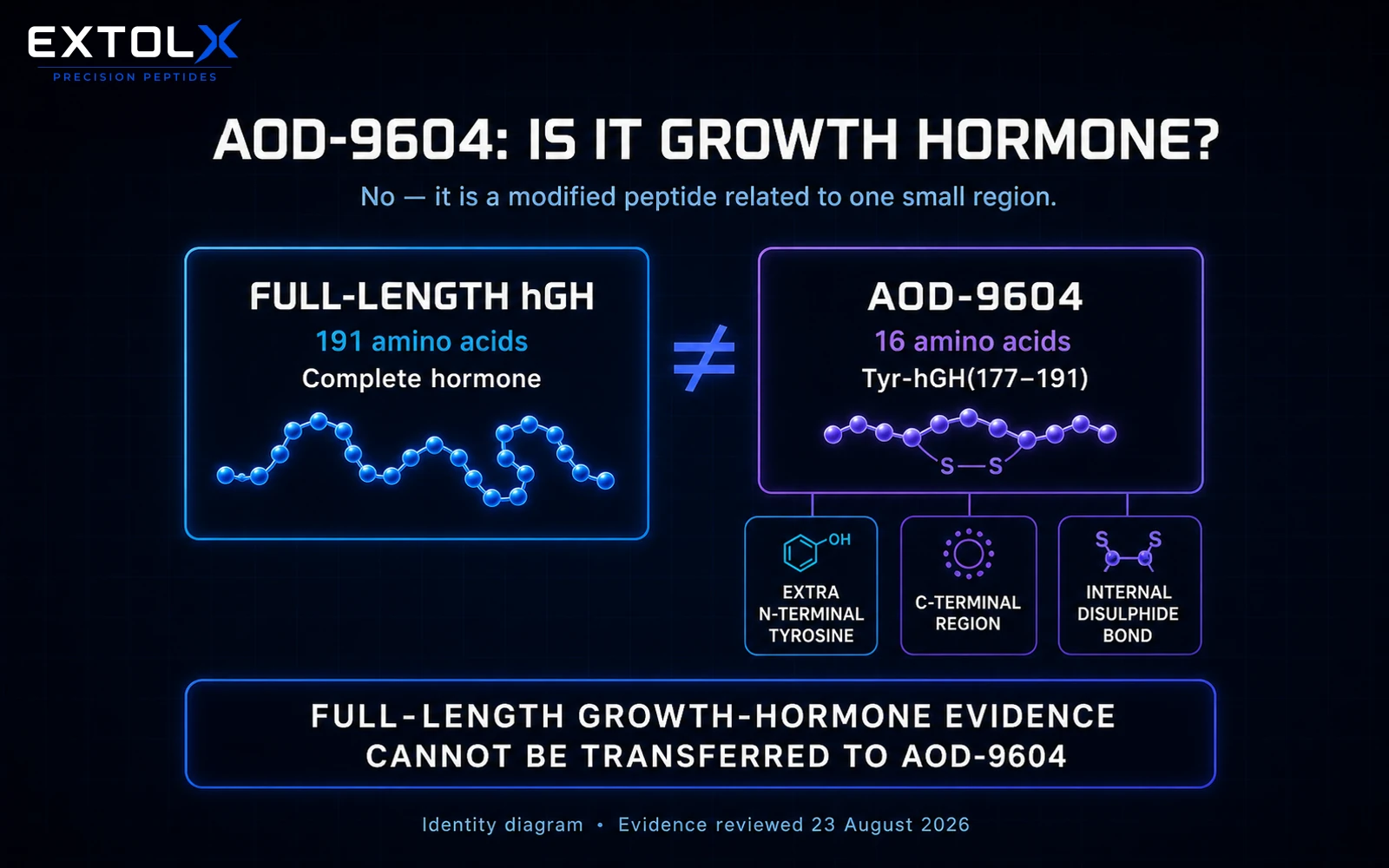
The practical point is that AOD-9604 is a modified fragment-inspired peptide, not a miniature form of the complete growth-hormone molecule.
Human growth hormone contains 191 amino acids. AOD-9604 is described as Tyr-hGH(177–191): it is related to the final 15-amino-acid region of growth hormone with an additional tyrosine at the beginning, producing a 16-amino-acid peptide. It also contains a disulphide bond between two cysteine residues.
Those structural differences matter. A fragment can fold differently, be broken down differently and interact with different targets. It cannot be assumed to retain the complete hormone’s receptor activity, biological timing or safety profile.
Why was this part of growth hormone studied?
Researchers were trying to separate different parts of growth hormone’s biology. Early fragment studies asked whether the region near the hormone’s end influenced fat storage or fat breakdown without producing the broader growth-related signalling associated with the full molecule.
This was a reasonable structure-and-function question: if one region produced a narrower signal, it might be possible to study that signal separately. It was not proof that the resulting synthetic peptide would produce a useful or safe human outcome.
How might AOD-9604 work?
The mechanism is less settled than confident online explanations suggest. Preclinical studies examined lipolysis, the release of stored fat, and lipogenesis, the creation and storage of fat.
Some animal experiments suggested involvement of beta-3 adrenergic signalling, a pathway important in rodent fat tissue. That pathway does not operate identically in humans. Other work explored whether the peptide acted without raising IGF-1, a growth-related signal associated with full-length growth hormone.
The absence of a measured IGF-1 increase does not prove a complete safety profile, nor does it establish a beneficial alternative mechanism. It answers only the measurement and conditions tested.
What does the laboratory evidence show?
Laboratory and early fragment work supports the idea that the end region of growth hormone can be studied separately. However, different papers have examined natural fragments, modified fragments and AOD-9604 itself. These are related materials, not automatic substitutes for one another.
Assays of isolated cells or tissues can measure changes in fat-related pathways under controlled conditions. They cannot reproduce digestion, distribution, metabolism, immune responses or the hormonal feedback systems of a living person.
What have animal studies found?
Early studies in obese rodents reported changes in fat-related measurements after exposure to AOD-9604. Research also examined beta-3 adrenergic receptor knockout mice to test whether this pathway was necessary for the observed animal response.
These findings created the basis for human development, but rodent fat biology differs substantially from human fat biology. A result in a genetically obese rat or a receptor-knockout mouse is evidence about that model, not a prediction of human weight change.
The FDA’s later review of AOD-9604-related bulk substances also identified uncertainties in the non-clinical safety package, including signals that required further investigation and insufficient information to connect animal exposure with proposed human uses.
What has human research shown?
The most important point is that exposure in human studies is not the same as demonstrated effectiveness. Several controlled trials were conducted, but the public evidence is incomplete and the overall obesity programme did not establish a reliable benefit.
Early and smaller studies
A 2013 paper summarised safety observations from six randomised, placebo-controlled studies. It reported no clear change in IGF-1 or glucose handling under the studied conditions and described tolerability as similar to placebo.
That paper pooled and summarised a development programme rather than providing full primary reports for every trial. Short studies and selected antibody testing cannot establish long-term safety, uncommon effects or safety for a different material or formulation.
The larger obesity study
In its 2024 assessment, the FDA described a 536-participant Australian obesity study. After 12 weeks, oral AOD-9604 did not produce a statistically significant weight-loss difference from placebo on the study’s primary endpoint. The company terminated development for obesity following the failed study.
The FDA concluded that most identified studies did not show a benefit over placebo and that available summaries lacked enough methodological and results detail. It also found insufficient information to assess several proposed formulations and routes, long-term safety or immunogenicity risk.
Where do evidence-transfer mistakes happen?
- Full hormone to fragment: Growth-hormone evidence does not establish AOD-9604 effects.
- Related fragment to exact molecule: Natural hGH fragments, modified fragments and AOD-9604 must be identified separately.
- Rodent fat biology to humans: An animal pathway can be much less important in people.
- Safety measurement to safety conclusion: No change in one laboratory marker does not establish overall or long-term safety.
- Exposure to effectiveness: A substance being used in a trial does not mean the trial showed a benefit.
- Development material to independent vial: Formulation, route, manufacture and impurity profile affect whether findings can transfer.
What remains unknown?
The exact human mechanism remains uncertain. There is no robust published evidence establishing a clinically meaningful effect on body weight, body composition or other health outcomes.
Long-term safety, immune responses, how different chemical forms behave and how manufacturing-related impurities affect risk also remain unresolved. These gaps become more important—not less—when the public clinical record is limited.
What is the regulatory position?
AOD-9604 is not an FDA-approved medicine. During assessment for possible use as a bulk substance in US compounding, the FDA found limited evidence of effectiveness and safety and concluded that the balance of available information weighed against adding AOD-9604 free base or acetate to the relevant 503A Bulks List.
The agency now lists AOD-9604 among bulk substances that may present significant safety risks, citing limited safety information, possible immunogenicity and challenges involving peptide impurities and characterisation.
The ExtolX product is an independent laboratory research material. It is not an authorised medicine, compounded medicine or sponsor-manufactured clinical-trial product.
What about anti-doping rules?
The position is explicit. The 2026 WADA Prohibited List names AOD-9604 as an example of a growth-hormone fragment under section S2.2.3. Substances in this section are prohibited at all times, both in and out of competition.
What would better research look like?
- Full publication of methods and results from completed human studies.
- Analytical confirmation of whether free base, acetate or another form was tested.
- Well-powered randomised trials with prespecified clinically meaningful endpoints.
- Long enough controlled follow-up to assess durability and uncommon unwanted effects.
- Pharmacokinetic work explaining how the exact material is absorbed, distributed and cleared.
- Validated impurity, aggregation and immune-response assessments.
- Independent replication rather than reliance on summaries from a discontinued development programme.
Plain-English glossary
- Peptide fragment: A short amino-acid sequence related to part of a larger protein.
- Lipolysis: The process of releasing stored fat molecules.
- Lipogenesis: The process of making and storing fat.
- IGF-1: A growth-related signal influenced by full-length growth hormone.
- Primary endpoint: The main result a trial is designed to test.
- Immunogenicity: The ability of a material or impurity to trigger an immune response.
- Pharmacokinetics: How a substance is absorbed, distributed and removed.
- Bulk substance: An ingredient considered for use in preparing a finished compounded product; it is not itself an approval.
Explore AOD-9604 research material
The ExtolX AOD-9604 10MG research material is listed as a white to off-white lyophilised powder with a catalogue specification of at least 99%. At the review date, the product page marked its analytical certificate as pending.
This material is not the product used in the historical clinical-development programme. Shared naming does not establish chemical-form, formulation or pharmaceutical equivalence.
References and further reading
- AOD-9604 in an obese-rat model — PubMed
- AOD-9604 and beta-3 adrenergic signalling in animal models — PubMed
- Summary of AOD-9604 human safety studies — Journal of Endocrinology and Metabolism
- FDA scientific review of AOD-9604-related bulk substances — 2024 PCAC briefing document
- Bulk substances that may present significant safety risks — US FDA
- 2026 Prohibited List — WADA
Research-use notice: ExtolX materials are supplied strictly for legitimate laboratory research. They are not intended for human or veterinary use, consumption, diagnosis, treatment or prevention of disease.