
Evidence reviewed: 24 August 2026
Author: ExtolX Editorial Team
This is an educational overview of published research, not medical advice.
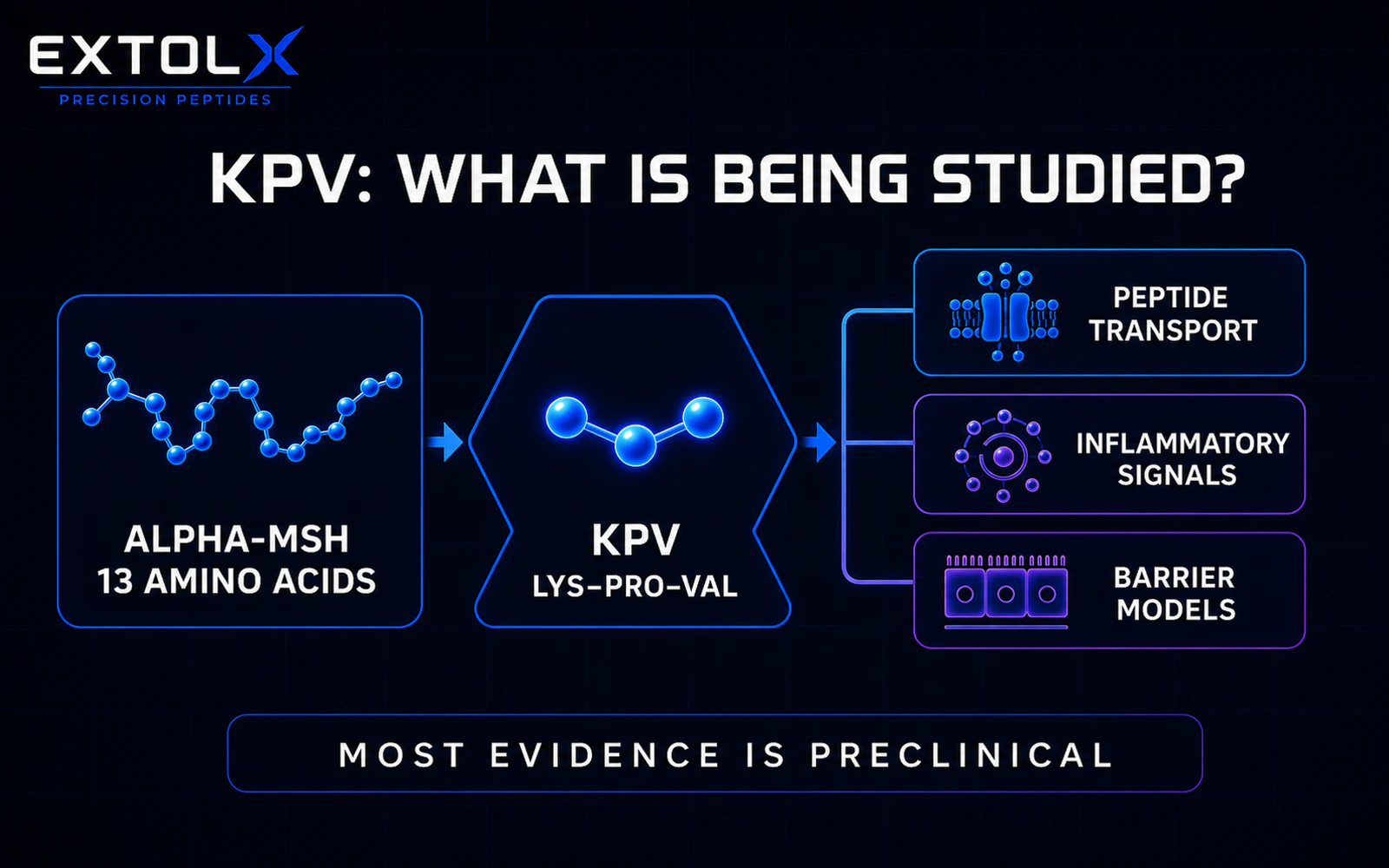
KPV is a very small peptide made from three amino acids: lysine, proline and valine. It matches the final three amino acids of alpha-melanocyte-stimulating hormone, usually shortened to alpha-MSH.
Most published KPV research asks whether this short fragment can influence inflammatory signals in cells or experimental animals. That is a useful research question, but it is not the same as showing that KPV treats inflammation in people.
The short version
- KPV is the three-amino-acid sequence Lys-Pro-Val, also written as alpha-MSH(11–13).
- It is a fragment of alpha-MSH, not the complete hormone.
- Laboratory studies have examined peptide transport, NF-kappa B signalling and inflammatory-mediator release.
- Animal studies have mainly used experimentally induced bowel-inflammation models.
- Human-derived cells are still laboratory evidence. They are not evidence of an effect in a person.
- No controlled human KPV trial establishing a clinical outcome was located in the sources reviewed.
- Evidence from alpha-MSH, animal experiments or specialised delivery systems cannot be transferred automatically to independent KPV research material.
On This Page
- The short version
- What is KPV?
- Does KPV work like the full alpha-MSH hormone?
- What does the laboratory evidence show?
- What have animal studies added?
- What human evidence is available?
- Where do evidence-transfer mistakes happen?
- What remains unknown?
- What is the regulatory position?
- What about anti-doping rules?
- What would better research look like?
- Plain-English glossary
- Explore KPV research material
- References and further reading
What is KPV?
The practical point is that KPV is a defined fragment, not a general name for the melanocortin system. Its sequence is Lys-Pro-Val, using the one-letter code K-P-V.
Alpha-MSH is a 13-amino-acid signalling peptide. KPV corresponds to positions 11 to 13 at one end of that larger molecule. Removing ten amino acids changes the structure and may change which targets the fragment can reach or influence.
PubChem lists the unmodified KPV tripeptide as C16H30N4O4, with a molecular weight of 342.43 g/mol. Salt or counter-ion forms are separate material questions and should not be assumed from the short name alone.
Does KPV work like the full alpha-MSH hormone?
Not necessarily. Sharing three amino acids does not make KPV and alpha-MSH interchangeable.
Some alpha-MSH effects involve melanocortin receptors. KPV research also points to routes that may not require the same receptor interaction. In intestinal cell experiments, researchers have studied uptake through PepT1, a transporter that moves small peptides across cell membranes.
Once inside the experimental system, KPV has been associated with changes in pathways such as NF-kappa B. This protein system helps cells switch inflammatory genes on and off. A changed laboratory signal shows biological activity under those conditions; it does not predict a health outcome.
What does the laboratory evidence show?
The practical point is that the strongest mechanistic evidence comes from controlled cell systems, where variables can be isolated more easily than they can in a whole body.
One study used human intestinal epithelial cell lines and immune cells. It reported PepT1-related KPV uptake alongside reduced activation of NF-kappa B and MAP-kinase inflammatory pathways. The same paper also included mouse experiments, so its cell and animal findings should be read separately.
Another laboratory study examined HIV-infected human monocyte-derived cells and reported changes in viral-expression signals after exposure to KPV. These were cells outside the body. The experiment did not test a treatment in people and should not be presented as clinical evidence.
What have animal studies added?
Animal work suggests that KPV can produce measurable effects in selected inflammatory models, especially experimental colitis. It cannot establish whether the same result would occur in humans.
Researchers have tested KPV in mouse models where bowel inflammation was created experimentally. Reported measures included tissue appearance, inflammatory-cell activity, cytokine signals and changes in body weight during the model.
Later studies placed KPV in nanoparticles, hydrogels or other delivery systems intended to change where the peptide travelled or how long it remained near inflamed tissue. Those results belong to the complete KPV-plus-delivery-system experiment. They do not describe free KPV in every formulation.
What human evidence is available?
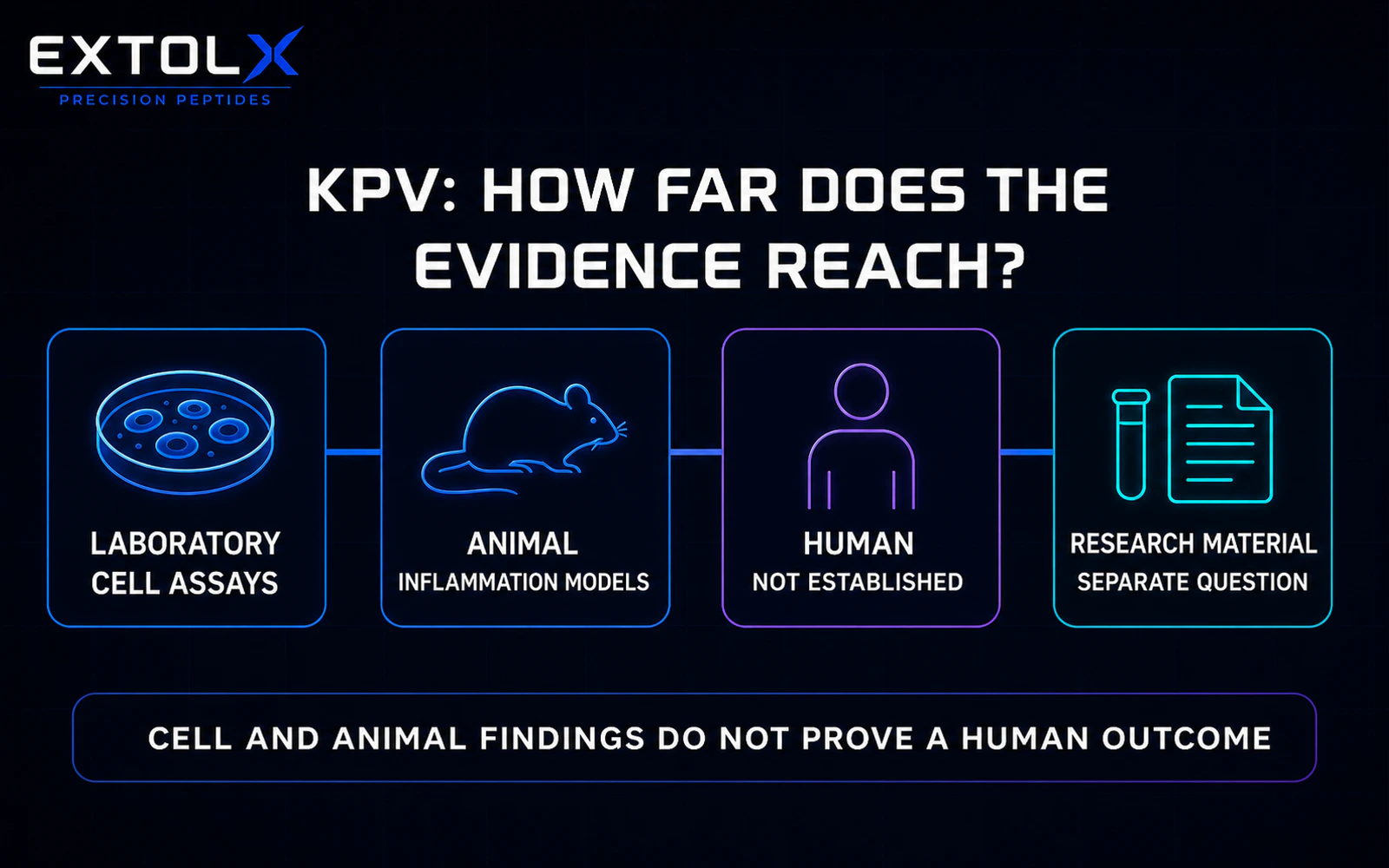
The key point is that human-derived cells are not human clinical evidence. No controlled human KPV study establishing a clinical benefit was located in the sources reviewed for this profile.
This leaves a large gap between the laboratory and animal literature and any claim about people. It also means that human safety, how long KPV remains available in the body, meaningful exposure levels and clinically relevant outcomes are not defined by the preclinical studies.
Where do evidence-transfer mistakes happen?
- From alpha-MSH to KPV: KPV is only one short fragment of the larger hormone.
- From human cells to humans: a cell line cannot reproduce absorption, metabolism, immune interactions or clinical outcomes in a person.
- From experimental colitis to human disease: an induced animal model is not the same as a complex human condition.
- From a delivery system to free peptide: nanoparticles and hydrogels can change exposure and tissue contact.
- From a published research material to a catalogue vial: shared naming does not prove matching sequence, molecular form, purity, stability or performance.
What remains unknown?
Important unanswered questions include KPV’s behaviour in humans, its stability in different biological settings, the exposure needed to reproduce laboratory signals, and whether any measured pathway change would produce a meaningful clinical outcome.
The long-term safety picture is also undefined. Small size does not remove the need to study identity, impurities, breakdown products, immune effects and formulation-specific risks.
What is the regulatory position?
The sources reviewed did not identify an authorised KPV medicine with an established human indication. A substance being discussed in research literature does not make it an approved treatment.
Independent KPV research material should therefore remain clearly separated from medicines, clinical products and any formulation used in a future regulated study.
What about anti-doping rules?
KPV is not specifically named in the reviewed 2026 World Anti-Doping Agency Prohibited List. That is not clearance. Section S0 prohibits pharmacological substances with no current human therapeutic approval when they are not addressed elsewhere in the List. Athletes and support personnel should use the current rules and obtain case-specific guidance.
What would better research look like?
- Confirm the exact sequence, molecular form, counter-ion, purity and impurity profile of the tested material.
- Replicate pathway findings across independent laboratories and more physiologically realistic models.
- Separate free KPV from nanoparticle, hydrogel and other delivery-system effects.
- Establish stability, distribution, breakdown products and exposure in validated preclinical studies.
- Use carefully monitored human studies designed first around safety and measurable biological questions.
- Predefine outcomes and publish neutral as well as positive findings.
Plain-English glossary
- Alpha-MSH: a 13-amino-acid signalling peptide involved in melanocortin biology.
- Tripeptide: a peptide made from three amino acids.
- PepT1: a cell-membrane transporter that can move some small peptides.
- NF-kappa B: a protein system that helps regulate inflammatory gene activity.
- Preclinical: research performed before adequate human clinical testing, usually in cells or animals.
- Delivery system: a material designed to carry or release a research compound in a particular way.
Explore KPV research material
The ExtolX KPV 10MG research material is listed as the Lys-Pro-Val tripeptide in a white to off-white lyophilised powder format, with a catalogue specification of at least 99%. A third-party Janoshik analytical certificate is linked from the live product page.
The product page lists CAS 67727-97-3, molecular formula C16H30N4O4, molecular weight 342.43 g/mol and SKU KP10. These catalogue details do not turn preclinical findings into claims about the supplied batch.
References and further reading
- KPV identity and structure — PubChem
- KPV and inflammatory signalling in human-derived cells — PubMed
- PepT1-mediated KPV uptake, cell assays and mouse colitis models — PubMed
- KPV in two mouse models of intestinal inflammation — PubMed
- KPV nanoparticle delivery in a mouse colitis model — PubMed
- 2026 Prohibited List — WADA
Research-use notice: ExtolX materials are supplied strictly for legitimate laboratory research. They are not intended for human or veterinary use, consumption, diagnosis, treatment or prevention of disease.