
Evidence reviewed: 24 August 2026
Author: ExtolX Editorial Team
This is an educational overview of published research, not medical advice.
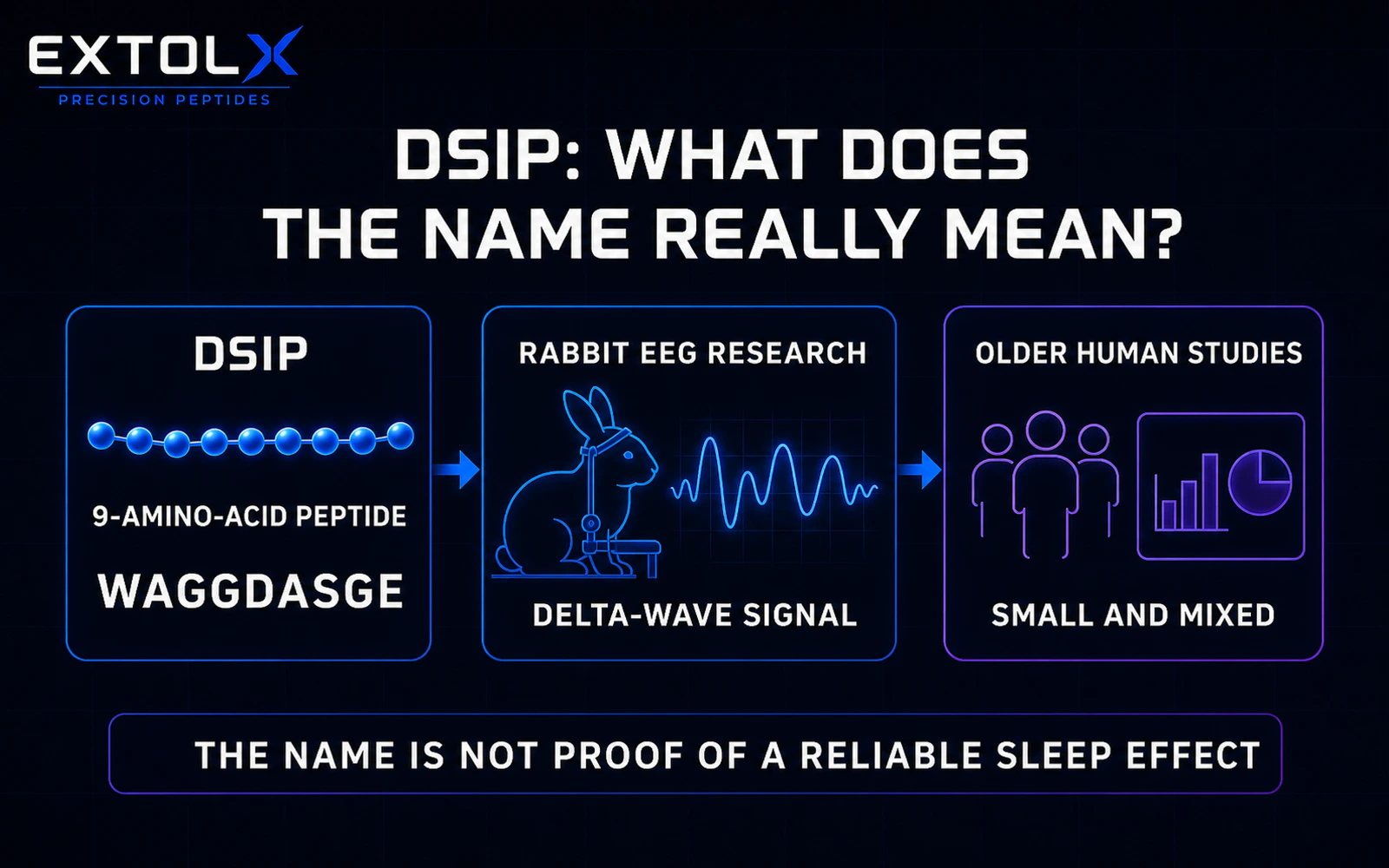
DSIP stands for delta sleep-inducing peptide. The name came from experiments in rabbits in the 1970s, where researchers connected a nine-amino-acid peptide with changes in slow-wave electrical activity recorded from the brain.
That history is often compressed into the much stronger claim that DSIP is a proven sleep peptide. The human research does not justify that conclusion. It is small, old and mixed.
The short version
- DSIP is the nine-amino-acid sequence Trp-Ala-Gly-Gly-Asp-Ala-Ser-Gly-Glu.
- Its name came from early rabbit EEG experiments, not from modern proof of a dependable human sleep effect.
- Animal studies investigated delta-wave activity, sleep patterns and related neurophysiology.
- Early human experiments involved very small groups and reported some changes in sleep measurements.
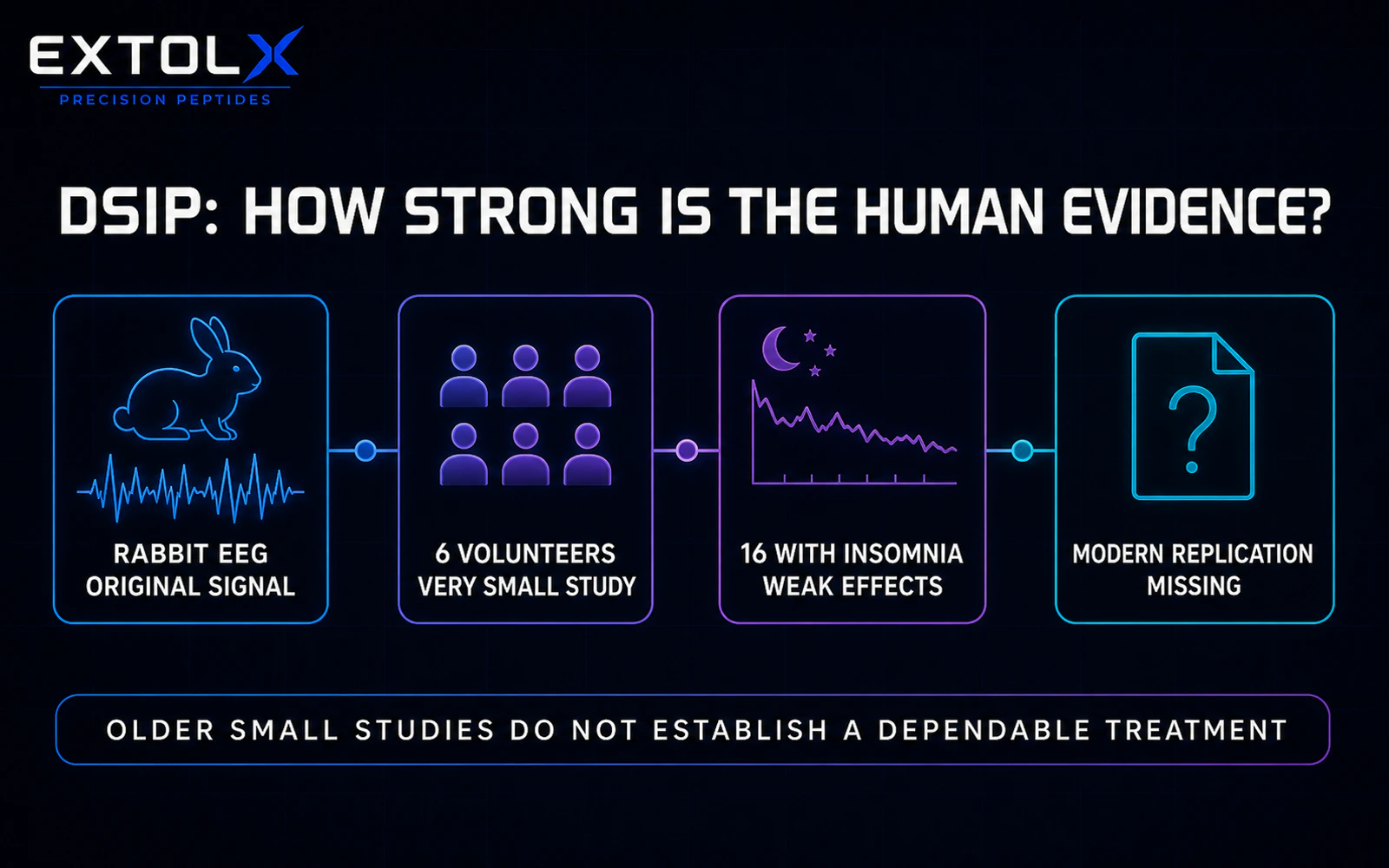
- A later double-blind study in 16 people with chronic insomnia found weak effects and concluded that major therapeutic benefit was unlikely.
- Older hormone studies explored ACTH and vasopressin signals, but they did not establish a single validated clinical mechanism.
- The published studies do not establish the safety or performance of independent DSIP research material.
On This Page
- The short version
- What is DSIP?
- Why does the name overstate what is known?
- What does the laboratory evidence show?
- What have animal studies found?
- What have human studies shown?
- Where do evidence-transfer mistakes happen?
- What remains unknown?
- What is the regulatory position?
- What about anti-doping rules?
- What would better research look like?
- Plain-English glossary
- Explore DSIP research material
- References and further reading
What is DSIP?
The practical point is that DSIP is a defined synthetic nonapeptide, meaning a chain of nine amino acids. Its sequence is Trp-Ala-Gly-Gly-Asp-Ala-Ser-Gly-Glu, or WAGGDASGE in one-letter code.
The original researchers isolated and characterised a peptide from rabbit experiments, then synthesised the same sequence and compared it with related fragments and analogues. Their reported EEG effect depended on the precise sequence and molecular form used in that experiment.
PubChem lists DSIP as C35H48N10O15, with a molecular weight of 848.8 g/mol. It records both 62568-57-4 and 69431-45-4 among the CAS identifiers associated with the compound. A registry number is a catalogue aid, not analytical confirmation of a vial.
Why does the name overstate what is known?
“Sleep-inducing” sounds like an established effect. In reality, it describes how the peptide entered the research literature.
Sleep is not one simple switch. Researchers measure electrical brain rhythms, time spent in different sleep stages, time taken to fall asleep, awakenings, total sleep time and how a person reports feeling. A change in one measurement does not prove a broad or dependable improvement.
The DSIP literature also includes experiments on hormone signals and stress-related physiology. Taken together, these studies suggest several research questions rather than one settled receptor-and-outcome pathway.
What does the laboratory evidence show?
The laboratory foundation is mainly chemical characterisation, synthesis and comparison of DSIP with related peptide sequences. These experiments helped define which molecular form was linked with the original rabbit EEG result.
They did not establish a single accepted human receptor target or show that every material carrying the DSIP name behaves identically. Sequence, stereochemistry, salt form, impurities and degradation can all affect an assay.
What have animal studies found?
The original rabbit work reported increases in delta and spindle EEG activity after the peptide was introduced directly into the experimental system. Follow-up animal studies examined sleep deprivation, learning tasks, hormone signals and DSIP analogues.
These findings are historically important, but experimental conditions matter. A peptide placed into or near the brain in an animal does not answer how an independent material would be absorbed, distributed or broken down in a person.
Results also varied between species and peptide analogues. That variability argues for careful molecular identification and independent replication rather than a general “sleep peptide” label.
What have human studies shown?
The practical point is that human evidence exists, but it is too small and inconsistent to establish DSIP as a reliable sleep treatment.
Six healthy volunteers
An early double-blind crossover experiment studied six healthy volunteers. It reported changes in immediate and later sleep measurements, but also noted that the pattern did not look like classic pharmacological sedation. Six people cannot define a dependable effect or safety profile.
Sixteen people with chronic insomnia
A later double-blind study included 16 people with chronic insomnia. Some objective measures favoured DSIP, but the authors described the effects as weak, noted that part of the difference could reflect a chance change in the placebo group, and concluded that major therapeutic benefit was unlikely.
Hormone measurements
Small crossover studies also examined ACTH, a pituitary hormone involved in the stress-response system, and vasopressin. Reported hormone changes are biological signals, not proof of better sleep or a clinical outcome.
Where do evidence-transfer mistakes happen?
- From the name to the outcome: “sleep-inducing” is not proof that DSIP reliably improves sleep.
- From EEG activity to restorative sleep: a brain-wave change is one measurement, not a complete clinical result.
- From animals to people: species, experimental route and exposure can change the response.
- From a tiny study to a general claim: six or 16 participants cannot establish effectiveness or uncommon risks.
- From one molecular form to another: sequence variants, analogues and degradation products are not interchangeable.
- From a study product to a catalogue vial: shared naming does not prove pharmaceutical or analytical equivalence.
What remains unknown?
Modern, adequately sized replication is missing. It remains unclear whether DSIP produces a consistent and clinically meaningful effect on sleep, which biological target would best explain any effect, and how different molecular forms or formulations behave.
Longer-term human safety, interactions, immune responses and uncommon adverse effects are also unresolved. Statements that a small early study found no obvious short-term problem cannot answer those questions.
What is the regulatory position?
The sources reviewed did not identify an authorised DSIP medicine with an established human sleep indication. The existence of an international non-proprietary name or older clinical experiments does not amount to current therapeutic approval.
Independent DSIP research material is not the same thing as a regulated medicine or the exact study material used decades ago.
What about anti-doping rules?
DSIP is not specifically named in the reviewed 2026 World Anti-Doping Agency Prohibited List. That does not establish permission. Section S0 covers pharmacological substances without current human therapeutic approval when they are not addressed elsewhere. Athletes and support personnel should check the current rules and obtain case-specific guidance.
What would better research look like?
- Confirm the exact sequence, stereochemistry, molecular form, purity and impurity profile of the study material.
- Define a plausible molecular target and show that the assay measures it specifically.
- Replicate animal EEG findings independently under modern reporting standards.
- Use adequately powered, preregistered human trials with objective and subjective sleep outcomes.
- Separate sleep-stage changes from next-day function and participant-reported benefit.
- Collect systematic safety, exposure and breakdown-product data.
Plain-English glossary
- Nonapeptide: a peptide made from nine amino acids.
- EEG: a recording of electrical activity measured at the scalp.
- Delta activity: slow electrical brain-wave activity often associated with deep sleep, but not a complete measure of sleep quality.
- Crossover study: a study in which the same participant receives more than one study condition at different times.
- ACTH: a pituitary hormone involved in signalling to the adrenal glands.
- Replication: repeating a study independently to see whether the finding is dependable.
Explore DSIP research material
The ExtolX DSIP 5MG research material is listed as the WAGGDASGE nonapeptide in a white to off-white lyophilised powder format, with a catalogue specification of at least 99%. A third-party Janoshik analytical certificate is linked from the live product page.
The product page lists CAS 62568-57-4, molecular formula C35H48N10O15, molecular weight 848.8 g/mol and SKU DS5. Published research on DSIP does not establish the safety or performance of the supplied ExtolX batch.
References and further reading
- DSIP identity and structure — PubChem
- DSIP sequence, synthesis and rabbit EEG activity — PubMed
- Six-person controlled human sleep experiment — PubMed
- Double-blind study in chronic insomnia — PubMed
- Randomised crossover ACTH study — PubMed
- DSIP, ACTH and vasopressin measurements — PubMed
- 2026 Prohibited List — WADA
Research-use notice: ExtolX materials are supplied strictly for legitimate laboratory research. They are not intended for human or veterinary use, consumption, diagnosis, treatment or prevention of disease.