
Evidence reviewed: 23 August 2026
Author: ExtolX Editorial Team
This is an educational overview of published research, not medical advice.
Cagrilintide is a synthetic, longer-acting version of amylin, a hormone normally released by the pancreas alongside insulin after food. Amylin helps the body coordinate post-meal signals, including messages linked with fullness and the movement of food through the stomach.
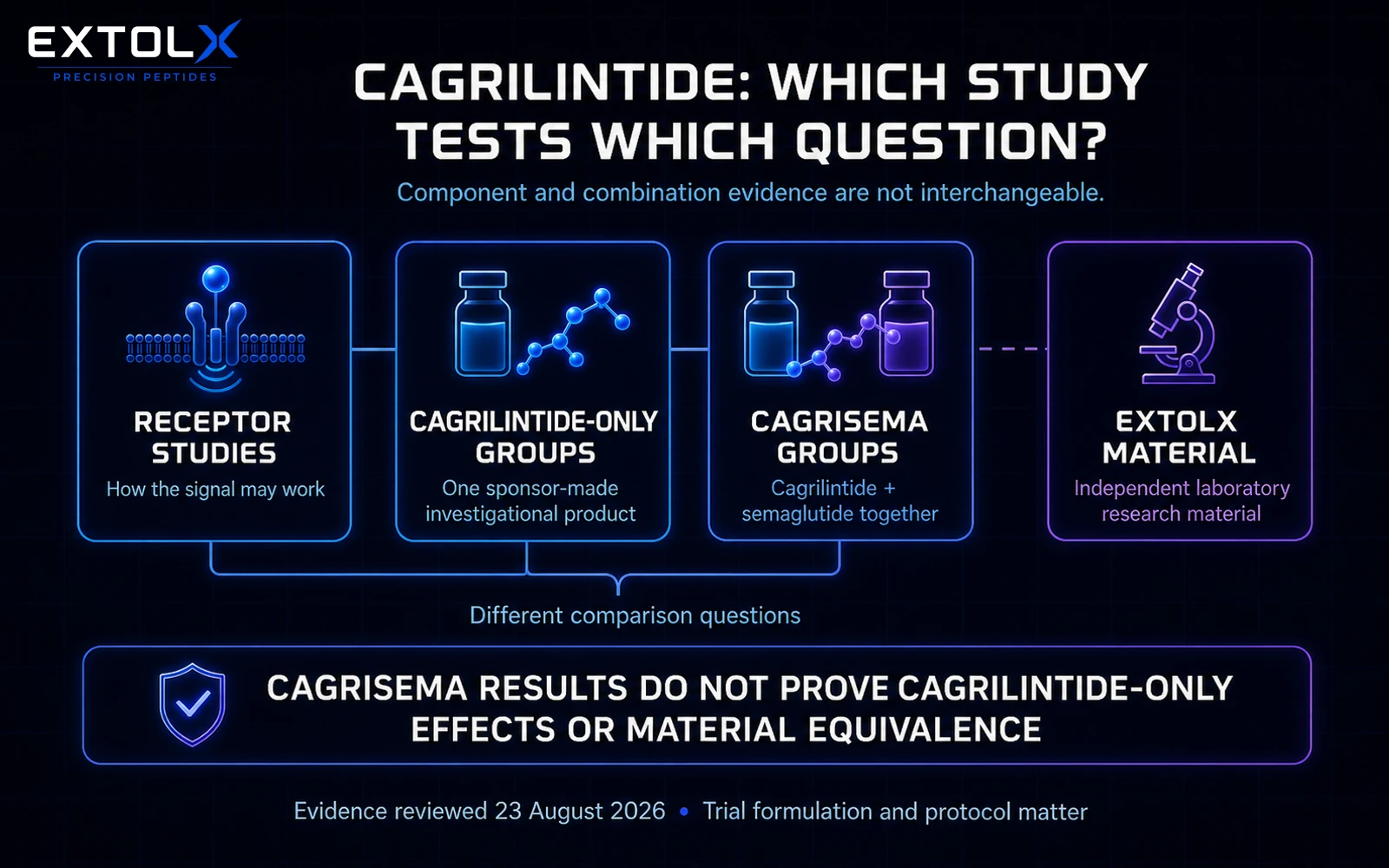
Human trials have studied cagrilintide on its own and together with semaglutide. Those are different research questions. A result for the combination—often called CagriSema—cannot be presented as a result for cagrilintide alone.
The short version
- Cagrilintide is a laboratory-designed analogue of the natural hormone amylin.
- It can activate amylin-receptor complexes and the calcitonin receptor in experimental systems.
- Animal research points to amylin receptors in the brain as an important part of its studied effects.
- Controlled phase 2 and phase 3 research has included cagrilintide-only groups.
- CagriSema combines cagrilintide with semaglutide, so its results cannot establish what either component does alone.
- Clinical findings apply to sponsor-manufactured investigational products, not independent research material.
On This Page
- The short version
- What is cagrilintide?
- What does natural amylin do?
- How might cagrilintide signal?
- What does the laboratory evidence show?
- What have animal studies added?
- What has human research found?
- Where do evidence-transfer mistakes happen?
- What remains unknown?
- What is the regulatory position?
- What about anti-doping rules?
- What would better research look like?
- Plain-English glossary
- Explore Cagrilintide research material
- References and further reading
What is cagrilintide?
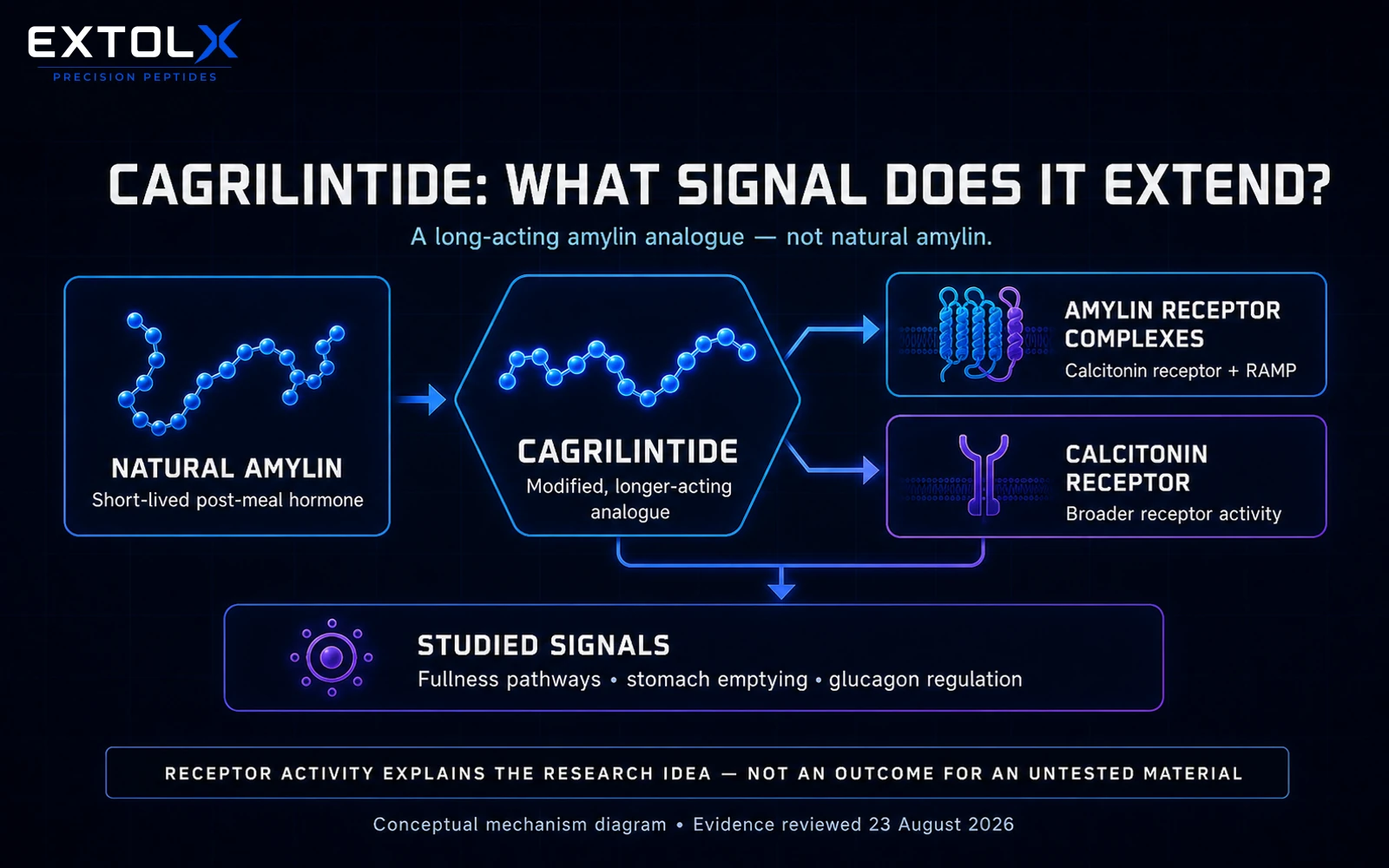
The practical point is that cagrilintide imitates part of a natural signalling system but is not natural amylin. Researchers changed the molecule to make its signal last much longer than the body’s short-lived hormone.
Cagrilintide has also been called AM833 and NN0174-0833 during development. It is sometimes described as a dual amylin-and-calcitonin receptor agonist. An agonist is a molecule that activates a receptor.
The development code or ingredient name does not identify a finished product’s formulation, manufacturing controls or impurity profile. Those details matter whenever findings are transferred from a clinical programme to another material.
What does natural amylin do?
Amylin is released from pancreatic beta cells at the same time as insulin. It contributes to the body’s response to food through several connected processes.
- It sends signals to brain regions involved in meal size and fullness.
- It can slow the rate at which food leaves the stomach.
- It helps regulate glucagon, a hormone involved in making stored energy available.
A synthetic analogue can activate parts of this system, but it does not reproduce every feature of the natural hormone’s release, timing and local concentration.
How might cagrilintide signal?
Amylin receptors are not single, standalone switches. They are complexes formed when a calcitonin receptor joins with one of several receptor-activity-modifying proteins, usually shortened to RAMPs. Different pairings produce different amylin-receptor subtypes.
Structural and cell-based studies indicate that cagrilintide can activate more than one amylin-receptor subtype and the calcitonin receptor. This helps explain why researchers describe it as having broader receptor activity than natural human amylin.
Its longer duration also matters. The molecule was modified so that it remains available for much longer than natural amylin. That design feature changes exposure, but does not by itself tell us whether a particular outcome will occur.
What does the laboratory evidence show?
Laboratory evidence supports receptor activation as the starting mechanism. Researchers have used engineered cells, receptor-binding experiments and structural methods to examine how cagrilintide interacts with amylin and calcitonin receptor systems.
A 2025 structural study reported cagrilintide bound to an amylin-receptor complex and to the calcitonin receptor. These experiments help map contact points between the peptide and its receptors. They do not show how a complete person will respond, because isolated receptor systems omit digestion, neural networks, behaviour and many compensating signals.
What have animal studies added?
Animal work has tested where the signal may act and which receptor subtypes are needed. In knockout mice lacking selected RAMP proteins, researchers found evidence that brain amylin receptors 1 and 3 contribute to cagrilintide-related changes in food intake and body weight.
Other preclinical work uses tool compounds because cagrilintide’s receptor behaviour and how long it remains active can differ across species. That is itself an important limitation: a molecule tested in a mouse is not operating in an identical receptor system to the one found in humans.
What has human research found?
Controlled human studies show that cagrilintide has been tested as a defined investigational medicine. They do not validate every material carrying the same name.
Cagrilintide on its own
A multicentre phase 2 dose-finding trial enrolled adults with obesity or overweight and related conditions but without diabetes. It compared several cagrilintide groups with placebo and an active comparator over 26 weeks.
The study reported greater average weight reductions with cagrilintide than with placebo across the tested groups. Digestive unwanted effects were common, and the trial was designed to select a research dose and inform larger studies—not to establish long-term outcomes.
REDEFINE 1 was a larger phase 3 trial involving 3,417 adults without diabetes. It included separate groups for CagriSema, semaglutide, cagrilintide and placebo. The cagrilintide-only group therefore provides evidence about sponsor-manufactured cagrilintide within that trial, while the combination group answers a different question.
Cagrilintide with semaglutide
CagriSema research tests two active molecules together. REDEFINE 1 and REDEFINE 2 reported changes in body weight and metabolic measurements with the combination in different populations.
Those results do not reveal how much of a combined outcome came from cagrilintide, semaglutide, an interaction between them or the complete study protocol. The only reliable way to test the combination is through trial groups designed to compare the complete combination with its individual components and an appropriate control.
Where do evidence-transfer mistakes happen?
- Natural hormone to analogue: Cagrilintide imitates amylin signalling but is chemically modified and remains active for much longer.
- Receptor activation to human outcome: Switching on a receptor in a cell experiment does not establish a clinical result.
- Animal response to human response: Receptor distribution and experimental conditions differ between species.
- Combination to component: A CagriSema result is not cagrilintide-only evidence.
- Trial medicine to research material: Clinical results depend on the sponsor’s molecule, formulation, manufacture, protocol and participants.
What remains unknown?
Longer controlled follow-up is needed to understand durability, what happens after exposure ends, uncommon unwanted effects and outcomes beyond changes in weight or laboratory measurements.
Questions also remain about how different amylin-receptor subtypes contribute in humans and whether broader calcitonin-receptor activity changes the balance of effects. Combination programmes need to show whether any interaction adds value beyond the individual components.
What is the regulatory position?
Cagrilintide has been developed as an investigational medicine both alone and as part of CagriSema. A clinical-development programme or regulatory submission should not be confused with authorisation, and the status of an investigational programme can change.
The ExtolX material is an independent laboratory research product. It is not a sponsor-manufactured trial product or an authorised medicine and is not supplied for human or veterinary use.
What about anti-doping rules?
Cagrilintide is not specifically named in the 2026 WADA Prohibited List. The List is non-exhaustive, categories can apply to unnamed substances and the rules are updated annually. Athletes and support personnel should obtain a current decision from the appropriate anti-doping authority rather than infer permission from the absence of a name.
What would better research look like?
- Long-term randomised trials with clinically meaningful outcomes.
- Direct comparisons between cagrilintide, established comparators and placebo.
- Combination studies containing cagrilintide-only, semaglutide-only, combination and control groups.
- Prespecified analyses that separate treatment effects from adherence and discontinuation.
- Independent replication and full reporting of unwanted effects.
- Analytical confirmation of the exact molecule and formulation used in every experiment.
Plain-English glossary
- Amylin: A hormone released with insulin after food that helps coordinate fullness and other post-meal signals.
- Analogue: A modified molecule designed to resemble part of a natural molecule’s activity.
- Agonist: A molecule that activates a receptor.
- RAMP: A receptor-activity-modifying protein that combines with another receptor and changes which signals it responds to.
- Investigational medicine: A defined product being studied but not automatically authorised for routine medical use.
- Active comparator: An established active treatment included as a comparison group.
- Combination trial: A study designed to test two or more active components together.
Explore Cagrilintide research material
The ExtolX Cagrilintide 5MG research material is listed as a white to off-white lyophilised powder with a catalogue specification of at least 99%. A third-party Janoshik analytical certificate is linked from the live product page.
This material is not the sponsor-manufactured cagrilintide used in clinical trials and is not the CagriSema combination. Shared naming does not establish pharmaceutical or formulation equivalence.
References and further reading
- Structural study of cagrilintide receptor activation — PubMed
- Cagrilintide and brain amylin receptors in mice — PubMed
- Preclinical tool compound for cagrilintide research — PubMed
- Cagrilintide phase 2 dose-finding trial — PubMed
- REDEFINE 1 trial with component and combination groups — New England Journal of Medicine
- REDEFINE 2 CagriSema trial — PubMed
- REDEFINE 1 registry record — ClinicalTrials.gov
- 2026 Prohibited List — WADA
Research-use notice: ExtolX materials are supplied strictly for legitimate laboratory research. They are not intended for human or veterinary use, consumption, diagnosis, treatment or prevention of disease.