Evidence reviewed: 24 August 2026
Author: ExtolX Editorial Team
This is an educational overview of the available identity information and evidence gaps, not medical advice.
Adamax is sold in parts of the research-material market as a peptide name. The central problem is that a reliable public primary-source record confirming its sequence and standardised molecular identity was not identified.
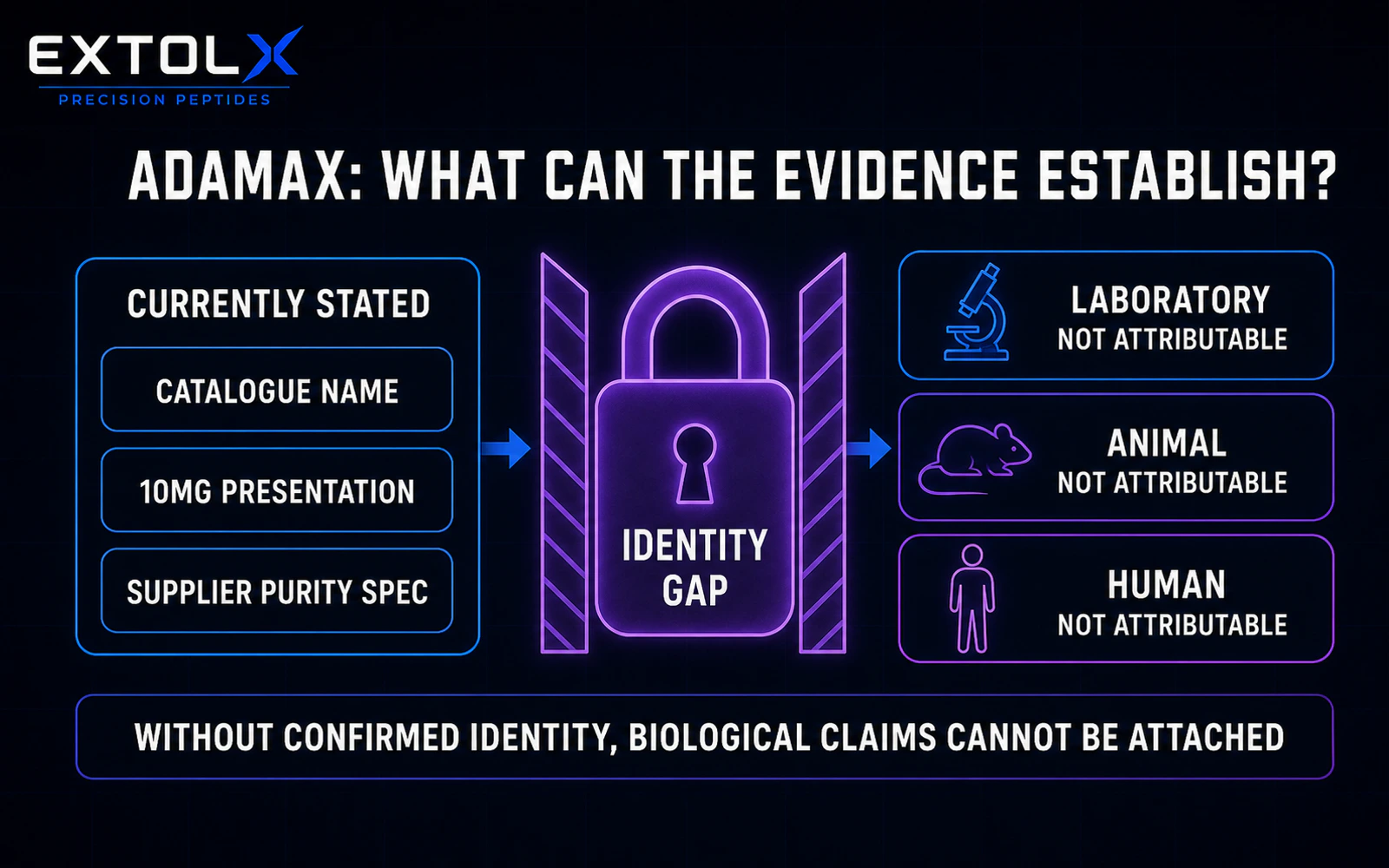
That changes what an evidence article can responsibly say. Without knowing exactly which molecule the name represents, published mechanisms, animal findings or human claims cannot be attached to it with confidence.
The short version
- “Adamax” is currently a supplier-defined catalogue name rather than a clearly standardised public scientific identity.
- No independently confirmed sequence, molecular formula, molecular weight or recognised reference standard was located for this profile.
- A purity percentage cannot identify an unknown molecule on its own.
- Without confirmed identity, mechanism claims are speculative.
- Laboratory, animal and human evidence cannot be matched reliably to the catalogue name.
- The next valid research step is analytical identity verification, not an outcome claim.
- The ExtolX product page therefore limits its research context to verification, method validation and batch comparison.
On This Page
- The short version
- What is Adamax?
- Why is molecular identity the first question?
- Can a “99% purity” statement prove identity?
- What does the laboratory evidence show?
- What animal evidence is available?
- What human evidence is available?
- Where do evidence-transfer mistakes happen?
- What remains unknown?
- What is the regulatory position?
- What about anti-doping rules?
- What would better research look like?
- Plain-English glossary
- Explore Adamax research material
- References and further reading
What is Adamax?
The honest answer is that the name is not enough to establish the molecule.
The live ExtolX catalogue describes Adamax 10MG as a supplier-defined lyophilised research material. It does not claim a confirmed amino-acid sequence, molecular formula, molecular weight or standardised scientific synonym.
This is different from a peptide such as KPV or DSIP, where a published sequence and recognised chemical record can be matched across primary literature and chemical databases.
Why is molecular identity the first question?
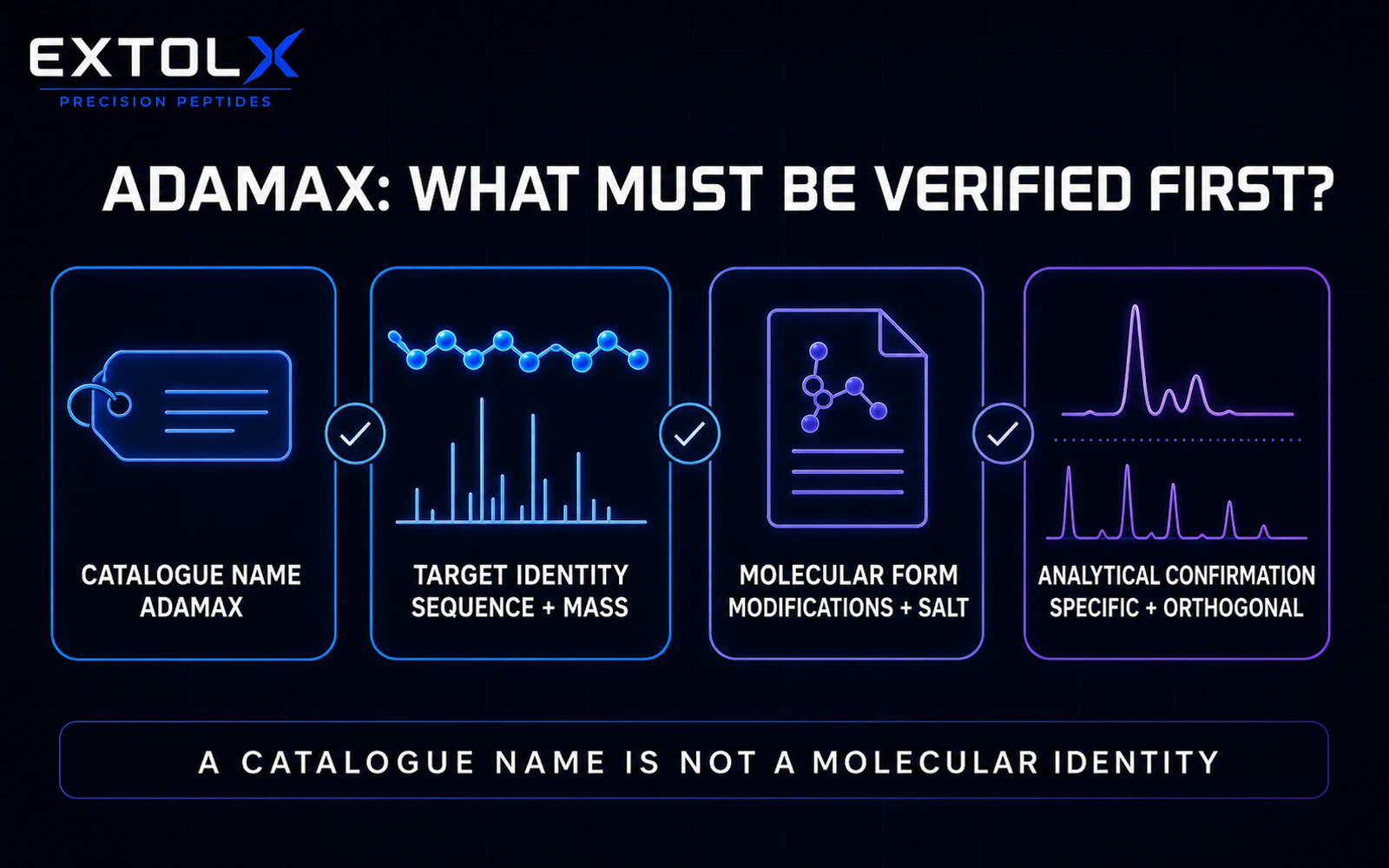
A mechanism belongs to a specific molecule. Changing a sequence, stereochemistry, chemical modification, salt or formulation can change how a material behaves in an assay.
For a peptide, a useful identity package would normally state the amino-acid sequence, expected molecular mass, relevant chemical modifications, counter-ion or salt information and an appropriate reference standard.
Analytical procedures then need enough specificity to distinguish that target from related compounds, impurities and breakdown products. The ICH Q2(R2) guideline explains that identification should use unique structural or other specific properties and may require more than one analytical principle.
Can a “99% purity” statement prove identity?
No. Purity and identity answer different questions.
A chromatographic purity result may estimate how much of the detected signal belongs to a main peak under a particular method. It does not, by itself, prove which molecule produced that peak.
Identity testing should discriminate the intended material from closely related structures. Depending on the molecule, that may involve mass spectrometry, sequence analysis, spectroscopy, comparison with a qualified reference and other orthogonal methods. The correct test plan can be designed only after a target identity has been defined.
What does the laboratory evidence show?
No biological laboratory finding can be assigned reliably to Adamax until the studied molecule and the catalogue material are both defined well enough to compare.
At present, the valid laboratory questions are analytical: what is the sequence or structure, does measured mass match the proposed identity, what impurities are present, and can the method distinguish related substances?
A positive assay performed on a differently defined material would not resolve the identity of this catalogue item.
What animal evidence is available?
No animal study can be matched confidently to a supplier-defined name without a confirmed molecular identity and study-material description.
Borrowing an animal result from another peptide, an assumed analogue or a similarly marketed name would create an evidence-transfer error.
What human evidence is available?
No attributable controlled human evidence was identified for a standardised molecule called Adamax.
Claims about memory, mood, sleep, performance, hormones or any other human outcome would therefore go beyond the evidence that can be verified. This profile does not repeat them.
Where do evidence-transfer mistakes happen?
- From a trade-style name to a sequence: a catalogue label does not define amino-acid order.
- From purity to identity: one clean-looking peak does not prove which molecule is present.
- From another peptide to Adamax: assumed family relationships cannot replace structural confirmation.
- From an online description to primary evidence: repeated marketing text is not an independent source.
- From a batch result to clinical meaning: chemical verification would not establish safety or a human outcome.
What remains unknown?
The sequence, molecular formula, molecular weight, stereochemistry, modifications, counter-ion, reference standard, impurity profile and biological mechanism remain unconfirmed in the public evidence reviewed.
Because identity comes first, questions about stability, how long the material remains intact, target binding, animal effects, human safety or outcomes cannot yet be answered responsibly.
What is the regulatory position?
No authorised human medicine can be matched to a standardised molecular identity called Adamax from the sources reviewed. Independent research material must not be presented as a medicine.
Regulatory classification ultimately depends on what the material actually is, how it is represented and the jurisdiction involved. An unresolved identity makes broad claims especially inappropriate.
What about anti-doping rules?
“Adamax” is not specifically named in the reviewed 2026 World Anti-Doping Agency Prohibited List. That is not clearance. The unknown identity prevents confident classification, and section S0 covers non-approved pharmacological substances not addressed elsewhere. Athletes and support personnel should not rely on a missing name and should obtain case-specific guidance.
What would better research look like?
- Obtain a complete supplier identity specification, including sequence, modifications and molecular form.
- Use an appropriate qualified reference material.
- Confirm identity with specific and, where needed, orthogonal analytical methods.
- Measure assay, purity, impurities and degradation products as separate attributes.
- Publish enough method detail for independent verification.
- Only after identity is established, design biological assays around a defined and justified research question.
Plain-English glossary
- Molecular identity: a precise definition of what a substance is, including its structure or sequence and relevant chemical form.
- Purity: an estimate of the main material relative to detected impurities under a stated method.
- Specificity: a method’s ability to measure or identify the intended material without confusing it with something else.
- Reference material: a well-characterised sample used for comparison.
- Orthogonal methods: different analytical approaches used together because they provide independent information.
- Mechanism: the molecular or biological process proposed to explain an observed result.
Explore Adamax research material
The ExtolX Adamax 10MG research material is listed as a white to off-white lyophilised material in a 10mg catalogue presentation, with SKU AX10 and a supplier specification of at least 99%.
The product page marks its certificate of analysis as pending and states that sequence and standardised molecular identity have not been independently confirmed. It does not assign mechanism-specific or disease-related claims to the material.
References and further reading
- Adamax 10MG catalogue identity and verification status — ExtolX
- Q2(R2) Validation of Analytical Procedures — US FDA
- Q2(R2) analytical validation guideline — ICH
- Q6A identity and specification principles — US FDA
- 2026 Prohibited List — WADA
Research-use notice: ExtolX materials are supplied strictly for legitimate laboratory research. They are not intended for human or veterinary use, consumption, diagnosis, treatment or prevention of disease.