
Evidence reviewed: 21 August 2026
Author: ExtolX Editorial Team
This is an educational overview of published research, not medical advice.
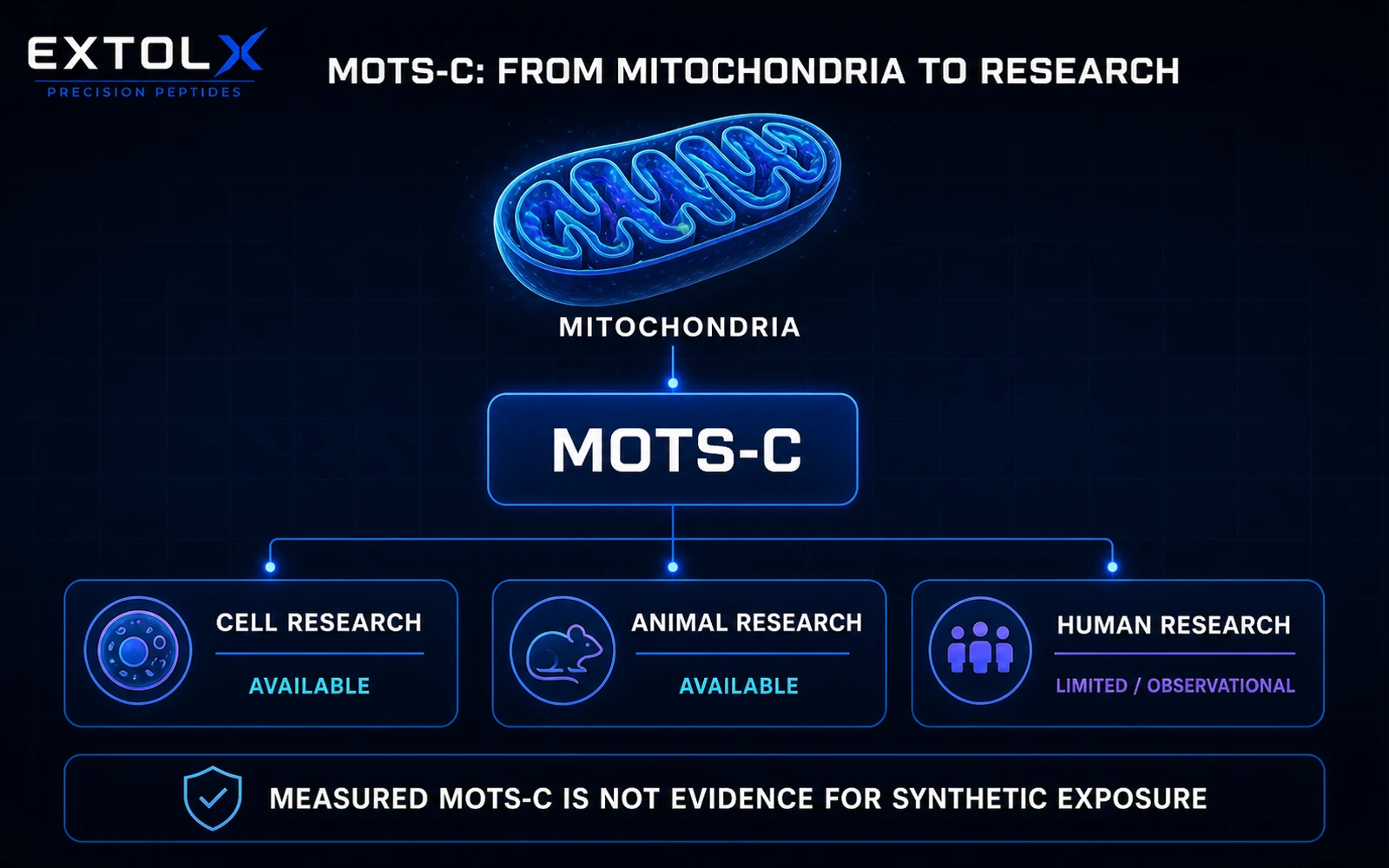
MOTS-c is a short peptide linked to mitochondrial genetic material. Cell and animal studies connect it with metabolic stress responses, but human research is mostly observational. Natural MOTS-c measurements in people do not show what externally supplied synthetic MOTS-c would do.
The short version
- MOTS-c is described as a 16-amino-acid mitochondrial-derived peptide.
- Laboratory and mouse studies explore metabolic adaptation and skeletal-muscle biology.
- Human studies mainly measure naturally occurring MOTS-c rather than test synthetic MOTS-c as an intervention.
- Measurement methods, sample handling and questions about the peptide’s source complicate comparisons between studies.
- No controlled human intervention trial of externally supplied MOTS-c was identified.
- An association between natural MOTS-c levels and health does not establish cause, benefit or the effect of synthetic exposure.
What is MOTS-c?
MOTS-c is a peptide made from 16 amino acids. It was reported to be encoded by a short open reading frame within the mitochondrial 12S ribosomal RNA region.
Mitochondria are best known for helping cells manage energy. They also contain a small amount of genetic material. The idea that this genetic material may encode signalling peptides has created a developing field of mitochondrial-derived peptide research.
The field is still resolving basic questions about where MOTS-c is produced, how it is measured and what circulating concentrations mean. Those questions matter before different studies can be compared confidently.
How might MOTS-c work?
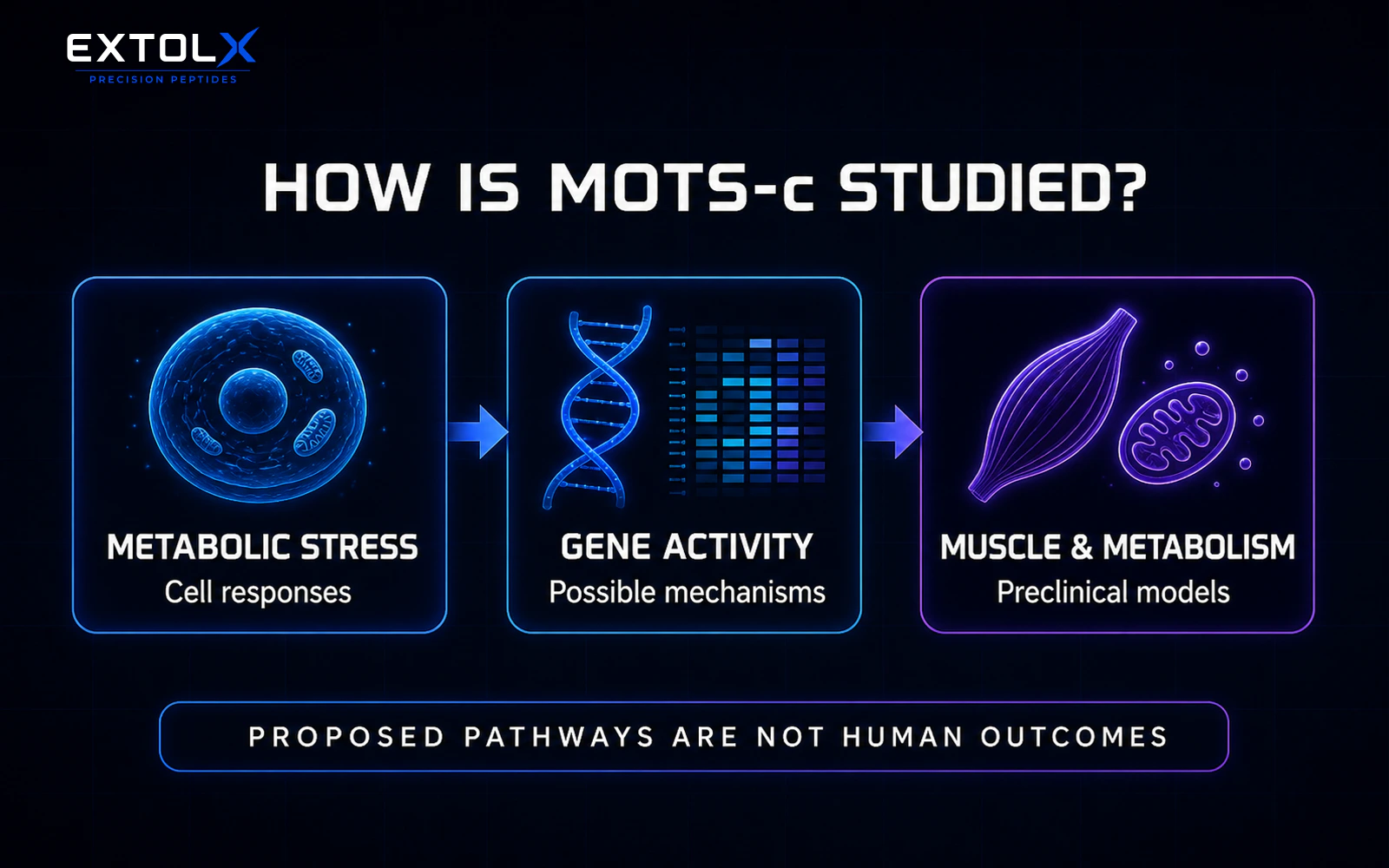
Preclinical work links MOTS-c with the way cells respond to metabolic stress. One proposed pathway involves folate metabolism, the molecule AICAR and AMPK, a cellular sensor that responds when energy availability changes.
Some studies also report that MOTS-c can affect gene activity in the cell nucleus. These findings provide testable mechanisms, but they do not establish what synthetic MOTS-c does in people.
What does the evidence show?
Laboratory research
Cell studies examine metabolic signalling, stress adaptation and changes in gene activity. These controlled systems help researchers test whether a proposed pathway responds to MOTS-c.
The results depend on the cell type, concentration and experimental conditions. They do not show a clinical outcome or define a safe human exposure.
Animal research
Mouse studies have explored metabolic adaptation, insulin sensitivity, physical activity and skeletal-muscle homeostasis. This is where many of the claims associated with MOTS-c begin.
Animal models can reveal a biological response and help choose measurements for human research. They cannot establish effectiveness or safety in people, and findings may depend on the specific model.
Human research
One small exercise study reported a trend in circulating MOTS-c after exercise. Later work has raised questions about the peptide’s biological source and how it is detected, which makes measurement findings harder to interpret.
Observational studies in obesity and diabetes have reported inconsistent relationships between measured MOTS-c and metabolic features. An observational association cannot show that MOTS-c caused the difference.
No controlled human intervention trial of externally supplied MOTS-c was identified. Human measurements of the body’s own MOTS-c therefore should not be presented as evidence for synthetic exposure.
| Evidence level | What is available | Main limit |
|---|---|---|
| Laboratory | Metabolic and gene-signalling studies | Controlled systems do not establish human outcomes |
| Animal | Several mouse metabolism and muscle studies | Model findings may not transfer to people |
| Human | Small or observational measurement studies | No controlled intervention evidence for synthetic MOTS-c |
Where are evidence-transfer mistakes made?
- From natural level to intervention: measuring the body’s own MOTS-c does not show what synthetic MOTS-c would do.
- From association to cause: a relationship with a health marker does not prove MOTS-c created that difference.
- From mouse metabolism to human benefit: a response in a specific model is not a clinical outcome.
- From one assay to certainty: different tests and sample-handling methods may produce results that are not directly comparable.
What remains unknown?
- How much measured MOTS-c comes from the proposed mitochondrial source.
- Which laboratory method provides reliable and comparable human measurements.
- Whether circulating MOTS-c is a cause, consequence or marker of metabolic change.
- How externally supplied MOTS-c behaves in humans.
- The human safety profile, meaningful outcomes and longer-term effects of synthetic exposure.
Regulatory context
Investigational; no MHRA-authorised MOTS-c medicine was identified. A research-use label does not override the way a product is presented, promoted or used. Safety information from one formulation or jurisdiction cannot be transferred automatically to another.
What would better research look like?
Progress begins with measurement. Independent laboratories should validate tests for identity, concentration and sample stability, then agree how specimens are collected and handled.
Human intervention research would need fully characterised material, a registered randomised protocol, suitable controls and predefined metabolic and safety outcomes. Measuring exposure over time would help connect the tested material with any observed response, followed by independent replication.
Plain-English glossary
- Mitochondria: Structures inside cells that help manage energy and contain a small amount of genetic material.
- Open reading frame: A stretch of genetic sequence that may contain instructions for making a peptide or protein.
- AMPK: A cellular sensor involved in responding to changes in energy availability.
- Endogenous: Produced naturally within the body.
- Exogenous: Supplied from outside the body.
- Observational study: Research that records existing differences without assigning an intervention.
- Assay: A laboratory test used to detect or measure a substance.
Explore MOTS-c research material
ExtolX MOTS-c 10MG is supplied as research material. Its identity and analytical documentation should be assessed separately from studies that measure naturally occurring MOTS-c.
References and further reading
- Review of mitochondrial-derived peptides and MOTS-c — PubMed
- MOTS-c and exercise-related research — PubMed
- Research examining the proposed source of MOTS-c — PubMed
Research-use notice: ExtolX products are supplied strictly for legitimate laboratory research. They are not intended for human or veterinary use, consumption, diagnosis, treatment or prevention of disease.