
Evidence reviewed: 21 August 2026
Author: ExtolX Editorial Team
This is an educational overview of published research, not medical advice.
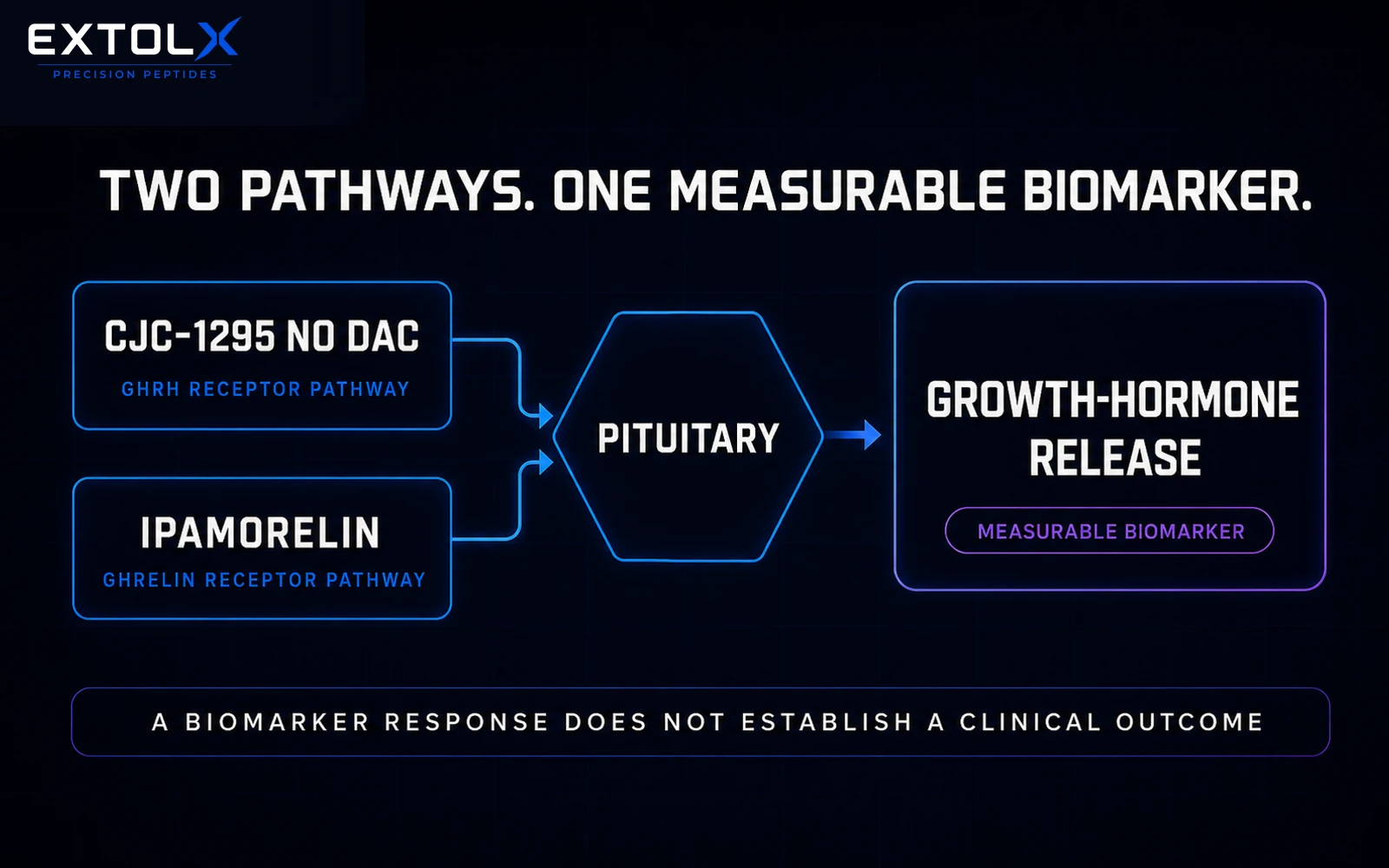
CJC-1295 No DAC and ipamorelin are combined because they send different signals that can both lead to growth-hormone release. That makes the blend interesting to study, but it does not prove that the combination is effective, safe or better than either peptide alone.
The short version
- CJC-1295-type peptides are altered versions of growth-hormone-releasing hormone, or GHRH.
- Ipamorelin can signal growth-hormone release through the ghrelin receptor, also called GHSR1a.
- The two receptor pathways can both lead to growth-hormone release from the pituitary gland.
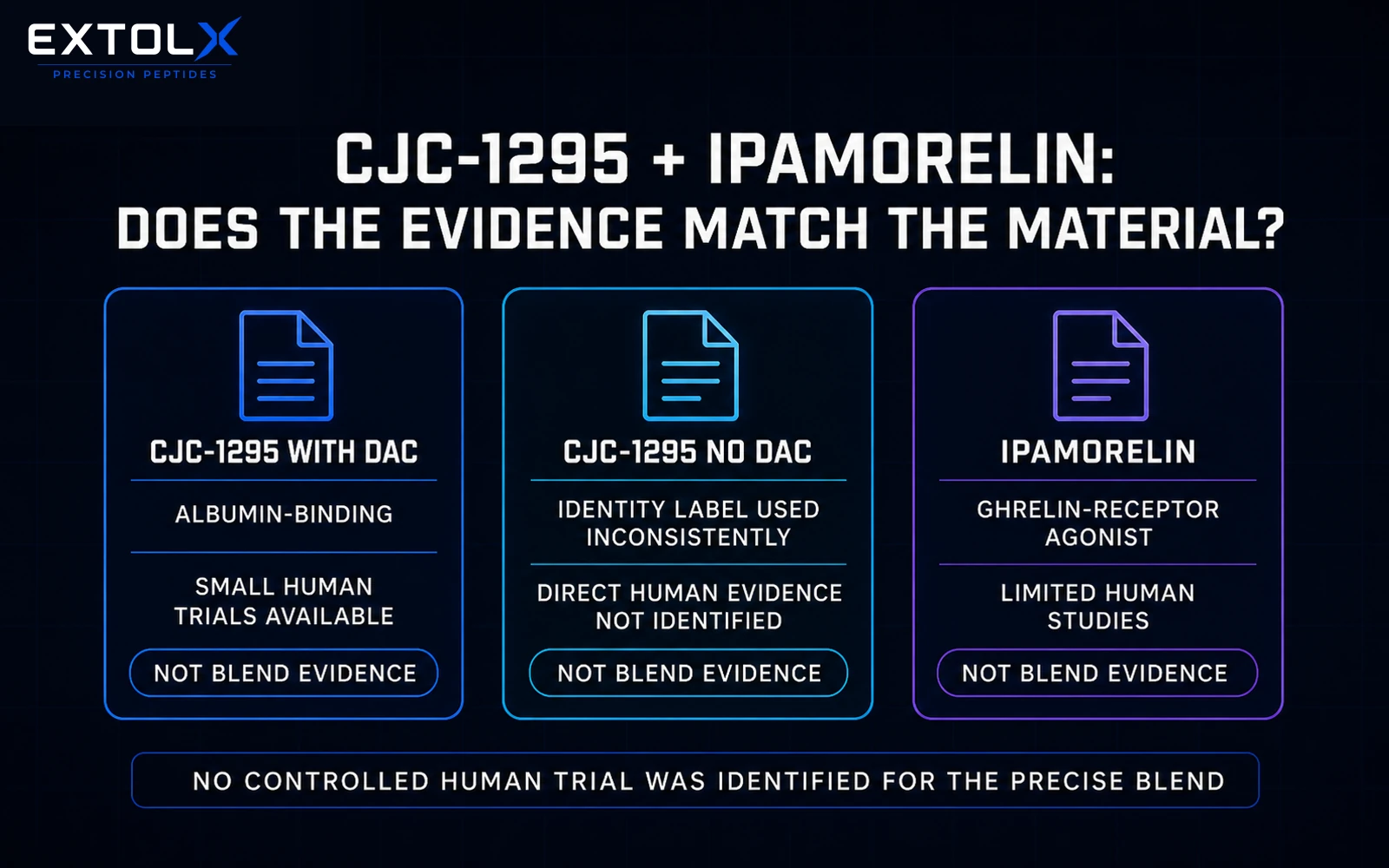
- The name “CJC-1295 No DAC” is used inconsistently and should not be treated as identical to albumin-binding CJC-1295 with DAC.
- Published human CJC-1295 trials studied the long-acting DAC molecule, not a marketed No-DAC blend.
- Controlled human evidence for the precise No-DAC plus ipamorelin combination was not identified.
What does “CJC-1295 No DAC” mean?
The original CJC-1295 used in published studies is a modified 29-amino-acid peptide. It includes a feature called DAC that attaches to albumin, a common blood protein. This helps the peptide remain in circulation for much longer.
Products labelled CJC-1295 No DAC leave out that albumin-binding feature. The name is not used consistently, so two products with the same label may not necessarily contain exactly the same peptide form. Researchers need analytical testing to confirm the sequence and chemical form of the material they are studying.
This difference matters. A study showing that CJC-1295 with DAC stays in the body for several days cannot tell us how long a No-DAC peptide will remain there.
What is ipamorelin?
Ipamorelin is a synthetic peptide made from five amino acids. It activates the ghrelin receptor—a different biological “message receiver” from the one targeted by CJC-type peptides. Early studies found that it could trigger growth-hormone release under specific test conditions, but that does not by itself prove a health benefit or establish safety.
One small study in healthy male volunteers measured how ipamorelin moved through the body and the brief rise in growth hormone that followed an intravenous infusion. A later Phase 2 study tested intravenous ipamorelin for slowed bowel function after surgery. Neither study tested the marketed blend discussed here.
Why are the two peptides combined?
The two peptides use different signalling routes, but both routes can reach cells in the pituitary gland that release growth hormone. Researchers can therefore ask whether using both signals together changes the size or timing of the hormone response.
That is a research question, not proof that the peptides work better together. A fair experiment needs four matching groups: a control, the CJC-type peptide alone, ipamorelin alone and the combination. A change in growth hormone or IGF-1 is a measurable biological sign, not automatic proof of a health, recovery or performance benefit.
What has human research found?
Albumin-binding CJC-1295
Two small randomised, placebo-controlled studies in healthy adults examined long-acting CJC-1295. They reported that growth hormone and IGF-1 remained raised for a time and estimated that the peptide stayed in circulation for days. Because the molecule was designed to bind albumin, these findings apply to CJC-1295 with DAC.
Ipamorelin
In healthy volunteers, larger measured amounts of ipamorelin were linked with larger growth-hormone responses after intravenous infusion. A later programme tested a specific intravenous formulation for slowed bowel function after surgery. FDA’s 2024 assessment concluded that available information did not adequately establish clinical effectiveness for nominated compounded ipamorelin uses and highlighted serious safety and characterisation concerns.
The No-DAC plus ipamorelin blend
Claims made about this blend go much further than the direct research. We did not identify a controlled human trial that clearly defined and tested this exact No-DAC CJC-1295 plus ipamorelin combination. Separate studies of the two ingredients cannot tell us how the mixture behaves in the body, whether it is safe or whether it produces a clinical effect.
Common evidence-transfer mistakes
- Using DAC data for No-DAC material: removing the albumin-binding group changes the peptide and how long it is expected to stay in the body.
- Treating a GH rise as a clinical outcome: growth hormone and IGF-1 are biomarkers, not proof of benefit.
- Combining separate studies: one CJC-1295 study plus one ipamorelin study does not equal a combination trial.
- Assuming the label proves identity: exact sequence, modification, salt form and content require analysis.
- Assuming two pathways guarantee synergy: the interaction has to be measured against the components alone.
What remains unknown?
- Which exact sequence is present in material labelled CJC-1295 No DAC?
- How long does it stay in a biological system compared with CJC-1295 with DAC?
- Do both components remain stable and measurable in the finished mixture?
- Does stimulating both receptors change the timing of growth-hormone release, or only the size of the measured response?
- What safety findings apply to repeated exposure to the defined blend?
- Can any proposed clinical effect be shown in a controlled study rather than inferred from biomarkers?
Regulatory and anti-doping context
No approved medicine is established by the product name CJC-1295 No DAC plus ipamorelin. FDA assessments of CJC-1295-related and ipamorelin-related bulk substances have highlighted limited clinical data, peptide characterisation, aggregation, impurity and immunogenicity concerns. Those reviews considered specific bulk substances and proposed compounded uses; they did not validate the commercial blend.
WADA’s 2026 Prohibited List includes GHRH analogues such as CJC-1295 and growth-hormone secretagogues such as ipamorelin. They are prohibited at all times in sport.
What could better research look like?
Better research would start by confirming exactly what the No-DAC component is. Studies could then compare CJC-1295 with DAC and the defined No-DAC peptide directly, including how long each remains in the body, rather than assuming that similar names mean similar behaviour.
Blend experiments should compare a control, each peptide alone and both together, with the main measurements decided in advance. Any later human research would also need consistent manufacturing, formal safety testing and regulatory oversight. Most importantly, it would need to test a meaningful outcome rather than assume that a larger hormone signal must be beneficial.
Plain-English glossary
- GHRH receptor: A receptor involved in signalling that can stimulate pituitary growth-hormone release.
- Ghrelin receptor: A different receptor that can also influence growth-hormone release.
- DAC: A drug-affinity-complex modification designed to bind albumin and extend circulation time.
- Biomarker: A measurable biological signal that is not necessarily a clinical outcome.
- Pharmacokinetics: How a substance moves into, through and out of a biological system.
Explore CJC-1295 No DAC and ipamorelin research material
ExtolX lists CJC-1295 (No DAC) + Ipamorelin 10MG research material. The product name does not establish equivalence with albumin-binding CJC-1295, an ipamorelin clinical-development product or any material used in a published study.
References and further reading
- Identification of albumin-binding CJC-1295 — PubMed
- Long-acting CJC-1295 healthy-adult trials — PubMed
- Ipamorelin pharmacokinetic and pharmacodynamic study — PubMed
- Ipamorelin Phase 2 postoperative-ileus study — PubMed
- FDA 2024 ipamorelin evidence review
- FDA 2024 CJC-1295 briefing document
- 2026 WADA Prohibited List
Research-use notice: ExtolX materials are supplied for laboratory research only and are not for human or veterinary use.