
Evidence reviewed: 21 August 2026
Author: ExtolX Editorial Team
This is an educational overview of published research, not medical advice.
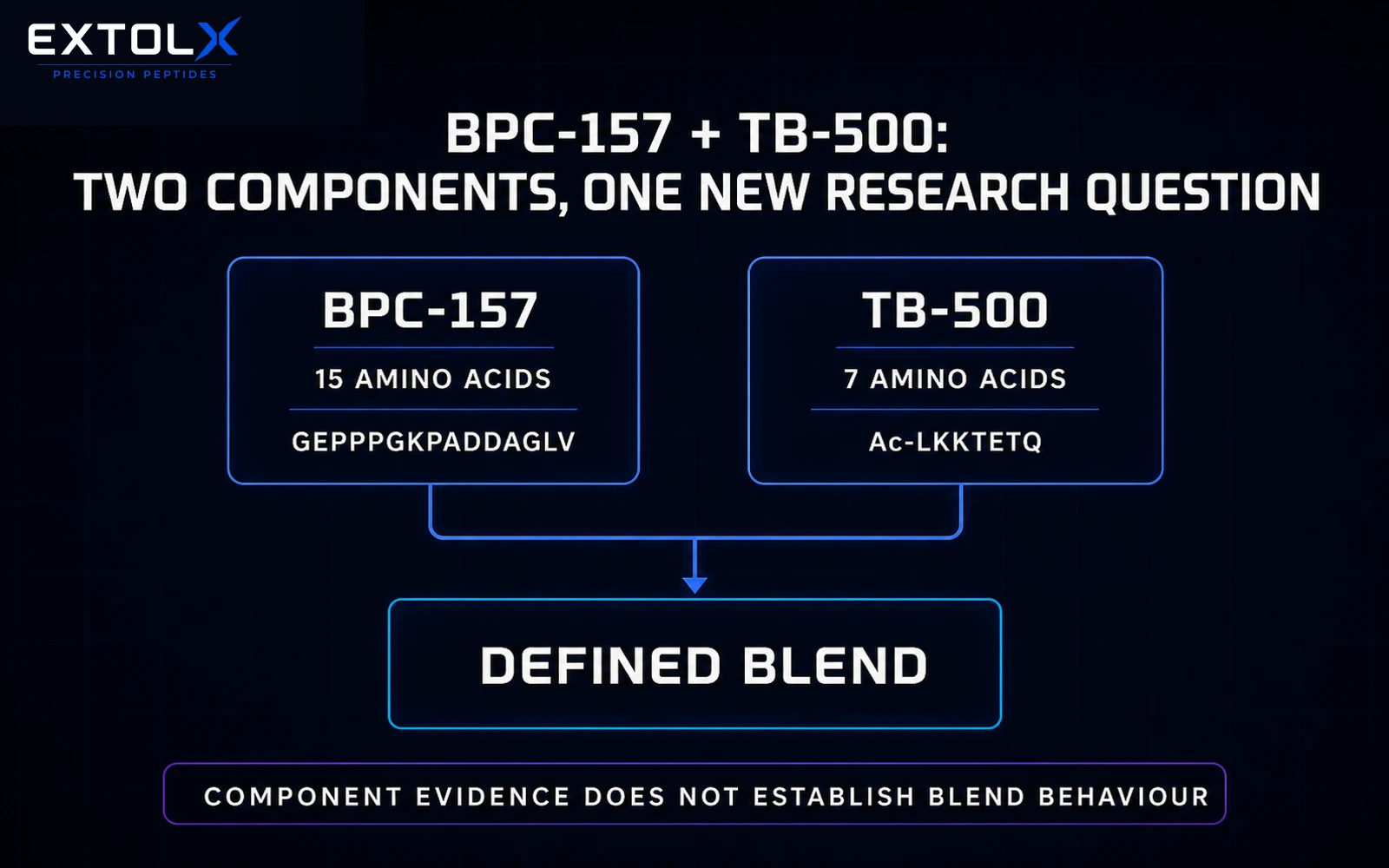
This blend puts two different research peptides—BPC-157 and TB-500—into one product. Studying each peptide separately cannot tell us how the mixture behaves or whether combining them makes any measured effect stronger, weaker or unchanged.
The short version
- BPC-157 is a synthetic 15-amino-acid peptide; TB-500 is an acetylated seven-amino-acid fragment associated with residues 17–23 of thymosin beta-4.
- The two components have different sequences, proposed pathways and evidence bases.
- Most BPC-157 biological evidence is preclinical, and published human evidence remains very limited.
- Direct evidence for the TB-500 fragment is thinner still; full-length thymosin beta-4 research is not direct TB-500 evidence.
- No controlled human evidence was identified for the defined BPC-157 plus TB-500 combination.
- A blend requires its own identity, stability, compatibility and biological testing.
What is in the blend?
BPC-157 is a short chain of 15 amino acids with the sequence GEPPPGKPADDAGLV. Laboratory and animal studies have looked at how it may affect cell movement, cell attachment, blood-vessel signals and experimental injuries. These early findings do not show one confirmed effect in people.
TB-500 is a seven-amino-acid fragment with the sequence Ac-LKKTETQ. It matches part of a much larger 43-amino-acid peptide called thymosin beta-4, but it is not the complete molecule. Research on full-length thymosin beta-4 therefore cannot automatically be treated as TB-500 research.
A product label is only a starting point. Researchers still need to confirm which forms of the two peptides are present, how much of each is included and how pure they are. Both peptides must also be measurable in the finished blend.
Why are they combined?
The idea behind the blend is simple. BPC-157 and thymosin-beta-4-related peptides have been studied in different laboratory pathways, so researchers may want to observe them in the same experiment. That gives researchers a question to test—it does not provide the answer.
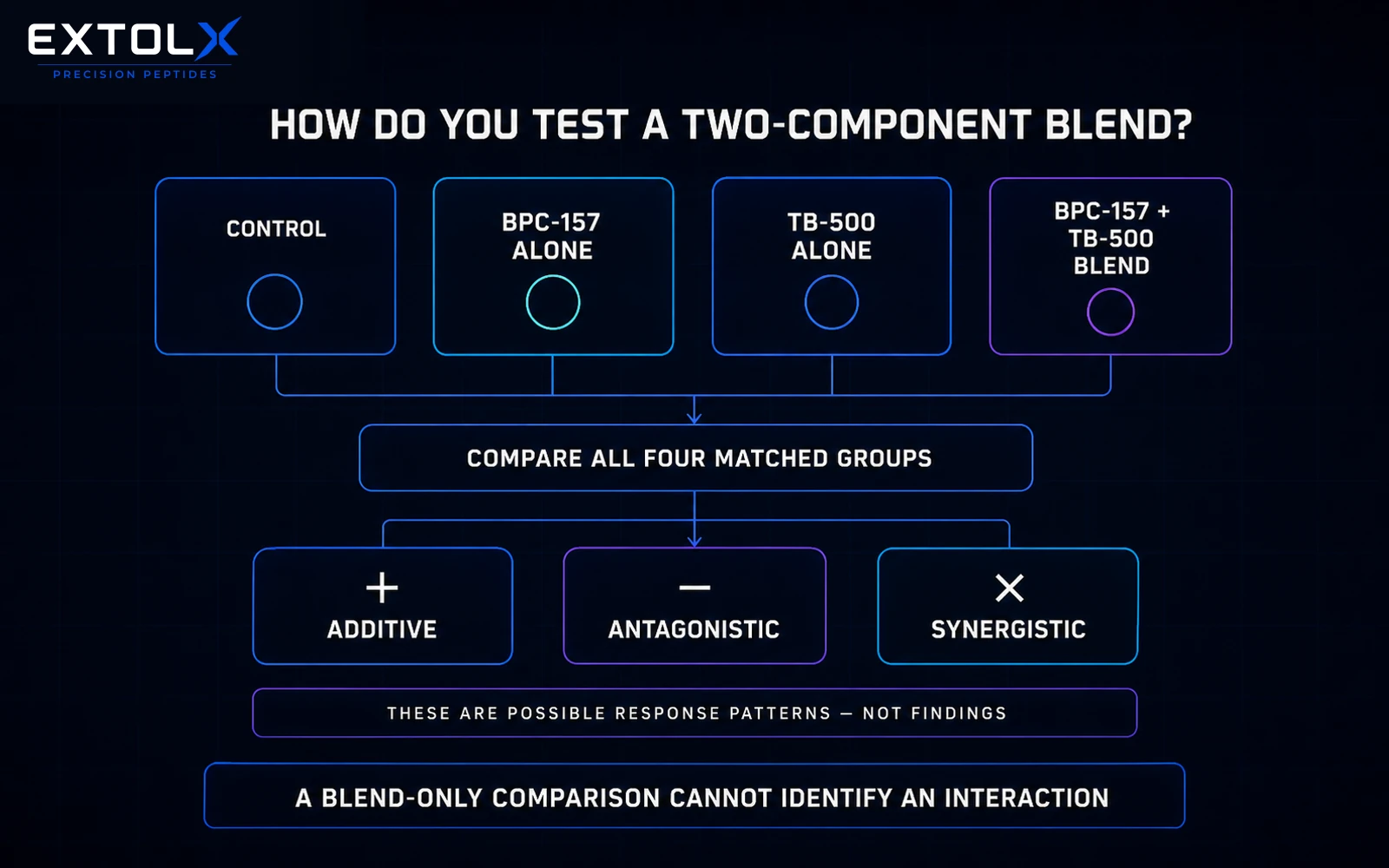
In research, synergy means the blend produces a response greater than researchers would expect from the two components separately. To test that properly, one experiment needs four matching groups: a control, BPC-157 alone, TB-500 alone and the blend.
What does the evidence show?
BPC-157 evidence
BPC-157 has an extensive animal literature compared with its human literature. Cell and tissue experiments report changes in migration, survival and signalling under defined conditions, while rodent studies cover several deliberately created injury models. A 2026 translational review found fewer than 30 participants across three published human reports and emphasised the lack of a validated pharmaceutical formulation and well-developed clinical programme.
TB-500 evidence
Much of the literature commonly cited for TB-500 actually concerns full-length thymosin beta-4. Fragment-specific publications include chemical identification, metabolism and anti-doping detection research. In its July 2026 assessment, the US FDA reported that it had not identified human exposure data for drug products containing the thymosin-beta-4 fragment known as TB-500.
Combination evidence
A targeted literature review did not identify a controlled human trial of a defined BPC-157 plus TB-500 blend. Component studies cannot fill that gap. Even if each component produced a reproducible result separately, the mixture could change solubility, stability, recovery during analysis or the concentration available to a biological system.
Why blend-specific testing matters
A blend has to be studied as a product in its own right. Researchers need to check that both peptides can still be identified and measured after they are mixed, stored and used in an experiment. Laboratory methods can then test purity, content and whether either peptide breaks down over time.
Comparing only the blend with an untreated control is not enough. Researchers also need a group for each peptide on its own. Otherwise, they cannot tell which component is linked with a response or how the mixture changes their separate effects.
What remains unknown?
- Whether BPC-157 and Ac-LKKTETQ remain chemically stable when stored and tested together.
- Whether either component changes the other’s solubility, aggregation or analytical recovery.
- Whether any blend-specific effect can be reproduced independently.
- Whether a measured interaction is additive, antagonistic or synergistic.
- How a defined mixture is absorbed, distributed and broken down in an appropriate model.
- Whether any proposed use could be supported by controlled human research.
Regulatory and anti-doping context
Neither BPC-157 nor TB-500 is an approved medicine. FDA’s July 2026 pharmacy-compounding review considered the substances separately and highlighted characterisation, impurity, aggregation and immunogenicity gaps; it did not validate their combination.
For sport, WADA’s 2026 Prohibited List includes BPC-157 within non-approved substances and prohibits thymosin beta-4 and its derivatives, including TB-500. Combining prohibited components does not alter that position.
What could better research look like?
A useful first study would fully characterise the mixture and compare four matched conditions: vehicle control, BPC-157 alone, TB-500 alone and the blend. Concentrations, exposure time and the primary endpoint should be chosen in advance. Replication should use a second preparation and an independent laboratory.
If repeated experiments found a consistent interaction, later studies would still need to examine how the exact blend behaves. They would also need to test its stability and address safety questions. Evidence about either peptide alone would remain useful background, but it could not replace research on the mixture itself.
Plain-English glossary
- Component: One of the individual substances in a mixture.
- Additive: A combined response consistent with the contributions of the separate components.
- Synergy: A combined response greater than a defined prediction from the components alone.
- Antagonism: An interaction in which one component reduces the measured response of another.
- Factorial design: A study that tests each component alone and together so their contributions can be separated.
Explore BPC-157 and TB-500 research materials
ExtolX lists BPC-157 + TB-500 10MG and BPC-157 + TB-500 20MG research materials. Researchers should request and assess the analytical documentation for the finished mixture rather than infer its identity or behaviour from the component names.
References and further reading
- 2026 review of BPC-157 translation and formulation barriers — PubMed
- BPC-157 tendon-explant and fibroblast study — PubMed
- Synthesis and characterisation of the TB-500 fragment — PubMed
- Anti-doping analysis of TB-500 — PubMed
- FDA 2026 BPC-157 and TB-500 evidence reviews
- 2026 WADA Prohibited List
Research-use notice: ExtolX materials are supplied for laboratory research only and are not for human or veterinary use.