
Evidence reviewed: 21 August 2026
Author: ExtolX Editorial Team
This is an educational overview of published research, not medical advice.
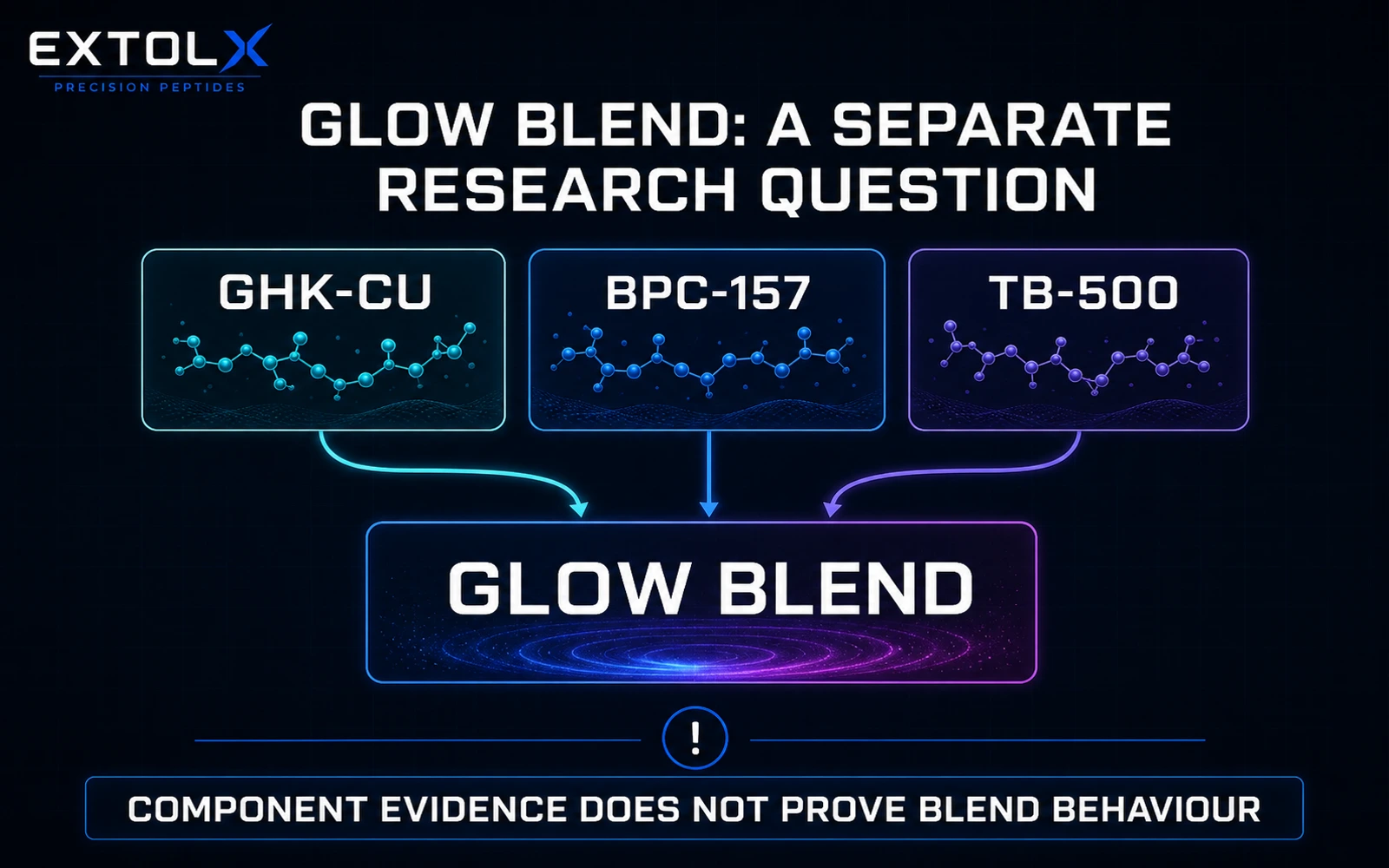
Glow is a research blend containing GHK-Cu, BPC-157 and TB-500. Each component has its own evidence base, but combining them creates a new mixture whose stability and biological behaviour must be tested directly.
The short version
- GHK-Cu, BPC-157 and TB-500 are different molecules studied for different reasons.
- Most component evidence comes from laboratory or animal research.
- Human findings for one component cannot be applied automatically to the other components or the complete blend.
- Full-length thymosin beta-4 research is not direct evidence for the shorter TB-500 fragment.
- No controlled human trial of the defined three-component Glow blend was identified.
- Testing a three-component interaction properly requires the components alone, their pairwise combinations, the complete blend and a control.
What is a peptide blend?
A peptide is a short chain of amino acids. A blend places two or more peptides in the same research material.
Researchers may combine substances to ask whether their signals interact. The important word is ask. Mixing three compounds does not prove they support one another, remain stable together or produce a stronger result.
What is in Glow?
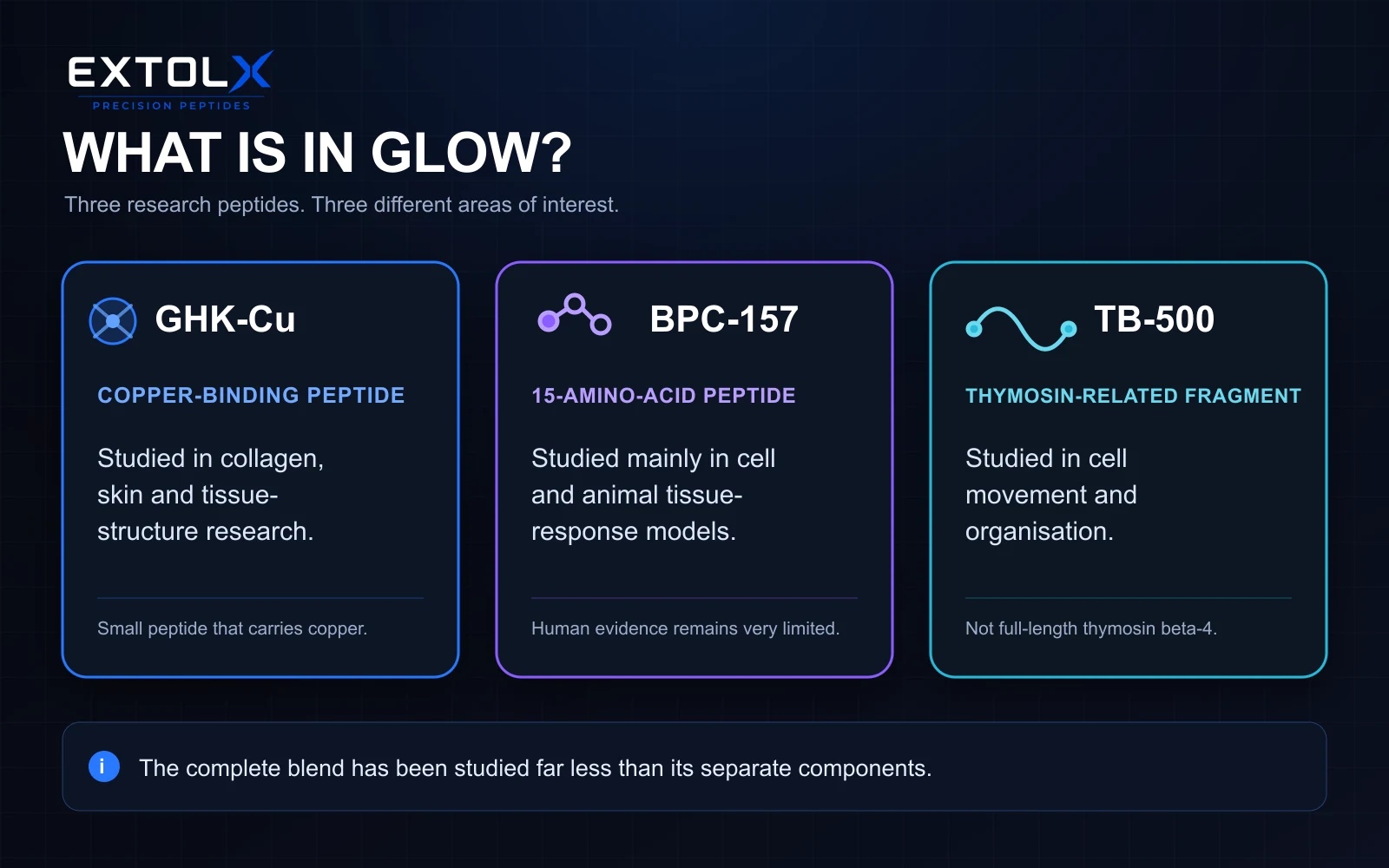
GHK-Cu
GHK is a peptide made from three amino acids. When it binds copper, it forms the complex known as GHK-Cu.
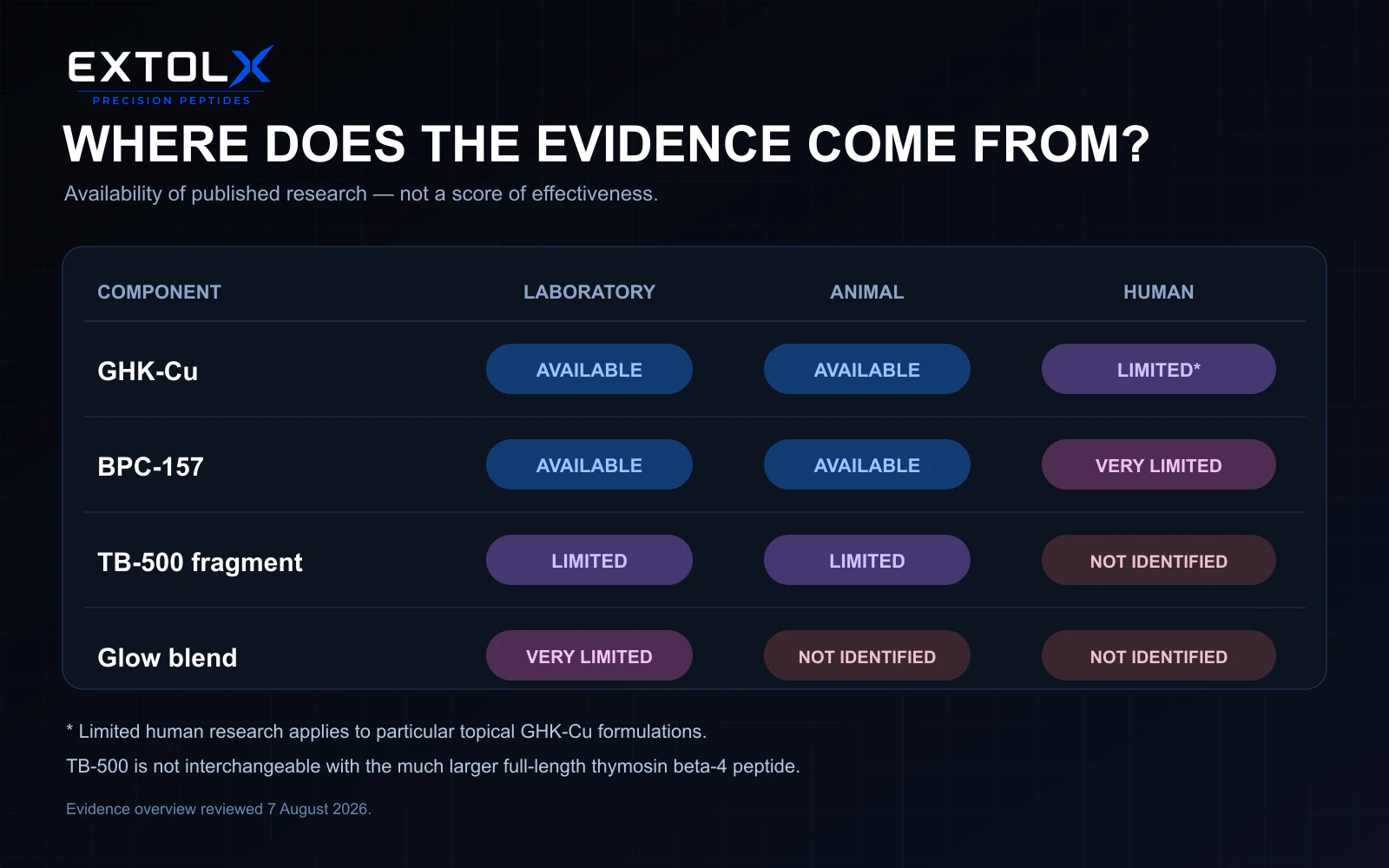
Laboratory research has examined collagen, copper handling and the supporting material around cells. Animal research also exists, while human findings are limited mainly to particular topical formulations. Evidence depends on the exact formulation and cannot be transferred automatically to a different material.
Read the plain-English GHK-Cu research guide.
BPC-157
BPC-157 is a laboratory-made peptide containing 15 amino acids. Studies have examined cell movement, blood-vessel signals and responses to deliberately created injuries in animals.
Published human evidence remains very small and cannot establish a medical benefit. Interesting results in cells or rodents do not show that the same effect will occur in people or in a three-component blend.
Read the plain-English BPC-157 research guide.
TB-500
TB-500 is the name used for a synthetic seven-amino-acid fragment related to thymosin beta-4. It is not the complete 43-amino-acid thymosin beta-4 molecule.
Much of the frequently cited research concerns full-length thymosin beta-4 and its interaction with actin, a protein involved in cell shape and movement. That work provides background biology, not direct evidence for the shorter TB-500 fragment.
Read the TB-500 and thymosin beta-4 guide.
Why is the blend a separate research question?
The components have different sequences, chemical properties and evidence bases. Placing them together may change how easily each peptide dissolves, how stable it remains and how reliably it can be measured.
A blend could produce a response similar to the components added together, a smaller response, a larger response or no clear response. Researchers cannot know which without testing the mixture against suitable comparison groups.
What does the evidence show?
Laboratory evidence
Each component has been studied separately in laboratory systems. Those experiments help identify possible pathways and measurements, but they do not show how the complete Glow blend behaves.
Animal evidence
GHK-Cu and BPC-157 have been examined in several animal tissue models. Full-length thymosin beta-4 also has an animal literature, but direct evidence for the TB-500 fragment is much thinner. No animal result for one component establishes a result for the complete blend.
Human evidence
Some human work concerns specific topical GHK-Cu formulations. Human BPC-157 evidence remains very limited, and controlled human evidence for the TB-500 fragment has not been established. No controlled human trial of the defined Glow blend was identified.
Common evidence-transfer mistakes
- Component to blend: a result for one peptide does not establish how the mixture behaves.
- Full-length peptide to fragment: thymosin beta-4 evidence is not direct TB-500 evidence.
- Laboratory to human: a cell response is not proof of a clinical outcome.
- Product name to identity: the label does not replace analysis of sequence, content, purity and stability.
- Multiple pathways to synergy: different proposed pathways do not prove that the components work better together.
What remains unknown?
- Whether all three components remain stable in the same stored mixture.
- Whether one component changes the solubility or measurement of another.
- Whether the complete blend produces a repeatable response beyond the components alone.
- Whether any interaction is additive, weaker than expected or greater than expected.
- Which findings can be repeated by independent laboratories.
- Whether any proposed use can be supported by controlled human research.
What would a useful blend study look like?
A complete three-component comparison needs eight matching groups: a control; each of the three components alone; each of the three possible two-component combinations; and the full three-component blend. This design allows researchers to separate the contribution of each component and test interactions.
The study should confirm the identity, amount and stability of every component before and after the experiment. Outcomes and analysis methods should be chosen in advance, followed by replication with a second preparation and an independent laboratory.
Plain-English glossary
- Component: One individual substance in a mixture.
- Blend: A research material containing more than one component.
- Actin: A protein that helps cells keep their shape and move.
- Additive response: A combined result consistent with the separate components.
- Synergy: A result greater than a defined prediction based on the components alone.
- Interaction: A change in one component’s measured effect when another component is present.
Explore Glow research material
The ExtolX Glow 70MG research blend contains GHK-Cu, BPC-157 and TB-500. Researchers should assess the analytical documentation for the finished mixture rather than infer its identity or behaviour from the component names.
References and further reading
- GHK-Cu and collagen research — PubMed
- GHK-Cu regenerative and protective research review — PubMed
- BPC-157 musculoskeletal research review — PubMed
- Characterisation of the TB-500 fragment — PubMed
- Thymosin beta-4 and actin research — PubMed
Research-use notice: ExtolX materials are supplied for laboratory research only and are not for human or veterinary use.